Learning from the crumb
You cut a loaf and see a large cavity near the top, with a tighter band below it. The temptation is to name the cause immediately: too much yeast, too little kneading, too much water. Yet the slice records an outcome, not a complete history. Several histories can produce a similar appearance. Learning to bake means making that history observable enough to choose a useful next step.
This final chapter brings the course together through a two-attempt notebook. You will define a target, preserve a baseline, describe the result and test one justified adjustment. The purpose is not to turn a home kitchen into a laboratory with perfect controls. It is to make your reasoning more reliable than a succession of guesses disguised as experience.
Begin with a description that another person could recognize
Crumb is the interior structure of a baked product, especially the arrangement of cells and the material around them. Describe where you are looking: a central bread slice, the middle of a cake layer, the base of a biscuit. A cross-section through one location is a sample, not a transparent view of the entire product.
Separate visible features from interpretations. “A single large cavity lies beneath the upper crust” is a description. “The yeast was too active” is a proposed explanation. “The bread is ruined” adds a judgment about usefulness. Each may belong in a notebook, but they should not be collapsed into one sentence that makes the cause sound directly observed.
Include texture and timing when you can safely assess the fully cooked, appropriately cooled product. A photograph cannot tell you how much force it takes to bite a pastry or whether a bread slice feels resilient. A warm slice and a next-day slice are also different observations. State when the comparison occurred and how the product was stored.
Use a consistent cut and camera arrangement for successive attempts. Place a ruler nearby if size matters, without implying that perspective has disappeared. Keep the camera approximately perpendicular to the cut face and preserve the original image. A dramatic angle or changing magnification may make a loaf look larger without providing better evidence.
Decide what counts as success for this product
An open, irregular crumb can be welcome in one bread and inconvenient in a sandwich loaf intended to hold a spread. A fine, even cake crumb is not inferior because it lacks the holes of a baguette. The target comes from the product's purpose and formula, not from the most striking image you have seen online.
Likewise, height is only one dimension of success. A taller product may have an undesirable cavity, a fragile center or a texture you dislike. A lower loaf in a wider pan may be entirely satisfactory. Evaluate the property you actually want instead of allowing one easily photographed feature to stand in for the whole result.
Write two or three observable criteria before the second attempt. For a sandwich loaf, these might include a fully set central crumb, slices that hold together and a reasonably even shape in the specified pan. For a tart shell, they might include an intact wall, a cooked base and a tender fracture. Keep safety and complete cooking requirements separate from optional preferences about color or sweetness.
Use photographs with their process records
Barb Alpern's published autolyse comparison provides an external example. In its first four-loaf panel, labeled cross-sections show different cell patterns; the photograph of the mix-and-pause loaf reveals both larger holes and finer surrounding crumb. The article also records incorporation difficulties and varying results across its trials. Read the labels and method alongside the images.
Those photographs are the publisher's baking observations, not trials performed for this course. They do not establish that one rest schedule is universally best. A photograph cannot recover unrecorded handling differences or turn a small kitchen comparison into a precise population estimate. The useful lesson is to connect visible evidence with a documented process and its limitations.
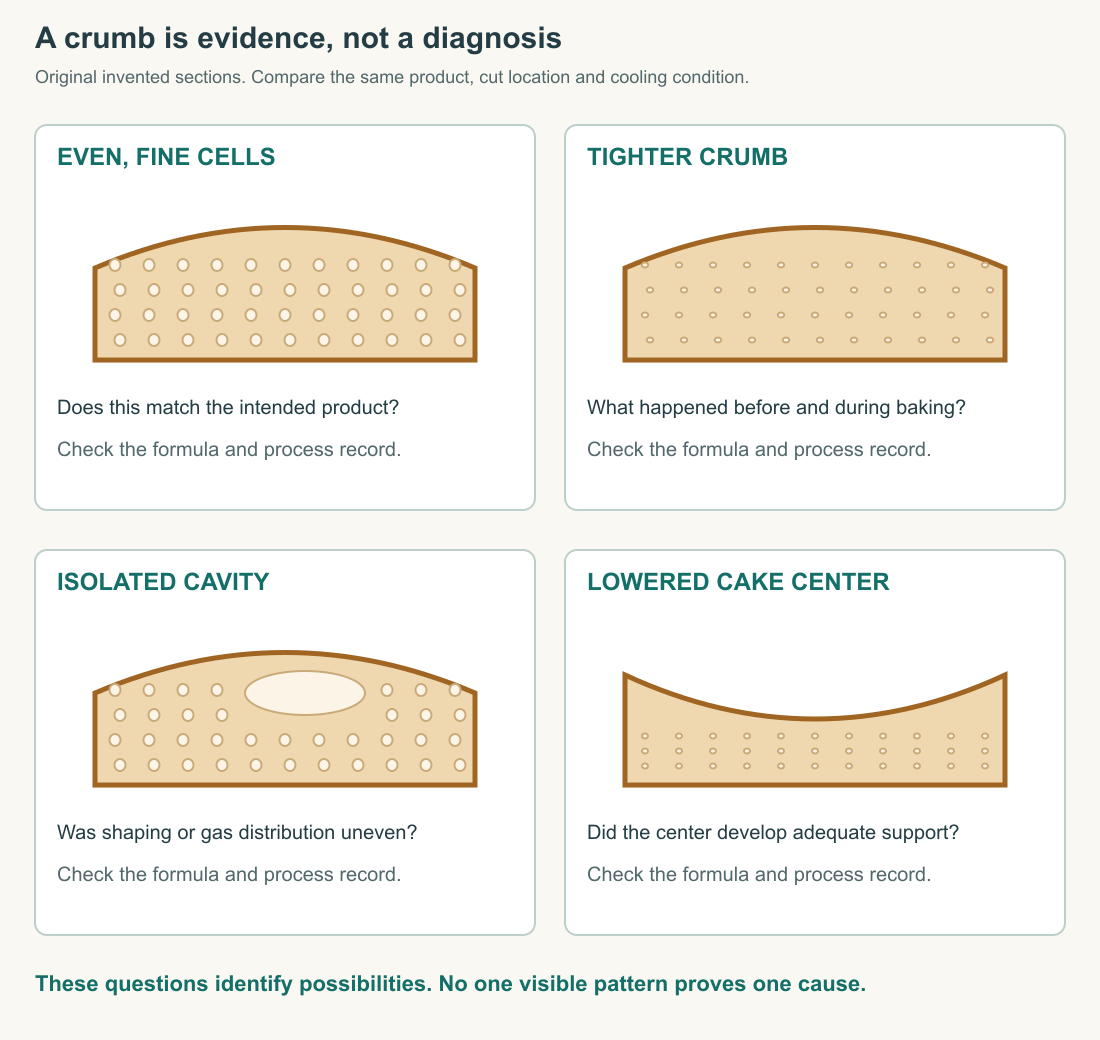
Our diagram below is different in kind: it is an original schematic of diagnostic questions. Its cell patterns are invented to clarify distinctions, not measured examples or photographs of actual bakes. Use it to organize observations rather than to match your slice to a supposedly infallible defect chart.
Work backward through stages, not through slogans
Start with the facts you can verify cheaply. Were the ingredient amounts correct? Was the actual flour the intended type? Did the pan match the recipe? Was the leavener the specified product? These checks often reveal a known departure before you need to propose a subtle mechanism.
Then examine the sequence. What did the mixture look and feel like after incorporation? What happened during the rise or chill? What shape entered the oven? Which readiness cues were recorded, and how was the product cooled? A missing observation is a limit on the diagnosis. It is also a useful instruction for what to record next time.
Avoid a rule such as “dense means underproofed.” In yeast bread, insufficient expansion before baking is one possibility, but a changed formula, inadequate gas retention, different geometry or baking and cooling problems can also matter. The evidence should narrow the possibilities. A confident label without a process record is often just a familiar story.
Rank hypotheses by how well they fit the observations and how readily you can test them. A documented extra 40 g of flour is stronger evidence of a changed composition than a vague suspicion about the weather. Start with the known departure unless another observation makes it irrelevant to the result you are investigating.
Case one: a low sandwich loaf
Consider an invented notebook. The cook used the correct ingredient quantities but baked in a 9 × 5-inch pan instead of the specified 8½ × 4½. The dough was puffy before shaping, the center reached the recipe's baking cues and the cooled slices held together. The main complaint is that the loaf looks shorter than the reference.
The pan difference is a plausible contributor to height. It does not prove that fermentation was ideal, but it makes failed yeast an unnecessary first conclusion. The simplest next comparison is to use the specified pan while preserving the formula and observing the same readiness stages. Alternatively, the cook may accept the wider slices if they serve the intended purpose.
Now change the record: the pan was correct, but the dough entered the oven well before the stated final-proof cue because dinner was late. In this version, proof timing is a documented departure worth correcting. The same complaint about height leads to a different next action because the process evidence differs.
Neither case justifies doubling the yeast by instinct. That would change the formula while leaving the known pan or scheduling issue unresolved. A useful adjustment should address a plausible cause, not merely push the most familiar ingredient in the direction associated with rising.
Case two: a cake with a sunken center
In a second invented record, the cake's edges looked brown, so the cook removed it before checking the center. The middle later sank and appeared compressed after cooling. Insufficient setting is a plausible explanation consistent with the missing readiness checks, but the record does not establish the precise contribution of every ingredient or oven condition.
The next attempt should preserve the tested formula and follow its complete baking cues. Record the pan dimensions, batter division and actual oven arrangement as well. Increasing flour and reducing liquid at the same time would make the batter a new formula, obscuring whether the original simply needed the intended bake.
Suppose instead that the recipe's baking cues were met, but the notebook reveals an accidental doubling of baking powder. That is a different known departure. Correct the measured amount before inventing a temperature adjustment. More gas production does not guarantee a stronger final structure; the structure must support the expansion it experiences.
A sunken center also does not create a universal salvage instruction. A product that has not been cooked appropriately should not be served merely because frosting hides the depression. Consult the developer's relevant guidance where recovery is uncertain, and let the next attempt carry the lesson if the current result cannot be used suitably.
Case three: pastry that resists the fork
Imagine a tart shell that is intact but unpleasantly tough. The cook repeatedly rolled and gathered the dough, added several unmeasured dustings of flour and omitted the required cold interval. The result has multiple documented departures, so the notebook cannot isolate one cause with confidence.
For the next attempt, restore the complete baseline. Use the simple press-in option, keep the measured formula and retain the prescribed chilling and supported bake. This changes more than one departure, but it is a sensible return to a coherent reference process. Be honest about the purpose: it tests whether following the baseline produces a useful result, not which isolated error caused the first shell's toughness.
Once you can repeat the baseline, a narrower comparison becomes meaningful. You might investigate a permitted handling variation while keeping the other conditions fixed. The distinction between restoring a process and isolating a variable prevents an ordinary practical improvement from being reported as a stronger experiment than it really was.
Build a notebook that you will actually use
A compact record should preserve the source and version, actual ingredient amounts, equipment, key stage observations, final result and next question. You do not need to transcribe every sentence of the recipe. Link it, note when you accessed it and record your departures. If the publisher revises the formula later, that date will help explain why your older record differs.
Use a small table for the planned and actual sequence. Include both elapsed time and the relevant condition. “Forty minutes; still below the recipe's proof cue” is more informative than “proofed forty minutes.” For a cold pastry interval, state the location as well as the duration. For baking, record the actual checks, not just the timer setting.
Mark uncertain memories as uncertain. If you cannot remember whether you added the salt, write that rather than reconstructing a reassuring history from the finished taste. The second attempt can include a simple ingredient check that resolves the uncertainty. Honest missing information is more useful than a complete-looking but invented record.
Choose one change with a prediction
A useful proposed change has three parts: the variable, the expected effect and the evidence that would challenge the explanation. For example: “I will use the specified pan because the wider pan may explain the low slices. I expect greater height with otherwise similar crumb. If height remains low, I will examine the recorded rise and shaping stages more closely.”
Keep unrelated variables as stable as practical. Use the same formula, flour type, measurement method and cooling point unless one is the target of the test. If a necessary difference occurs, record it. A home comparison can still be informative without pretending that room conditions, oven cycling and hand movements were perfectly identical.
One improved second attempt supports a practical conclusion: this revised process worked better on this occasion. It usually cannot quantify the independent causal effect of the change. Repetition strengthens confidence, especially when the original difference was small. You may reasonably adopt the better process while remaining modest about how precisely you have explained it.
Keep the repertoire small enough to repeat
You now have a connected set of preparations: a yeast loaf, cream biscuits, an egg-foam cake and a sweet short shell. Each exercises a different relationship between ingredients, handling, expansion and setting. Repeating these deliberately gives future recipes a structure you can recognize.
The final skill is not memorizing a list of fixes. It is knowing what you intended, observing what happened and selecting the next action for a defensible reason. A notebook that makes your second attempt clearer and more repeatable has already improved your baking, even when the first photograph was disappointing.
Application
Complete a two-attempt notebook for one published baseline in this course. Include the source and access date, target criteria, actual amounts and equipment, stage observations, photographs of the appropriately cooled result, two plausible explanations and one justified next action. State which variables you preserved and any unavoidable differences. If practical baking is unavailable, analyze one of the explicitly invented cases above and label the work as a written diagnosis rather than demonstrated cooking competence.
Check your understanding: The second loaf is taller after you change the pan, yeast amount and proof timing. Can you conclude that the extra yeast caused the improvement? What would make the comparison more useful?
Expected answer: No. Several changed variables could contribute, and height alone does not establish the desired crumb or complete baking. Start from a coherent baseline, change one justified variable where practical, preserve the others, record readiness and cooling, and compare the intended properties. If restoring several baseline departures at once, report that honestly instead of claiming an isolated causal test.