Decide what the watch is for
Mara wants a watch because taking out her phone to check the time often turns into checking something else. She works indoors, walks to appointments and sometimes wears a close cuff. She likes round dials and visible hands. She does not want messages arriving on her wrist. Her initial search is for a good watch under $350. That sounds specific, but it has not yet told a seller what the object needs to do—or told Mara which attractive compromise she would regret.
Mara is a fictional learner. Her budget, routines and preferences are invented so that we can follow a complete decision without presenting a purchase recommendation. Throughout this course, real specifications and manuals supply evidence about particular products; fictional buyers and listings let us examine choices. Keeping those categories separate makes the reasoning reusable when products, prices and personal circumstances change.
Start with an ordinary moment
A useful needs brief begins with an event. Mara is standing outside a meeting room with a bag in one hand and wants to know whether she has three minutes before the appointment. The task requires a quick reading of hours and minutes. It does not require a chronograph, a second time zone or a connection to her calendar. Those features might still appeal to her, but they have not earned a place among the requirements.
Now move the same person to a different event. She is traveling and needs to compare the hour at home with the hour where she is staying. An additional time display might help. If this happens once a year, however, she might reasonably use another device for that occasion. Frequency matters. Buying around an exceptional scenario can produce a less satisfactory object for the hundreds of ordinary days between exceptions.
Describe three recurring moments and one occasional demand. For each, identify the information needed, the conditions of reading and what currently happens. This prevents an abstract category such as everyday watch from hiding incompatible needs. Someone who swims daily, someone who reads tiny scales at a desk and someone who cannot wear wrist jewelry during work face different decisions.
The brief should also say when the watch will be absent. Mara is willing to remove hers for swimming and for activities where it could catch or interfere. That choice changes the specification she needs. A different person may want one object that remains on during a permitted range of water activities. Neither brief is more serious. They describe different arrangements of use.
Separate constraints from attractions
A constraint is a condition a candidate must satisfy to remain acceptable. A preference affects how much an acceptable candidate appeals. An uncertainty is a relevant fact that has not yet been established. These categories produce different next actions. A failed constraint can eliminate a candidate. A preference invites comparison. An uncertainty calls for evidence or an explicit decision about accepting it.
For Mara, no notifications is a constraint because avoiding interruptions motivates the purchase. A round dial is a preference: she is willing to consider another shape if it suits her well. Comfort under her cuff is important but unverified for any candidate she has only seen online. Putting comfort in the uncertainty column prevents a flattering photograph from silently passing the test.
A budget can contain both a firm boundary and a preference. Mara sets $350 as the maximum initial amount she is willing to spend, including any necessary fitting or attachment. Within that limit, spending less remains attractive. A watch priced at $349 has not passed if she must immediately buy a suitable strap or pay an additional charge that pushes the total over her boundary.
Do not give every desire the status of a constraint. If Mara insists on a particular shape, material, movement, size, finish, price and availability while refusing every compromise, she may have described an object that is not on offer. The brief can reveal that honestly. She can revise a preference, increase a genuinely affordable budget or decide to wait. Inventing a perfect candidate is not one of the available solutions.
Choose the maintenance relationship too
A watch brings a routine as well as a display. A battery-powered digital watch, a light-powered analog watch and an automatic mechanical watch ask different things of the owner. How a Wristwatch Works explains their mechanisms. Here the question is whether the routine fits the person who will live with it.
Mara sometimes leaves accessories in a drawer all weekend. The interval from Friday at 6 p.m. to Monday at 8 a.m. is sixty-two hours. A candidate described as running for approximately forty-one hours from a fully wound state should not be assumed to bridge that interval. If it stops, setting it again is part of ownership. Mara may enjoy that interaction or find it irritating; a longer list of admired specifications cannot decide for her.
Light-powered operation likewise needs a relationship with light. A watch kept under a sleeve and then in a dark drawer has a different energy situation from one regularly exposed according to its manual. Battery operation may require less frequent user attention, but an approximate battery-life figure remains conditional. No power source removes the need to understand what the manufacturer has actually specified.
The Casio F-91W-1 specification, for example, identifies a battery-powered digital watch with a daily alarm and stopwatch. Its linked operating guide states assumptions behind the approximate battery duration. This is useful evidence about an ownership arrangement, not proof that its appearance or controls will suit Mara. A product can meet the timekeeping task while missing an important preference.
Fit requires a person and an object
Reading a Watch developed the vocabulary of diameter, thickness, lug span and attachment. Use it now to decide what evidence to seek. A front photograph can show a layout. Dimensions can identify potential conflicts. Neither can establish how a particular watch feels on a particular wrist over a day.
Wrist circumference is not a complete shape description. A rigid case rests across a surface, and its lugs and first attachment segments determine where the assembly begins to bend. Two wrists with the same circumference can present different widths and curves. Two watches with the same diameter can have different spans. A sizing chart that assigns one ideal diameter to a circumference conceals these differences.
The original guide below shows which observations answer which questions. It does not prescribe a universal fit. Its purpose is to prevent the familiar diameter number from doing the work of every other measurement.
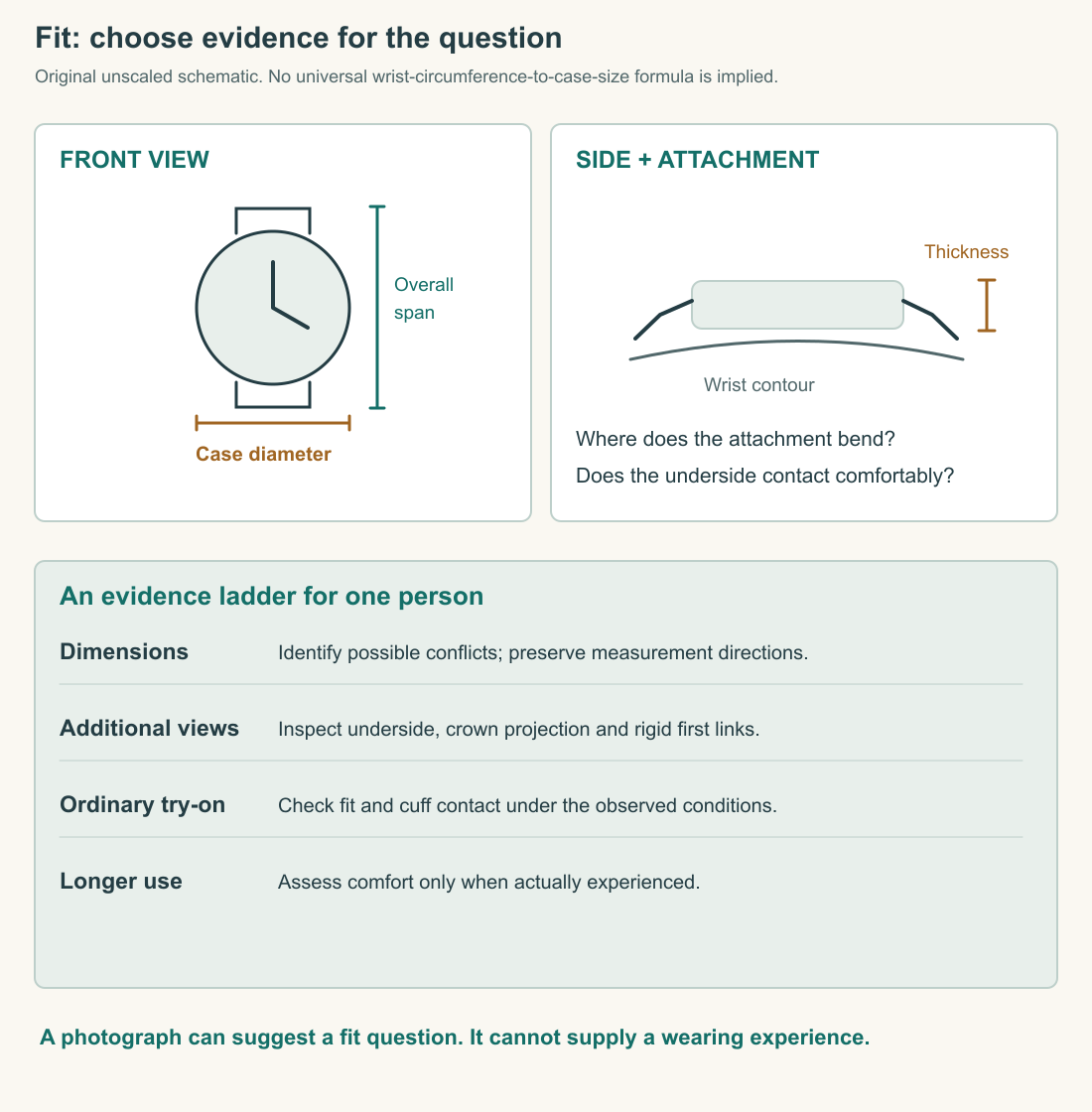
If an ordinary try-on is available without commitment, Mara can observe whether the case presses, the crown contacts her hand, the attachment adjusts adequately and the cuff passes comfortably. She should distinguish what she actually tried from what she expects. A brief counter visit cannot establish all-day comfort, just as a catalogue image cannot establish a counter visit.
If she cannot try the watch, she can still make progress. She can request the missing side view, check the available adjustment range and understand the seller's return conditions before treating reversibility as part of the decision. Uncertainty can be reduced without pretending it has disappeared. A good decision memo states the remaining uncertainty in ordinary language.
Readability belongs to the task
Mara mainly needs hours and minutes. A large number of scales can be interesting without helping that task. Conversely, a spare dial can be difficult to read if its hands disappear into reflections. The label dress watch, field watch or sports watch does not replace examination of the actual display.
Her brief can specify an observation: at an ordinary viewing distance and under the available light, can she locate the minute hand and connect it to the scale? This is more useful than assigning a universal beauty score. If she needs the date often, she should test the date as a separate task. A dial can make the time easy and the date difficult.
Low-light needs require their own evidence. Luminous material, a small electric light and an illuminated screen work differently. A bright promotional image does not show how the display looks after hours in darkness or how easily the wearer can activate it. The course does not assign improvised night-performance claims to products it has not tested. It teaches the buyer to identify what remains to be checked.
A preference for analog hands is legitimate even if a digital display makes one task easier. Mara does not need to invent a technical superiority claim to defend something she enjoys looking at. She does need to acknowledge the tradeoff if the preferred display fails a task she previously described as essential.
Emotional appeal can be stated plainly
Some people want an object that connects them with a family member, a period of design or a form of craftsmanship. Others want an unobtrusive tool they rarely think about. A decision process that admits only measurable functions will miss these differences. A process that admits only emotion will make practical consequences harder to see.
Give personal appeal its own sentence. Mara likes the motion and appearance of hands on a dark round dial. Another fictional buyer wants to wear an inherited watch occasionally even if it is unsuitable for water or strenuous work. These are coherent aims. The resulting care plans may differ from those for a replaceable everyday purchase.
Sentiment is especially important when the object already exists. A repair that costs more than an ordinary replacement may still make sense to an owner who values that particular watch. A new buyer seeking convenient timekeeping may make the opposite decision. Comparing those choices through resale value alone would misunderstand both people.
Prestige can also influence attraction. The useful question is what kind of satisfaction the buyer expects and whether they still want the object when imagined outside the approving audience. This is a reflective exercise, not a diagnosis of anyone's motives. A person may enjoy a recognizable design and understand its social meaning without claiming that ownership demonstrates character or expertise.
Keep the alternative in the comparison
Mara already has a way to know the time. Keeping her phone and changing how she uses it is therefore an alternative to buying a watch. So is borrowing an appropriate watch with permission or using one she already owns. These alternatives have costs and limitations too, but excluding them would make purchase appear inevitable before the comparison begins.
Waiting can have a specific purpose. Mara might wait until she can try the case, receive a clear answer about the attachment or set aside the full initial amount. That is different from postponing indefinitely while collecting more product photographs. A useful waiting decision names the missing information and what will happen once it arrives.
Set a stopping rule for the search. Once Mara has a small group of candidates that meet the essential brief, she can compare them with the same evidence fields. Adding twenty more watches does not necessarily improve the decision if the real uncertainty is how one case fits. More options cannot substitute for the missing observation.
The brief can also stop a purchase that has become detached from its original purpose. If Mara finds herself considering a connected device with notifications because it looks impressive, she can return to the reason she started. She may deliberately change her aim, but the change should be visible. Otherwise, the search has rewritten the problem without her noticing.
A brief you can actually use
Mara's revised brief is now concrete. She wants quick access to hours and minutes during indoor work and ordinary travel, without notifications. She prefers a round analog dial and wants the case to work with her cuff. She will remove the watch for swimming and activities where it interferes. Her initial total must remain within $350. She will compare the routine of restarting a mechanical watch with the routines of battery and light-powered alternatives. Fit and low-light reading remain evidence questions.
This paragraph does not select a product. It makes selection possible. It also makes disagreement informative: another reader can identify which preference they would change rather than announcing that Mara has chosen the wrong kind of watch. In the next chapter, the brief meets real specifications, including numbers whose meaning changes when their units and conditions are read carefully.
Application
Write a needs brief of 250–400 words for yourself or an explicitly fictional person. Include three recurring moments, one occasional demand, essential constraints, preferences, unresolved observations and a total initial spending limit. Describe when the watch would be removed and how it would be stored between uses. Include keeping the current arrangement or waiting as an alternative.
Choose one desire that initially looked essential and explain whether it is truly a constraint. Then state a stopping rule for your research and the single missing piece of evidence most likely to affect the choice. No purchase or physical try-on is required.
Check your understanding: Why should untested comfort remain an uncertainty instead of being marked as a satisfied constraint after viewing a product photograph?
Expected answer: A photograph and dimensions can reveal possible fit issues, but comfort depends on the actual case, attachment and wearer in use. Marking it satisfied would turn an expectation into an observation. The next step is a relevant try-on, better evidence or an explicit decision about the remaining uncertainty.