Quartz and electronic counting
Two watches have hands, crowns, and round dials. One contains a mainspring, a balance, and a lever escapement. The other contains a battery, a quartz resonator, an electronic circuit, and a small motor. Their displays answer the same everyday question, but their internal routes to that answer differ.
The quartz movement does not escape the need for a physical timekeeping process. Its crystal really vibrates. What changes is the oscillator's construction, the way its motion is sustained, and the way repeated events become a useful count. Electronic circuitry can perform the counting before a motor and gears turn the result into hand movement.
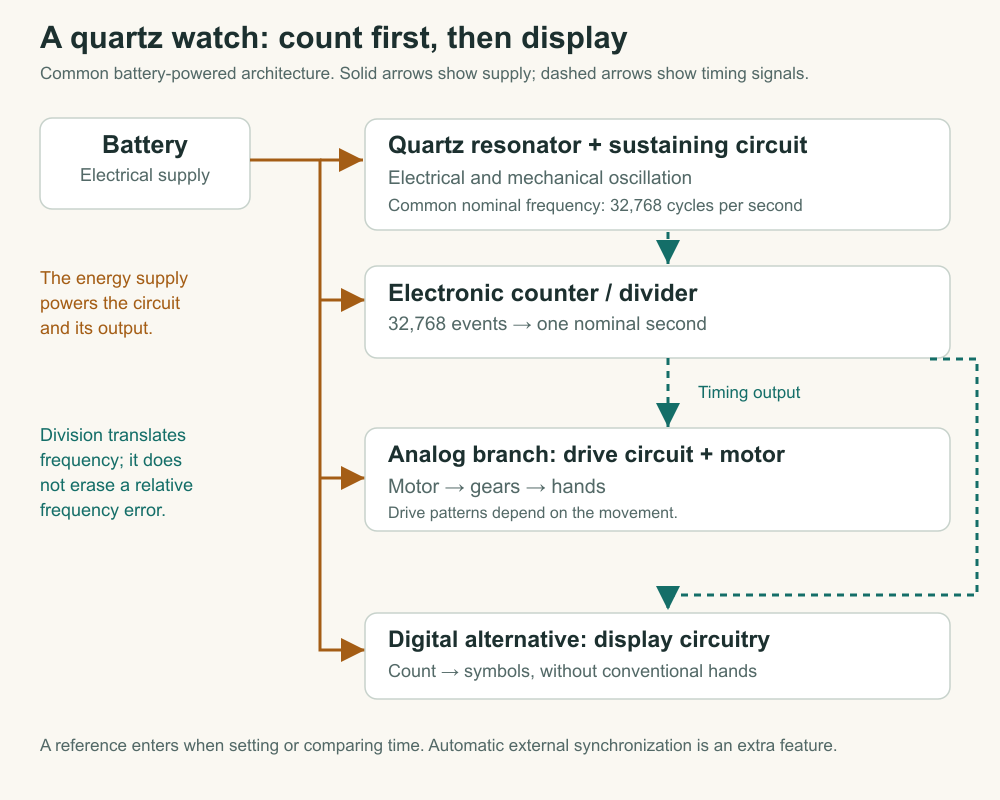
This chapter follows a common battery-powered analog quartz architecture and then varies the display and energy source. It does not present every quartz watch as identical. The central task is to keep three things distinct: the resonator that helps establish frequency, the circuit that sustains and counts oscillations, and the mechanism that presents the resulting time.
Quartz is a resonator, not a fuel
Quartz is piezoelectric: mechanical deformation and electrical effects are coupled in the material. Suitable electrical excitation can produce mechanical vibration, and the mechanical response can participate in an electrical signal. Cut and mounted appropriately, a piece of quartz has resonant behavior that makes it useful in an oscillator circuit.
A resonator has a characteristic response at particular frequencies. It does not start telling the time simply because a piece of quartz is present in the case. The complete oscillator includes powered circuitry and the electrical conditions around the resonator. Microchip's technical introduction treats the crystal and circuit as interacting parts of that system. Microchip AN826: crystal oscillator basics
Imagine an ordinary acoustic tuning fork after it has been struck. It vibrates and gradually loses energy. That analogy helps explain resonance, but a watch crystal is not struck by a tiny hammer once each second. The powered oscillator circuit sustains its electrical and mechanical activity. The circuit's design and the resonator's properties determine the operating behavior together.
The battery supplies energy; the crystal does not provide a hidden source of unlimited power. Remove a functioning oscillator's supply and it cannot continue sustaining its normal operation indefinitely. The quartz architecture still obeys the energy account from Chapter 2, even though the store and transmission route have changed.
Why 32,768 appears so often
A common watch-oscillator frequency is 32,768 complete cycles per second. Written in kilohertz, that is 32.768 kHz, since one kilohertz means one thousand cycles per second. It is a nominal operating frequency: the intended value, not a guarantee that every crystal under every condition produces it exactly.
The number is convenient for binary division because it equals two multiplied by itself fifteen times, or two to the fifteenth power. Repeatedly divide 32,768 by two and the sequence passes through 16,384, 8,192, 4,096, and eventually two and one. Fifteen successive halvings produce a one-hertz output from the nominal input.
Electronic circuitry can also express the operation as counting. A fifteen-bit binary counter has 32,768 distinct states. Starting at zero, it can count through 32,767 and return to zero on the next input event. A pulse associated with that rollover occurs once for each 32,768 counted events. Under the nominal frequency assumption, that corresponds to one second.
Microchip's real-time-clock explanation describes this fifteen-bit counting relationship and the further counters used for human-readable time. It is a general circuit example, not a claim that every wristwatch uses one particular Microchip component. Microchip: real-time clock counters
Not every quartz timepiece uses this frequency. Seiko's museum identifies 8,192 Hz in its original Quartz Astron and contrasts that with the later widespread 32,768-Hz choice. The relevant lesson here is the variation in architecture, not a ranking of historical prestige. The detailed frequency of an example should come from its own documentation. Seiko Museum: quartz timepieces
Counting faithfully preserves a frequency error
Suppose an invented oscillator intended to run at 32,768 Hz instead runs twenty parts per million fast. A part per million is one millionth of the reference quantity. Twenty parts per million is a relative difference of 0.000020, so the actual frequency in this example is 32,768 × 1.000020 = 32,768.65536 Hz.
If a perfect counter still treats each group of 32,768 events as a second, those groups arrive slightly too soon. During 86,400 reference seconds, the device accumulates 86,400 × 0.000020 = 1.728 extra indicated seconds. Its indicated time gains because its input events arrive faster than the intended rate.
Dividing the input frequency does not erase this fractional error. A divider that turns the nominal input into one hertz turns the fast input into 1.000020 Hz. The absolute difference in hertz becomes smaller, but the relative difference remains twenty parts per million. The display continues accumulating time at that slightly fast rate.
This calculation is an original constant-frequency model. It is not a measured specification for a watch, nor does it include temperature variation, compensation, synchronization, or reading uncertainty. Its purpose is to prevent an attractive mistake: assuming that a very large division factor automatically repairs an inaccurate input.
A high oscillator frequency can be useful in a practical design, but performance depends on the behavior of the oscillator and the whole system. Compare stated accuracy and actual observations under their conditions. Frequency alone cannot tell you how two movements will compare in use.
From a counted second to a moving hand
In a common analog quartz movement, a circuit sends drive pulses to a small stepping motor. The motor converts electrical energy into controlled mechanical movement through magnetic interaction. Its output drives a train of gears that produces the intended hand movements.
The motor does not need to rotate once for every oscillation of the quartz. Counting and division occur before the drive signal reaches it. This separation makes a visible one-second hand advance compatible with tens of thousands of internal oscillations during that interval. The hand is the downstream indication, not an enlarged picture of the crystal's motion.
The gears also mean an analog quartz watch is not devoid of moving mechanical parts. Hand alignment, clearances, transmission, and contact conditions still matter. The presence of gears does not turn its timekeeping oscillator into a balance, just as the presence of electronics does not make the displayed hands imaginary.
Even an apparently simple hand step can conceal a more complicated drive pattern. Grand Seiko describes two closely spaced motor-driven steps per second in its 9F movement, appearing to the eye as one step. That example shows why the observed output should not be treated as a complete motor specification. Grand Seiko: 9F mechanism and twin-pulse drive
A digital display takes another branch
With a digital display, the electronic count can be translated into symbols without a motor driving conventional hands. The circuitry maintains time-related state and controls which display elements present the numerals. The display itself still requires an appropriate electrical arrangement and energy supply.
This is where the distinction between an elapsed-time counter and a clock becomes visible again. A counter can keep accumulating events from zero. A clock's display must interpret the accumulating count relative to its initial setting and its chosen format. Changing from a twelve-hour display to a twenty-four-hour display changes the presentation without necessarily changing the oscillator.
Additional functions can use the same underlying time base. An alarm can compare a stored target with the current time state. An elapsed-time function can retain a start or accumulated interval. The details depend on the circuit and controls; the important architectural point is that several displays or functions need not require several independent quartz crystals.
An invented digital watch might show seconds, a date, and an alarm symbol. If its owner changes the date, the oscillator does not need to learn a different rhythm. The setting changes stored or displayed information. If the oscillator runs fast, several functions based on its count can share that timing error.
A battery label does not define the oscillator
The common architecture we began with uses a battery that is replaced when appropriate. Other watches obtain energy from light or from motion and store it electrically. Those differences concern obtaining and storing power; they do not, by themselves, require abandoning quartz regulation.
Citizen describes Eco-Drive as converting light into electrical energy and storing surplus energy for later operation. That makes operation in darkness possible for the available reserve. The exact charging conditions and reserve belong to the identified model. “Light-powered” is an energy-path description, not a claim that the watch directly counts the sun's movement. Citizen: Eco-Drive
Consider a hypothetical light-powered quartz watch left in a drawer. Its quartz frequency does not become a measure of the drawer's darkness. The stored supply gradually supports operation until the device's energy-management behavior intervenes. An empty reserve and an inaccurate oscillator are different explanations for a wrong or stopped display.
There are also architectures that combine a mainspring with electronic quartz regulation. Seiko's Spring Drive description follows mainspring energy through a generator and electronic regulating system that controls a rotating glide wheel. It does not use the conventional balance-and-lever arrangement we traced in Chapter 3. This example is enough to show why “has a mainspring” and “uses quartz regulation” are not mutually exclusive statements. Seiko Museum: Spring Drive mechanism
Local timekeeping and external correction
A quartz oscillator can run independently after a watch has been set. The word quartz does not imply that the watch receives a radio signal, talks to a phone, or automatically knows the local time zone. Those are additional capabilities requiring their own receiving, communication, or setting mechanisms.
If a watch does receive an external correction, distinguish its behavior between corrections from its behavior immediately afterward. An invented watch might gain one second during each day and be reset to the reference every night. Observing it only just after the reset would conceal the daily gain of its independent time base.
A failed synchronization can likewise leave the watch relying on its local oscillator. Whether and how that is reported depends on the model. To understand a specification, identify whether the quoted performance describes autonomous operation, successful signal reception, or another stated condition. The functional map should include an external-reference arrow only when the watch actually has that path.
Restarting after a complete interruption raises a different question. If the device did not maintain a count during the interruption, restoring energy does not reconstruct how much time passed. It needs a new setting or other information to recover the correct indication. An oscillator that restarts at its intended frequency can therefore coexist with an incorrect displayed time. Knowing the pace is different from knowing the starting point.
The same discipline applies to the comparison phone you might use. A changing reference display can affect the apparent difference between devices. A useful timing record identifies the reference and notes known corrections, rather than quietly treating any convenient screen as a perfect, unchanging standard.
Compare complete architectures
Place the conventional mechanical diagram beside the common analog quartz diagram. Both require stored energy, sustained oscillation, translation of recurring events, and an indication. Both need a starting setting. They implement these requirements with different components and interactions.
In the mechanical example, the mainspring powers the train and sustains the balance through the escapement; the oscillator governs the train's permitted advance. In the quartz example, electrical energy sustains an oscillator circuit; electronic counting produces a signal that controls a motor; the motor and gears move the hands. The timing and energy routes meet differently.
These distinctions let you evaluate claims without making taste masquerade as mechanics. You may prefer the visible motion of a balance or the practical convenience of a quartz movement. Those preferences do not establish the measured accuracy, service needs, or reliability of an unidentified watch. Use the actual specification and an appropriate observation for each claim.
Explain an error before diagnosing it
Suppose a fictional quartz watch's circuit counts correctly but its motor occasionally fails to deliver the commanded step. Its hands can lose indicated time even though the quartz frequency is correct. Conversely, a motor and train can execute every commanded movement while an inaccurate oscillator supplies those commands at the wrong pace.
A digital display removes that particular motor-and-hand route but does not remove every possibility of error. Settings, circuitry, supply, the display, and the reference comparison all remain relevant. You should now be able to say which functional stage an observation concerns without claiming that the observation proves a specific physical defect.
The complete architecture is in view. What remains is to judge the behavior of an actual or supplied timing record: where an offset began, how it accumulated, which conditions varied, and what the evidence cannot establish. That is the work of the final chapter.
Application
Build the quartz map
Draw a battery-powered analog quartz watch using separate labels for battery, quartz resonator and sustaining circuit, electronic counter or divider, motor-drive circuit, stepping motor, gears, and hands. Distinguish energy arrows from timing relationships. Add a second display branch for a digital implementation, marking which analog-output components it replaces.
Add a light-energy input and storage cell to show a possible solar-powered variant. Explain which timing components need not change merely because the energy source changes. Do not label the schematic as the circuit of a specific manufacturer's movement.
Work the frequency comparison
In an invented constant-rate case, an oscillator runs ten parts per million slow, and an ideal counting system interprets every 32,768 events as one second. How many indicated seconds does it lose over two reference days? Does a finer display showing hundredths correct that loss?
Explain why a visible hand step cannot establish the crystal's frequency, the number of motor pulses, or the presence of automatic external synchronization.
Model interpretation
Electrical supply powers the oscillator, counting and drive circuits, and the motor. The oscillator's recurring electrical events feed counting; counted intervals control motor drive; mechanical output reaches the hands through gears. A digital display uses an electronic display path in place of the conventional motor, gears, and hands. A light-powered energy route can still support quartz oscillation and counting.
Two days contain 172,800 reference seconds. A relative deficit of 0.000010 produces 1.728 seconds of lost indication in this constant-rate model. More display digits do not repair the time base; they only present its result with finer numerical resolution.
A hand is a downstream output. Counting, motor control, and gearing stand between it and the oscillator, and manufacturers can use different internal patterns for similar visible steps. External synchronization is an additional documented capability. None of these internal details follows reliably from one observed movement of the hand.