Feathers and the body beneath
At about five seconds in Cornell's short recording of a male Anna's hummingbird, the throat looks relatively dark. At about ten seconds, with the head directed differently, a vivid pink-red patch is visible. The bird remains on the branch. You have not watched it grow a new set of feathers between frames. You have watched the relationship between a surface, light, and a viewing direction change. Watch Larry Arbanas's recording through Cornell Bird Academy.
This is a good place to begin because feathers are often introduced as if they had one obvious purpose. A feather can help form a wing, but plumage also mediates heat exchange and appearance. Different kinds of feathers accomplish different things, and one feather can contain regions with different structures. To understand that versatility, we need to look beneath the outline.
Branches make a surface
A typical large flight feather has a central shaft. Its bare basal portion is the calamus; the portion supporting the vane is the rachis. The vane consists of branches called barbs, which themselves carry smaller branches called barbules. In a firm, pennaceous region, neighboring barbules interlock. A broad surface therefore emerges from an organized set of small elements rather than from one continuous sheet. Downy, or plumulaceous, regions have looser branching that does not form the same locked plane. Cornell's feather structure guide.
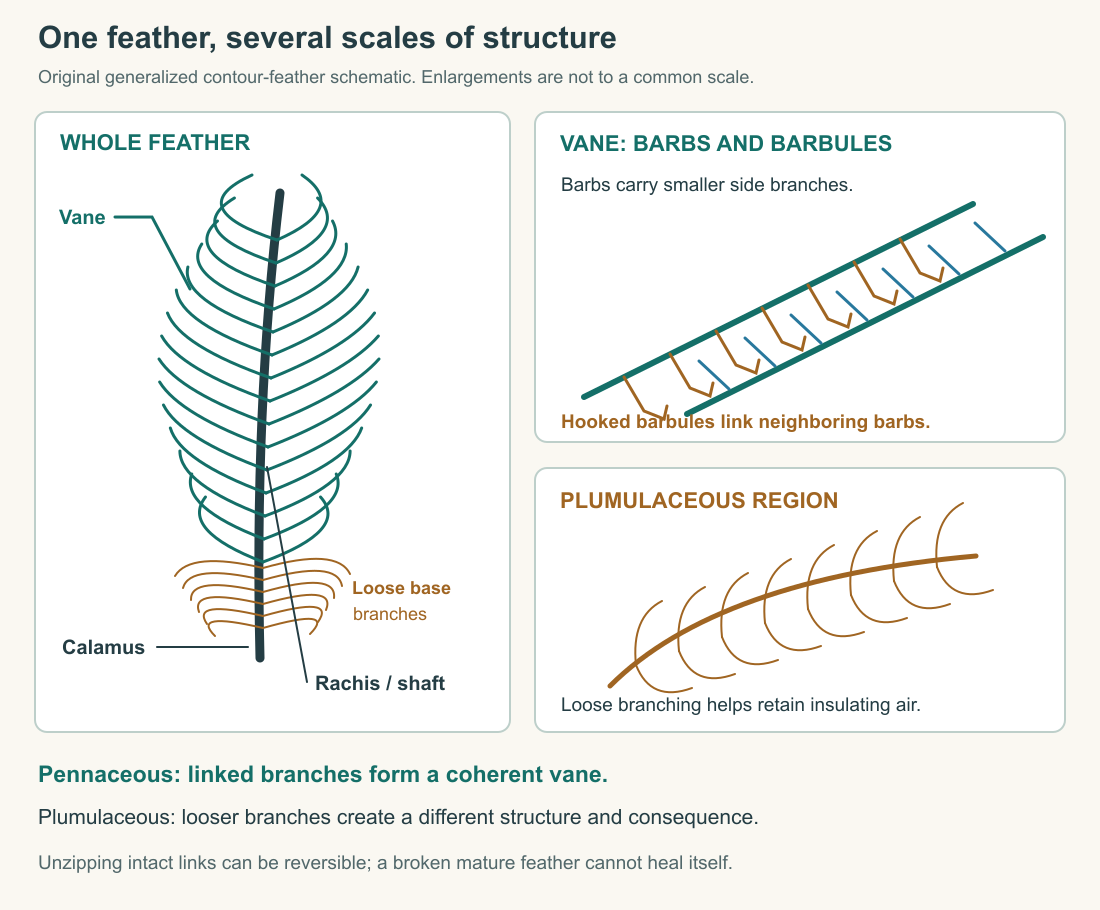
The diagram is a generalized explanatory drawing, not a microscopic image of the hummingbird in the recording. Follow it from the whole feather to the smaller branching pattern. Notice which connection each label identifies. The rachis supports barbs; a barb supports barbules. Calling every fine strand a “barb” would hide a level of organization that helps explain the surface's behavior.
A useful comparison is a screen assembled from many linked strips. A force applied in one place can be distributed through neighboring connections. If connections can release and reconnect, a local separation need not destroy the whole screen. The comparison is mechanical, not a claim that feathers are woven or that their development resembles manufacture in a workshop.
Researchers studying the separation of feather vanes have measured how arrays of hooklets disengage. In the study Unzipping bird feathers, repeated separation did not simply destroy all the connectors; stroking could restore the vane's arrangement. The authors combined force measurements with a numerical model. This supports a distinction between a vane that has come apart at its connections and a structure that has actually fractured. Kovalev and colleagues, 2014.
That distinction gives preening a more interesting meaning. A bird drawing its bill through plumage may be restoring arrangement as part of maintenance. You should not translate every such movement into “repairing broken feathers,” because rearrangement and replacement are different processes. Nor does seeing preening establish which particular microscopic connection changed. The behavior is visible; its fine mechanical effects require closer study.
Support depends on geometry as well as material
Imagine holding a narrow strip of paper flat and then folding it lengthwise into a shallow channel. The material remains paper, but its resistance to bending changes. This familiar observation helps explain why a structural description needs more than a material name. Where material lies relative to a bending axis matters.
Feather shafts are not simple solid sticks. Microscopic studies describe organized outer material and internal structure, with differences across regions and scales. Research on rachis and barb architecture has traced fibers extending from within the shaft toward its branches. Such findings concern how loads can pass through an attachment that looks simple from a distance. Lingham-Soliar, 2017: feather microstructure.
We do not need to reproduce that microscopic architecture in our drawing to use the principle. A feather must maintain useful shape under load while allowing some deformation. “Rigid” and “flexible” are therefore incomplete descriptions unless we ask: under which force, in which direction, and by how much? A structure may bend readily one way while resisting another kind of deformation.
Consider a hypothetical feather-like beam fixed at one end. A small load near its base and the same load near its tip do not produce the same bending demand at the attachment. The farther load has a longer lever arm. If the beam twists as well as bends, its surface orientation can change even when the tip moves only modestly. This is why a drawing of an unloaded feather cannot fully explain its behavior in flight.
The same reasoning prevents a common mistake about strength. Increasing stiffness everywhere is not automatically an improvement. A structure that yields in a controlled way may avoid damage or accommodate a changing load. But excessive deformation could spoil the surface it needs to maintain. The relevant question is how a particular arrangement behaves within the conditions it encounters, not whether it wins an abstract competition to be hardest or stiffest.
A feather coat controls exchanges
In the loose branching of downy plumage, spaces help retain air near the body. The resulting layer contributes insulation. Firm outer feathers also help organize the body's exposed surface. These functions can coexist with feathers used in flight or display; plumage is a system of overlapping components. Cornell: what feather structures do.
Insulation does not manufacture heat. It changes the rate at which heat moves between regions. A coat wrapped around an unheated object cannot maintain it indefinitely above the surroundings. A living bird supplies metabolic heat, and its plumage affects how quickly that heat is exchanged. This is the difference between a source of heat and resistance to heat transfer.
That distinction also explains why more insulation is not an unlimited advantage. Imagine an animal producing heat rapidly while its surroundings are warm. Retaining heat can become a problem. The consequence of a feather layer depends on the temperature difference, movement of air, wetness, posture, and the body's own activity. We will return to the balance in the chapter on food and temperature.
A bird that appears rounder after changing its feather posture has not necessarily gained tissue. The visible outline includes the arrangement of plumage and the spaces within it. This creates an observational trap: silhouette can change faster than body mass. An inference about weight or nutritional condition from one distant view should therefore be modest.
Here is an original comparison you can make on paper. Draw the same small body inside a thin surrounding layer and then a deeper surrounding layer. Keep the actual body outline fixed. The outer silhouettes differ, but the underlying animal does not. Add arrows representing possible heat transfer and label the conditions that would affect them. The sketch will not calculate insulation, but it will stop you from confusing the coat's geometry with the dimensions of the tissues beneath it.
Color is a relationship with light
The hummingbird clip demonstrates a visible change, but it cannot resolve the feather's internal structure. For that we need a different observation scale. Giraldo, Parra, and Stavenga studied Anna's hummingbird gorget feathers using optical measurements and anatomical information. They described layered arrangements of melanosomes within barbules and compared measured reflection with an optical model. The reflected appearance depends on the direction of illumination and observation. Their proposed courtship significance is an interpretation beyond the basic optical measurements. Giraldo and colleagues, 2018: abstract and figure descriptions.
Iridescence refers to this dependence of color on angle. It is not a fresh dose of red pigment delivered each time the bird moves its head. The distinction matters because it produces a prediction: the same feather structure can appear different when its orientation changes. A still photograph records one part of that relationship.
A small mirror offers a limited analogy. Tilt it and a reflected bright source can enter or leave your view. A hummingbird's colored reflection involves much finer structure and wavelength-dependent interactions, so a mirror is not an anatomical model. It does, however, make directionality intuitive. The observer is part of the viewing geometry.
Return to the five- and ten-second frames. In each, the feet remain associated with the perch while the direction of the bill differs. The crown and throat appearance changes more conspicuously than many surrounding body regions. This is a useful description of the inspected frames. It does not measure reflectance, establish the bird's visual experience, or show that a particular recipient responded.
The recording also changes framing slightly across time. That reminds us not to treat every pixel difference as a biological change. Exposure, focus, image compression, and the camera's position can affect a recording. The optical research supplies independent support for an explanation that the video makes worth asking about. A strong lesson uses the two kinds of evidence together while keeping their jobs distinct.
The wing is an altered forelimb
Below the feathers, a wing contains a recognizable vertebrate limb pattern: an upper arm, forearm, and modified wrist and hand. In living flying birds, reductions and fusions of distal elements accompany the support of an extensive feathered surface. The bones alone do not trace the entire aerodynamic outline. The surface extends beyond them.
The large pectoralis supplies much of the force associated with downstroke. The deeper supracoracoideus acts through a tendon redirected at the shoulder to help elevate and rotate the wing. Its position below the wing does not mean it must pull the wing downward; the tendon path changes the direction in which its pull acts on the humerus. The shoulder girdle and sternum provide attachments and transmit substantial loads. Biewener, 2022: avian flight biomechanics.
You can understand the redirection without memorizing every attachment. Imagine pulling downward on one end of a cord passing over a fixed guide. The other end can rise. The guide and its support must bear forces too. The comparison explains why the location of a muscle belly is not enough to predict the movement it produces. Attachment points, tendon route, joint geometry, and activation all matter.
Do not turn this simplified arrangement into a two-muscle puppet. Muscles controlling joints and feather-bearing regions contribute to the shape and orientation of the wing. A movement also depends on forces already acting on the limb, including those from the air and from its own acceleration. The flight chapter will ask how these relationships change between a slow maneuver and a glide.
An internal skeleton must transmit force as well as avoid unnecessary mass. Some bird bones contain air spaces, but pneumatization varies among bones and species. “Every bird bone is an empty tube” is false. A bone containing air also has walls and supporting structure; it is not an absence of anatomy. OpenStax: avian skeletal modifications.
Compare a solid rod and a tube made from the same amount of material. Spreading material farther from the central axis can change resistance to bending. The result depends on dimensions and loading, so the example does not prove that any hollow object is stronger than any solid one. It shows why mass alone is insufficient to describe structural performance. Living bone adds further complexity through tissue organization and growth.
Maintenance is part of the design problem
A mature feather cannot heal a broken shaft as living tissue heals a wound. Replacement occurs through growth of a new feather, and molt names the patterned replacement of some or all plumage. Timing and extent vary. A complete molt means the plumage is replaced over the relevant molt, not that every feather necessarily falls out on one day. Cornell: feather molt.
This changes the time horizon of our explanation. The surface you see today is partly a product of growth in the past, use since then, maintenance, and replacement. A bird must continue functioning while that system changes. Replacement consumes material and time, and a feather still growing is not equivalent to the fully developed structure it will become.
An engineering analogy makes the scheduling issue clear. Imagine replacing components of a vehicle that must remain in service. Replacing everything at once and replacing a sequence of parts create different interruptions. The analogy does not imply conscious planning by the bird; it identifies a constraint that physiological timing and evolutionary history must accommodate.
Feather condition therefore belongs in an observation notebook. Record a visible gap, uneven edge, or short developing feather if your view supports it. Do not immediately diagnose injury, disease, or neglect. Several histories can produce an unusual outline, and the explanation may require species-specific molt information. A photograph can preserve the question for later examination. Include the date and the viewing angle, since both may become relevant when comparing the image with a documented molt sequence.
One surface, several consequences
We can now explain why a feather is a poor candidate for a single-purpose label. Its branching helps establish a surface; its material arrangement affects mechanical behavior; its placement contributes to a coat; its microscopic organization may influence appearance. Different feathers emphasize different combinations. Their functions arise within a body, not in isolation on a page.
Consider the consequences of a hypothetical change in one feather's shape. It might alter a small part of an aerodynamic surface, expose an underlying region, or change how light is reflected. Which consequence matters most depends on its location, the magnitude of the change, and the activity under consideration. There is no need to claim that every change has a large effect. The value of the exercise is to trace possible connections precisely enough to investigate them.
The body beneath the plumage makes those connections operational. Muscles move the skeleton; the skeleton carries and reorients surfaces; the surfaces interact with the surroundings. At a different timescale, living tissues produce replacement structures. Feathers can be nonliving at maturity while remaining part of an actively maintained living system.
In the next chapter, the outside and inside must meet a particularly demanding condition: an animal supported by air. The wing's outline will become a moving surface, its structural support will carry aerodynamic loads, and the apparently effortless glide will reveal an energy account of its own.
Application
Use the original feather diagram and the linked Cornell recording. Make a two-panel sketch of the bird at approximately five and ten seconds. Record the orientation of the bill, the apparent crown and throat colors, and a body region whose appearance changes less conspicuously. Attribute the recording to Larry Arbanas and Cornell; an original sketch is sufficient, and no download or reuse of their video is required.
Below your sketch, explain three distinct matters in 300 words: how branching can form a feather surface, why head orientation can change apparent color, and why neither observation establishes the bird's immediate purpose. Then explain the difference between reconnecting separated vane elements and replacing a fractured feather.
Check your understanding: Why can a muscle below a bird's wing contribute to lifting it?
Expected answer: A muscle's effect depends on its attachments and the route of the tendon transmitting its force. The supracoracoideus tendon is redirected at the shoulder, so contraction of the ventrally located muscle can contribute to elevation and rotation of the humerus. Muscle location alone does not specify the movement.