Making and controlling flight
A gull passes the waterfront with its wings extended. A hummingbird holds position beside a flower while its wings keep moving. Both animals remain in the air, but they are not doing the same mechanical job in the same way. The gull moves through an air mass with a largely extended wing surface; the hovering hummingbird moves its wings rapidly through the air while its body remains nearly stationary. What matters to an aerodynamic surface is motion relative to the surrounding air, not simply motion relative to the pavement below.
To explain either bird, begin with forces and motion. Then ask where the required energy comes from. This order prevents two familiar mistakes: treating lift as a mysterious substance made by a wing, and treating a glide as flight without any energy account.
Draw the forces on the bird
Weight is the gravitational force on the bird. Aerodynamic force comes from interaction with air. For a surface moving relative to an incoming flow, the component perpendicular to that flow is called lift, and the component opposing relative motion is drag. These directions are definitions tied to the flow; lift does not always mean vertically upward in the world. NASA: lift and relative motion.
A force has both magnitude and direction. An arrow can therefore show more than “something acts here.” Its orientation shows direction; its length can represent magnitude if the diagram uses a stated scale. A drawing that includes a long upward arrow and a short downward arrow implies an unbalanced vertical force, unless other forces have been omitted. That implication should match the motion being explained.
For a bird maintaining a steady average height during a hover, the average upward aerodynamic force must balance its weight. If upward force exceeds weight over an interval, the bird accelerates upward. Acceleration is a change in velocity, not a synonym for fast movement. A bird can move upward at constant speed without continuing to accelerate upward.
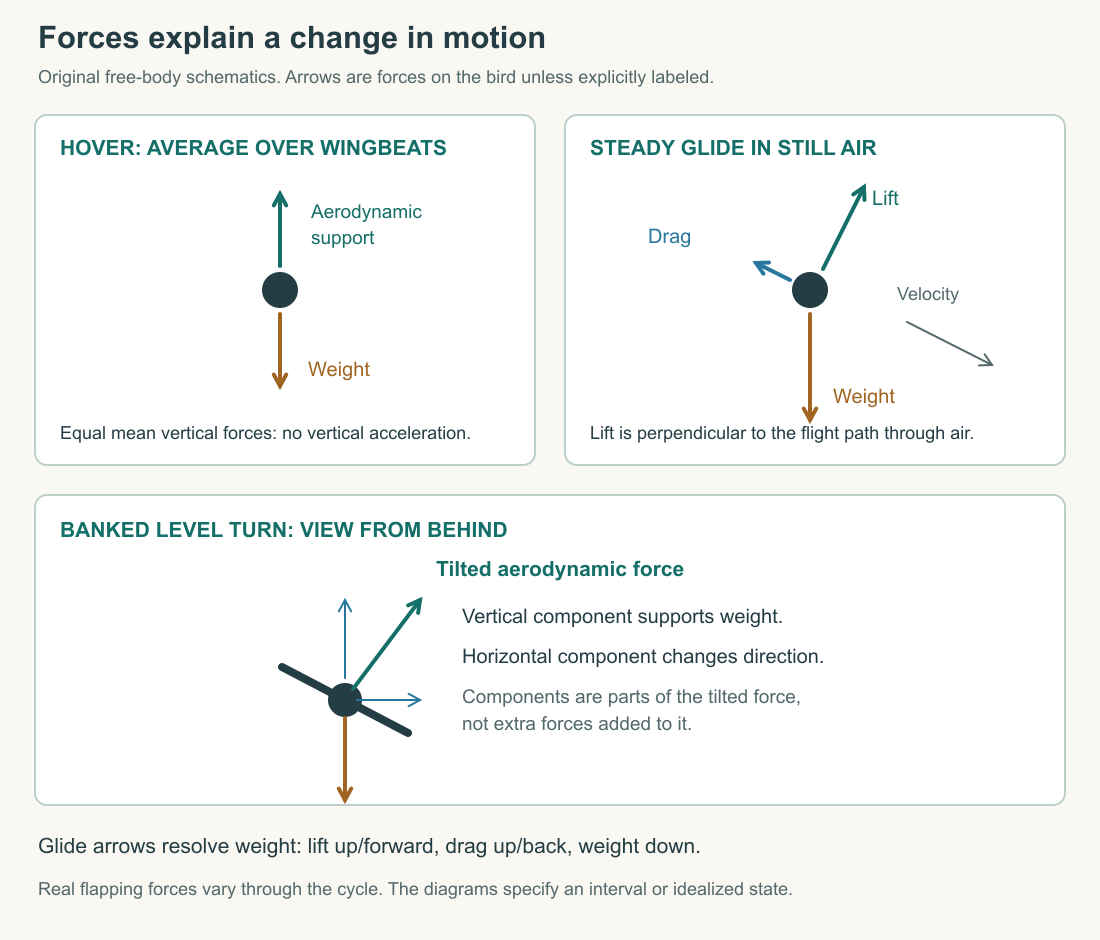
Read the diagram's glide carefully. The bird moves forward and downward relative to still air. Lift is perpendicular to that sloping path, while drag opposes the path. Their combined upward component can balance weight during a steady descent. The bird can lose height at constant velocity even though the forces balance. Balanced forces mean no acceleration, not no movement.
A second common mistake mixes action and reaction arrows on the same object. The bird pushes on air; the air pushes on the bird. These are forces on different bodies. If you put both arrows on the bird and cancel them, you erase the very interaction you are trying to explain. Label the object whose forces a diagram represents before interpreting it.
Pressure and moving air belong to one explanation
A wing changes the flow around it. Pressure differs across its surfaces, and the combined effect of those surface pressures contributes to aerodynamic force. At the same time, the air's momentum changes. A pressure account at the surface and a momentum account of the surrounding flow describe connected aspects of the same interaction. They are not rival explanations from which you must choose. Viscous stresses also contribute to the full force on a real surface. NASA: aerodynamic surface forces, flow turning.
You may have heard that two particles of air separate at the front of a wing and must reunite at its back. Because the upper path is longer, the story says, the upper particle must move faster. There is no general requirement that the particles reunite. NASA identifies this equal-transit explanation as incorrect. A symmetric or thin wing can also generate lift when appropriately oriented to the flow. NASA: the equal-transit error.
Rejecting that story does not mean curvature and pressure are irrelevant. It means the flow must be established from the actual geometry, motion, and physical conditions. An attractive sentence about path length is not a substitute for those conditions. Likewise, saying that a wing “pushes down” is a useful beginning but an incomplete account of the complicated flow around a flapping bird.
Angle of attack is the angle between a chosen wing reference line and the relevant incoming airflow. It is not simply the angle of the bird's body above the horizon. A bird can pitch its body while changing its wings separately, and a flapping wing meets air whose relative direction changes during the stroke. A single side-view photograph may not establish that local angle.
This is why flight research uses several measurements together. A video can establish wing motion. Flow measurements can reveal how air moves. Force estimates or direct measurements address the resulting mechanical effect. An explanation becomes stronger when these lines agree, especially when a simple-looking motion initially suggests the wrong distribution of forces.
Hovering is active support
The hummingbird's body may seem to occupy one point, but its wings continually move and change orientation. To keep the body supported over repeated strokes, the bird must transfer momentum to air. Accelerating that air requires mechanical work, supplied through the flight apparatus. Remaining in place does not make the activity mechanically free.
Warrick, Tobalske, and Powers tested hovering rufous hummingbirds, Selasphorus rufus, using particle image velocimetry to measure the wake. In their sample of three birds, the downstroke provided about three quarters of weight support and the upstroke about one quarter. The apparently similar halves of the wingbeat therefore did not contribute equally. This is a result for the studied species and conditions, not a fixed ratio for every hummingbird, and certainly not for every bird. Warrick and colleagues, 2005.
The study is especially useful as a lesson in reasoning. Similar-looking movements can produce different forces because a surface's orientation and shape matter as well as its path. Our recurring Anna's hummingbird is a related comparison, but the experiment's numerical division remains attached to rufous hummingbirds. Retaining the species name prevents a convenient example from silently turning into a universal law.
Now return to the force balance. Suppose an invented hovering body weighs one newton. Its average upward aerodynamic force must also be one newton if its average vertical velocity is unchanged. That does not mean the force is exactly one newton at every instant. It may fluctuate through a stroke while the body undergoes small motions. Averaging can reveal a stable condition that contains substantial variation.
If the body must rise rapidly from rest, the average force during acceleration must exceed its weight. The difference is the net upward force. Once it reaches a desired upward speed, the required net force changes again. These are successive mechanical tasks. A single label such as “upward flight” can hide them.
Leaving a perch involves more than wings
Before takeoff, a perch supplies support through the bird's feet. As the bird launches, leg action and wing action can overlap. The support condition changes when contact ends. A complete explanation of takeoff therefore includes the contact phase, rather than starting only after the bird is already airborne.
Tobalske, Altshuler, and Powers combined a force-measuring perch with high-speed video in rufous hummingbirds. Their study found contributions from both legs and wings, with the relative contributions and launch performance changing among spontaneous, escape, and aggressive departures. The experiment shows that even this familiar movement depends on its context. It does not authorize reading an individual bird's motivation from an ordinary distant clip. Tobalske and colleagues, 2004.
The physical quantity connecting force and a change of motion over time is impulse. A larger force applied briefly and a smaller force applied longer can sometimes produce the same change in momentum. The direction matters, and the support arrangement limits what forces can be transmitted. We do not need to calculate a hummingbird's impulse from a blurry video to appreciate why launch duration belongs in an explanation.
For observation, identify the last visible contact with the perch, the onset of wing movement if resolvable, and the subsequent path. If the camera cuts between those stages, mark the missing interval. A clip that begins with an airborne bird cannot reveal its entire launch sequence. Do not startle wildlife to obtain a more dramatic departure; existing recordings and spontaneous behavior supply the appropriate evidence for this course.
A glide spends height or uses moving air
A gliding bird maintains airflow over its wings while allowing gravity to contribute to motion along a descending path through still air. As height is lost, gravitational potential energy decreases. Energy is transferred to the surrounding flow and dissipated through drag. The wings need not flap for this account to operate.
In a steady glide through still air, the lift-to-drag ratio relates to the horizontal distance traveled per unit of height lost. A higher ratio corresponds to a shallower descent under those defined conditions. The relation is about aerodynamic performance in an air mass; wind changes the path measured over the ground. NASA: lift-to-drag ratio.
Take a hypothetical glider that travels ten meters horizontally while losing one meter of height in still air. If its conditions remain similar, a loss of three meters would accompany about thirty meters of horizontal travel. This is a geometric model, not a measured glide ratio for Western gulls. It also leaves out acceleration, turns, changing posture, and a moving air mass.
Now let the air rise. A bird can descend relative to that air while remaining level or even rising relative to the ground, provided the upward movement of the air is sufficient. The ground observer sees the combined motion. This is one reason an apparently level, unflapping bird does not demonstrate that gravity and drag have disappeared.
A headwind introduces another distinction. It can reduce progress over the ground at a given airspeed. A bird that appears nearly stationary above a point may still experience substantial airflow across its wings. Compare that condition with a hummingbird hovering in still air: the ground positions may look similar, but the sources of relative airflow and the wing actions differ.
Wing shape changes the available compromises
Wing loading is weight divided by a defined wing area. Aspect ratio relates span to area, conventionally span squared divided by area. These measurements describe different things. Two birds can have the same wing loading and different aspect ratios, or similar outlines but different weights. Definitions and measurement conventions matter when comparing published values.
For an idealized finite wing, increasing aspect ratio can reduce the drag associated with generating lift under comparable conditions. It does not eliminate other sources of drag or the structural consequences of a long span. A wing that performs well during a long glide may face different demands during rapid reorientation or movement through confined space. NASA: wing geometry, induced drag.
Use the gull and hummingbird as invitations to compare strategies, not as entries in a contest with one winner. The gull's extended-wing travel and the hummingbird's repeated close positioning involve different combinations of speed, maneuvering, and support. A short observation can identify those actions. Demonstrating comparative efficiency would require a defined task and relevant measurements.
A hypothetical comparison makes the requirement clear. Which animal is “better at flight”: one that covers a long distance with little expenditure per meter, or one that repeatedly reaches a small food source while holding position? The question has no single answer until “better” names an outcome. Distance, duration, payload, acceleration, and precision are different outcomes.
Turning changes the direction of force
A bird following a curved path accelerates even if its speed stays constant, because its direction changes. A turn therefore requires a net force toward the inside of the curve. Banking can tilt the aerodynamic force so that it has a sideways component. If height is to be maintained, the vertical component must still supply the necessary support.
Imagine an upward force arrow tilted away from vertical without increasing its length. Its vertical component becomes smaller. To retain the original vertical support while adding a sideways component, the total force must increase. This simple vector construction explains why a level turn can demand more aerodynamic force than straight, level motion. Real birds also adjust speed, wing shape, body orientation, and sometimes height.
Landing presents another transition. The bird must reduce its motion relative to the landing surface while arranging its body and feet for contact. “Stopping” contains a change of momentum, and that change must be produced by forces acting over time. A successful approach links sensing and control with mechanics; it cannot be explained by wing anatomy alone.
The most useful flight account now has a clear sequence. Identify the reference frame, describe the motion, draw the forces on the bird, and ask where energy enters or leaves. Then add the relevant wing motion and supporting evidence. This procedure works for a hover, a glide, and a turn without pretending they share one fixed force diagram.
Our next chapter follows a less visible requirement behind repeated muscular work. Moving air with wings is one task. Moving respiratory air through a body, exchanging gases, and supplying active tissues is another. The two become connected whenever flight continues beyond a brief maneuver.
A force diagram must match the interval
A useful numerical check is to separate force from accumulated movement. Imagine an invented one-kilogram object moving horizontally at a steady speed while its vertical forces balance. A horizontal net force of two newtons acts for half a second. Its acceleration during that interval is two meters per second squared, and its horizontal speed changes by one meter per second. If the net force then returns to zero, the acquired speed does not disappear. The object continues with its new velocity in this simplified model.
For a bird, the forces fluctuate across wingbeats and maneuvers. A diagram might represent an instant or an average over several beats; label which one. Averaging can reveal the support needed over an interval while concealing the within-beat sequence. Conversely, one dramatic wing position does not establish the average force throughout a flight. The choice of interval is part of the explanation, not a minor presentation detail.
Application
Draw the forces for three invented conditions: steady hovering, a steady glide downward through still air, and a level turn. Use separate line styles for force and motion, label which arrows act on the bird, and state which features are averaged or simplified. Do not draw an upward “lift” arrow by habit when the relative airflow calls for a different direction.
Then analyze thirty seconds of an existing public bird recording, or a spontaneous flight viewed from a safe public location. Identify the modes you can actually see. For one transition, explain the change of motion and the forces that would be required. Keep any unobserved wind condition explicit. A 350-word account with two sketches is sufficient.
Check your understanding: Can a gliding bird descend at constant speed while its forces are balanced?
Expected answer: Yes. Balanced forces imply no acceleration. A steady descending velocity is compatible with that condition. In a glide through still air, lift and drag together balance weight while the bird loses gravitational potential energy. The direction of lift is perpendicular to the relative flight path, not automatically vertical.