A body that pushes against water
A tail sweeps left, then right, while the fish moves forward. At first this looks like an awkward arrangement: why spend so much motion going sideways when the destination is ahead? The puzzle becomes more interesting when another fish travels with almost no obvious tail beat, using the fins beside its body. “Fish swim by wagging their tails” identifies one visible movement and misses the problem it solves.
Swimming requires forces that move the body and control its orientation. Those forces arise through interactions among muscle, supporting tissues, fins, and water. A useful explanation has to connect all four. We will begin with a simple body wave, then examine documented cases in which fins deform, several fins cooperate, or a fish takes advantage of water already moving around an obstacle.
Locate the moving surfaces before assigning jobs
On a familiar ray-finned fish, the paired pectoral fins lie behind the head. The paired pelvic fins occupy another position on the lower body, with location varying among groups. Dorsal fins lie along the upper midline, the anal fin along the lower midline behind the digestive opening, and the caudal fin forms the tail surface. These names identify positions; they do not assign one exclusive function to each fin.
For an initial sketch, draw the body's long axis from head to tail. Add each visible fin and record whether it is paired or centered along the body. Then mark the direction from which you are viewing the fish. A side view hides much of the difference between left and right fin movements. A top view reveals lateral bending but can hide vertical deformation.
The distinction matters because a fin is a three-dimensional surface. What appears to be a narrow line in one frame may have rotated, folded, or moved behind the body. Before concluding that it stopped working, ask whether the camera could see its relevant motion. A useful diagram makes its viewpoint explicit and leaves an unseen fin uncertain rather than declaring it inactive.
Sideways motion can produce a forward reaction
A moving body surface pushes on and redirects water. The water exerts a corresponding force on that surface. The force need not point in the same direction as the visible displacement of the tail tip. Surface orientation, its motion relative to the surrounding water, and pressure and shear over the surface all contribute to the result.
Imagine an inclined paddle moving through still water. The reaction has components: part may point forward along the swimmer's route and part sideways. If the paddle changes orientation on the return movement, the next stroke can also contribute forward force while reversing the lateral component. This is a conceptual construction, not a claim that every fish uses two rigid paddles with identical strokes.
At a steady average speed, forward propulsive contributions balance opposing contributions over the relevant interval. The instantaneous force can fluctuate during a stroke even when the average speed is nearly unchanged. Starting, stopping, and turning require a different balance. A fish moving at constant speed is not force-free; it is not gaining net forward momentum on average.
For an invented impulse account, assign the water reaction on a model body 0.03 newton-seconds forward during one half-cycle and 0.02 during the other. The forward impulse is 0.05 per cycle. At two cycles per second, its average forward contribution is 0.1 newtons. If the opposing average contribution is also 0.1, the model has no average forward acceleration. Sideways contributions still require their own account.
A body wave is a pattern, not a traveling piece of flesh
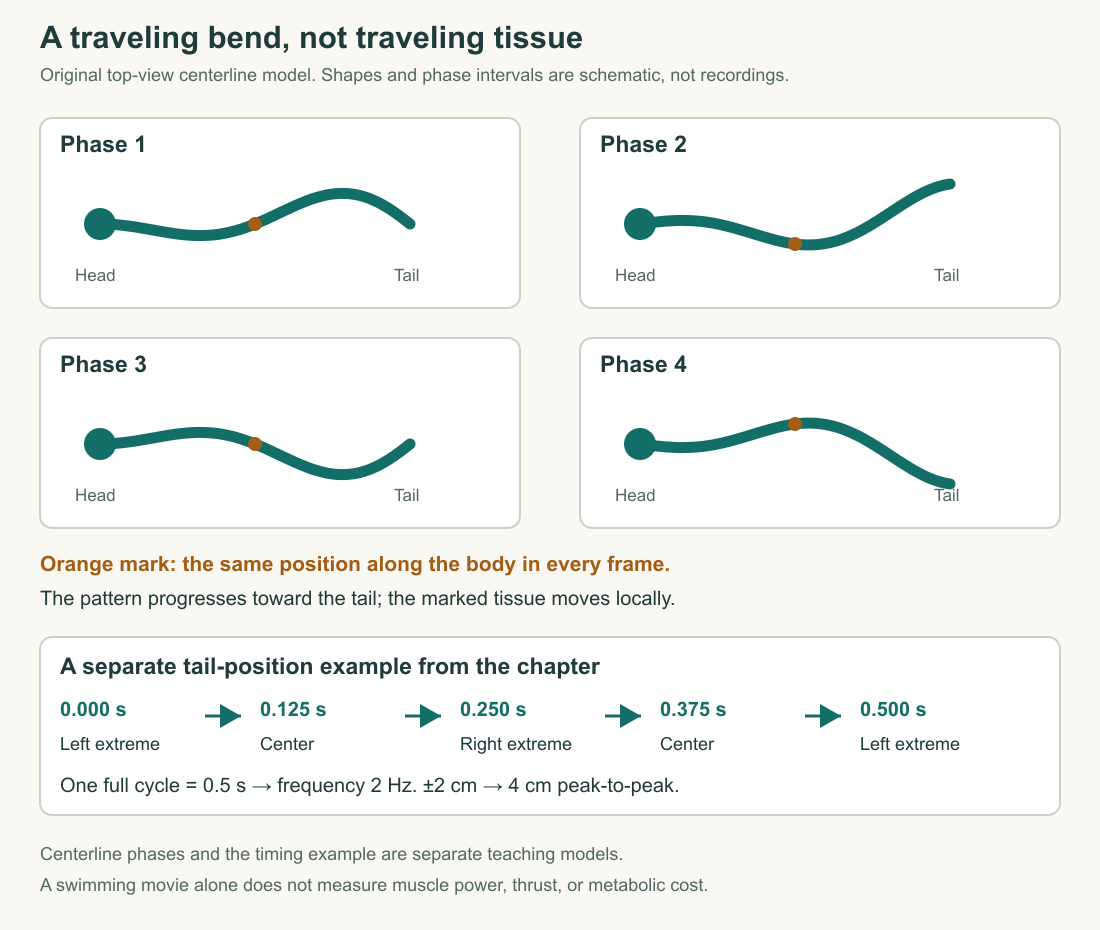
In body-undulating swimming, bends can progress along the animal as different regions change shape in sequence. A point on the skin moves locally, while the pattern of curvature travels from one region to another. Confusing these motions leads to the mistaken picture that a chunk of muscle slides from head to tail during every beat.
Use an original sequence of three marked positions along a flexible model: front, middle, and rear. Suppose maximum leftward displacement occurs at the front at time zero, the middle at 0.1 seconds, and the rear at 0.2 seconds. The delay indicates a rearward-moving pattern. The marks themselves remain at their respective positions along the model; their sideways displacements occur at different times.
Now follow the tail alone. It reaches a leftmost position at zero, passes the center at 0.125 seconds, reaches the rightmost position at 0.25, passes the center again at 0.375, and returns left at 0.5. One complete cycle takes half a second, giving a frequency of two cycles per second. Counting each left-to-right movement as a complete cycle would double the answer incorrectly.
If the tail's extremes are two centimeters left and two right of its mean path, the one-sided amplitude is two centimeters and the peak-to-peak excursion is four. Both conventions can appear in research. A comparison must identify which one is used. Frequency and amplitude describe the movement; neither alone measures thrust, metabolic expenditure, or speed through the water.
Muscle force travels through a structured body
Muscle develops tension and transmits it through attachments. Alternating activation on the two sides can contribute to alternating bends, but the fish is not a loose string pulled directly beneath each visible curve. Connective structures, the axial support, neighboring tissue, and fluid loads influence where shortening produces movement. Some muscle activity can resist a deformation or stiffen a region instead of visibly shortening it.
Yellowfin tuna provide a documented reason to look beneath the outline. Shadwick and Syme measured deep red muscle length changes and activation during swimming, and measured forces transmitted through a caudal tendon in some fish. Local body curvature did not simply predict the muscle's shortening. Their results support transmission of power toward the tail rather than treating each active region as a local bending motor. Shadwick and Syme: yellowfin tuna muscle mechanics
This is not a reason to abandon observations of bending. It is a reason to state what they measure. A silhouette provides kinematics, the description of motion. An electrical recording can help establish activation timing. Length and force measurements add mechanical information. Those observations address different links in the same explanation, and one should not silently substitute for another.
Consider a hypothetical muscle that develops tension while its length remains nearly constant. It can transmit force without doing shortening work during that interval. The tissue may still consume energy. Conversely, visible shortening at low force can produce less mechanical work than modest shortening under high force. A picture of the most dramatic bend is therefore not a map of the largest power production.
A flexible fin changes what a stroke can do
A fin supported by rays can change curvature and orientation across its surface. Different portions need not behave as one rigid plate. Muscles act through the supporting structures, while water loads also deform them. Active control and passive material response combine to determine the surface that the flow actually encounters.
Lauder and colleagues' bluegill research describes substantial pectoral-fin deformation and control of different regions. Their fluid measurements found forward thrust throughout the studied beat cycle, challenging the assumption that one half must be only a useless return. The report connects movement, material properties, control, and flow rather than treating the fin outline as sufficient. Lauder and colleagues: flexible pectoral propulsors, abstract
An original paper model can help you think about the distinction without serving as a fish experiment. Sketch one fin as a flat rectangle at two successive angles. Sketch another with its upper and lower edges bent differently. The two drawings can share the same tip position while presenting different surfaces to the water. Tracking only the tip would miss that difference.
The next inference should remain specific. Different deformation could alter force direction, magnitude, or timing. The drawing does not tell us which change occurred. That requires a flow or force analysis appropriate to the movement. The useful advance is that we have identified a missing variable instead of assuming that matching tip paths imply matching propulsion.
Moving forward and staying upright are separate tasks
A force can translate a body and also tend to rotate it, depending on where its line of action lies relative to the center of mass. The turning effect is torque. In a simple perpendicular-force model, torque magnitude equals force multiplied by the perpendicular distance from the center to the line of action. Direction matters as well as magnitude.
Assign a model fin a sideways force of 0.2 newtons acting with a perpendicular distance of 0.05 meters. The torque magnitude is 0.01 newton-meters. Moving the same line of action to 0.1 meters doubles that value. A larger turning effect need not require a larger force; location can change the result.
Describe rotations using three axes. Yaw changes the heading left or right. Pitch raises or lowers the head relative to the tail. Roll rotates the body around its long axis. A movement intended to generate forward force may also create one of these rotations, which another surface or later part of the stroke must accommodate.
Two fin forces can partly cancel in translation while contributing to rotation, or cooperate in translation while their torques oppose one another. That is why counting how many fins move does not tell us how many independent purposes they serve. A maneuver is a coordinated force-and-torque problem involving the arrangement of the whole body.
Backing up is more than playing a swimming film backward
Flammang and Lauder studied slow backward swimming in four bluegill sunfish using video, muscle recordings, and flow measurements. Several fins participated, with a coordination pattern different from slow forward swimming. Their measured dorsal and anal fin flows included momentum directed toward the head, consistent with contributions to backward propulsion. Flammang and Lauder: backward swimming in bluegill
The comparison makes an everyday maneuver into a mechanical question. A fish moving backward has not exchanged the anatomical locations of its head and tail. Its fin forces still act at their original positions relative to the center of mass. A pattern adequate for forward movement can therefore require different coordination when the desired translation reverses.
Imagine backing away from a crevice while keeping the same heading. Turning around first would be a different solution, potentially requiring more space. The observed outcome—retreat without a heading reversal—constrains the explanation: it must account for backward translation and orientation control together. It cannot be explained by saying only that the tail pushed harder.
Our three recurring species should not inherit the bluegill's exact fin sequence merely because it solves an attractive problem. The bluegill supplies a documented comparison showing what coordinated fins can accomplish. A claim about garibaldi maneuvering requires observations of garibaldi, while the mechanical questions about force location and orientation transfer more broadly.
Water can contribute energy already present in the surroundings
Behind an obstacle, flow can differ from a uniform current in both speed and structure. Rotating regions of flow, called vortices, can pass in a repeating pattern. A fish there encounters changing forces even before its own movements are considered. The environment is an active part of the mechanical account.
Liao and colleagues compared rainbow trout swimming near experimental cylinders with trout in unobstructed flow. Downstream trout showed a distinctive body pattern with tail-beat timing matching the shed vortices. Their comparison distinguished occupying slower water from synchronizing body motion with the flow pattern. The kinematic results support possible use of environmental flow energy; they are not, by themselves, a complete metabolic measurement. Liao and colleagues: the Kármán gait
The lesson is more precise than “fish rest behind rocks.” A sheltered position can reduce one demand, while a repeating flow can create a different interaction. Shape, timing, and placement determine whether that interaction helps or destabilizes the body. Seeing a trout sway behind an obstacle does not establish that all the energy producing the sway came from its muscles.
Nor does environmental assistance make continued control unnecessary. Remaining in a useful region and maintaining an appropriate orientation are themselves biological tasks. The observation invites a linked explanation involving the flow, the body's mechanical response, and sensory control. Chapter 6 will return to how a fish can obtain information about water movement.
Choose a performance question before ranking bodies
An animal that covers a long distance steadily and one that turns within a crowded space face different performance questions. Maximum short-term speed, duration at a specified speed, turning radius, stopping distance, and precision of position are not interchangeable achievements. A body cannot be ranked on “good swimming” until the task and conditions have been stated.
Use two invented swimmers. One covers ten meters in ten seconds but needs a wide turn. Another covers the same distance in twenty seconds and turns within a narrow passage. The first is faster on that segment. The second may complete a route the first cannot negotiate under the assigned spatial constraint. These observations do not reveal which uses less metabolic energy over a whole day.
When you inspect the swimming sequence, record translation, rotation, body curvature, and fin motion separately. Add the camera timing and local flow estimate. Then propose the force relationships that could connect them, marking which remain inferred. A useful account of swimming explains the route from muscle to moving water and back to the body's trajectory, rather than ending with a name for the tail shape.
Application
Annotate the supplied model sequence
Use the tail positions at 0, 0.125, 0.25, 0.375, and 0.5 seconds. Draw the five positions relative to the mean path, label one complete cycle, and distinguish one-sided amplitude from peak-to-peak excursion. Explain why the sequence alone cannot give water-relative swimming speed or muscle power.
Compare two explanations of station holding
An observer says a trout's large bends behind an obstacle prove it is working harder than a trout in uniform flow. Give a competing account suggested by the supplied cylinder study. Name one observation that addresses body movement and another that would be needed to address energetic expenditure more directly.
Model interpretation
The tail completes one cycle in 0.5 seconds, so frequency is 2 Hz. The one-sided amplitude is 2 cm and peak-to-peak excursion is 4 cm. The series describes a marked point's lateral motion. Without body translation and local flow it does not establish water-relative speed; without the relevant force and metabolic information it does not establish mechanical or energetic cost.
The cylinder study suggests that changing environmental flow can contribute to a large body motion while the trout coordinates with the passing vortices. A body outline supplies kinematics. Appropriate metabolic measurements under comparable conditions would address expenditure, with the measurement setup and other activities accounted for. Large motion can be important evidence without being a direct energy meter.
For the torque model, 0.2 × 0.05 = 0.01 N·m, and doubling the perpendicular distance doubles that torque. The fin's location therefore belongs in a maneuver explanation alongside its force. The complete account must address both progress and orientation.