Remaining at the right depth
Two fish appear suspended in the water. One makes occasional fin adjustments; the other swims steadily along a nearly horizontal path. Both keep approximately the same depth, but they need not be balancing the same forces in the same way. A constant depth is an outcome. It does not identify the mechanism producing it.
The distinction matters when the fish changes speed or moves deeper. A gas-filled space changes volume under pressure, oil contributes differently to average density, and a moving fin produces forces that depend on flow. We will connect those mechanisms to the whole body's force account, then ask why a successful arrangement at one depth does not automatically work at another.
Start with the forces, not the organ name
Weight acts downward, and the surrounding water supplies an upward buoyant force. Motion of the body and fins can add vertical components of hydrodynamic force. Contact with the bottom can supply support as well. For a fish maintaining a steady depth without vertical acceleration, the relevant vertical contributions must balance over the interval being considered.
Assign one fictional fish a weight of ten newtons and a buoyant force of ten. It needs no additional average upward force in this simplified account. Give another the same weight but only nine newtons of buoyancy. It needs an additional one-newton upward contribution to avoid accelerating downward. If it rests on the bottom, support can supply that contribution; if it swims above the bottom, its movement may supply it.
These are deliberately assigned forces. They do not imply that the first fish is inactive or that the second must swim continuously throughout its life. Both may use fins to control orientation and position. The account distinguishes the force needed to counter weight from all the other work involved in occupying a place.
Neutral buoyancy means buoyant force balances weight under the stated conditions. It does not mean zero mass, zero inertia, or immunity to currents. A neutrally buoyant fish still requires forces to accelerate, turn, or resist transport by moving water. It can also have a rotational balance problem even when its net vertical force is zero.
A small gas space can change average density
Many bony fishes possess a swim bladder, a gas-containing organ whose volume contributes to the volume of the whole animal with relatively little added mass. The relevant density is the body's total mass divided by its total displaced volume. A gas space can therefore change buoyancy without replacing most of the body.
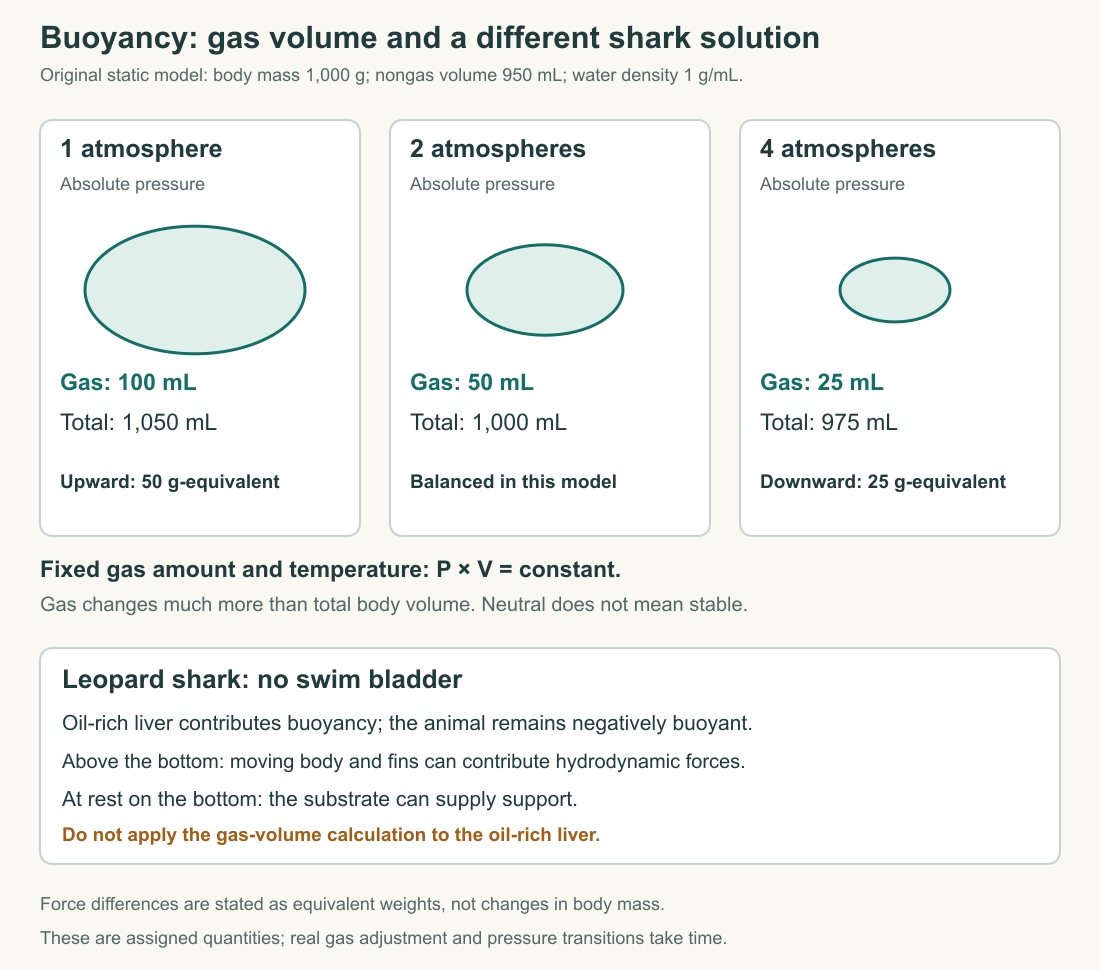
Build an original model with a mass of 1,000 grams, 950 milliliters of nearly incompressible body volume, and 50 milliliters of gas volume. Neglect the gas mass and assign the surrounding water a density of one gram per milliliter. Total volume is 1,000 milliliters, displacing 1,000 grams of water. Under these assumptions, weight and buoyancy balance.
Now reduce the gas volume to 25 milliliters without changing the modeled tissue volume or body mass. Total displacement becomes 975 milliliters, equivalent to 975 grams of water. The downward excess is the weight corresponding to 25 grams. Halving the gas space did not halve the whole fish: it reduced total displaced volume by 2.5 percent.
That distinction is easy to lose in a balloon analogy. The compressible part can be a small fraction of total volume while still making an important difference to the force balance. The calculation explains what changing gas volume can accomplish; it does not predict the exact bladder fraction or buoyancy of a particular species.
Pressure changes volume even before the fish responds
For a fixed amount of ideal gas at constant temperature, pressure multiplied by volume remains constant. This is Boyle's law. Use absolute pressure, including the pressure already present at the surface, rather than only the additional pressure due to depth. Real swim bladders also have walls, surrounding tissues, gas exchange, and temperature histories, so the relation is a starting model. NASA Glenn: Boyle's law
Suppose our 50-milliliter gas space is initially at two atmospheres absolute pressure. If pressure rises to four while gas amount and temperature remain fixed, its new volume is 2 × 50 / 4 = 25 milliliters. If pressure instead falls to one atmosphere, volume becomes 100 milliliters. These are changes caused by the altered physical conditions, before any gas addition or removal is included.
Using the approximate ocean-pressure relationship from Chapter 1, two atmospheres corresponds to roughly ten meters depth and four to roughly thirty. Going from ten to thirty meters triples depth but only doubles the absolute pressure in this approximation. A calculation based on depth alone would therefore give the wrong volume ratio.
The model is not an instruction to expose fish to changing pressure. It is a way to understand why a vertical movement can change the force balance. It also identifies the missing terms in a fuller account: gas amount, temperature, tissue mechanics, and the time available for physiological adjustment.
Neutral at one depth need not mean stable after displacement
Imagine the modeled fish initially neutral at two atmospheres. A disturbance moves it deeper before it can alter its gas amount. Compression reduces gas volume and buoyant force, creating a further downward tendency. If a disturbance instead moves it upward, expansion can increase buoyancy and encourage additional ascent. The passive response can amplify the original displacement.
This is different from a restoring response that returns the body toward its starting depth. Neutral force balance at one location and stability around that location are separate properties. A sketch that labels a fish “neutral” has not yet shown what happens after a small displacement or how the animal controls the resulting motion.
Fin forces and behavior can respond on different time scales from changes in the amount of bladder gas. A fish may alter its swimming path or orientation while its gas content remains approximately unchanged over the interval. Successful depth control can therefore combine a slowly adjusted buoyancy state with quicker movement corrections.
For a thought experiment, hold the gas amount fixed and compare an ascent that is stopped by downward swimming with one stopped by gas removal. Both could end at the same depth. Their muscle use, gas history, and subsequent response to another displacement could differ. The trajectory alone does not identify which mechanism supplied the correction.
There is more than one route for adjusting bladder gas
In physostomous fishes, a pneumatic duct connects the swim bladder to the digestive tract. Rainbow trout provide a familiar example. Air taken at the surface can enter through that route. In physoclistous fishes, the mature bladder lacks that open connection, so gas exchange with the blood becomes central to changing its gas content. The distinction concerns anatomy, not a simple ranking of better and worse control. Rainbow trout study: anatomical background to the pneumatic duct
A connected duct makes access to an external gas source a possible part of buoyancy control. It does not establish that a fish can instantly choose any gas volume at any depth. The animal's location, access, behavior, and other gas-transfer processes still matter. Likewise, a closed bladder is not sealed against all molecular exchange simply because no open tube leads to the mouth.
This also separates breathing from buoyancy. A visit to the surface can serve gas acquisition for a buoyancy organ without proving that the organ supplies the animal's respiratory oxygen. One should identify where the gas goes and what exchange takes place there. The same visible behavior can invite different explanations depending on the species and the organ involved.
For the recurring salmonid comparison, we will use rainbow trout and its migratory steelhead form, both Oncorhynchus mykiss. That choice lets us connect this anatomical example to the swimming evidence already encountered. It does not make a freshwater laboratory trout and an ocean-migrating steelhead physiologically identical at every stage; the next chapter will make those changing states explicit.
Filling against pressure requires a concentrating mechanism
A closed bladder at depth poses a chemical puzzle. How can gas enter when the surrounding hydrostatic pressure is high? The answer cannot be simply that blood arrives from the gills carrying oxygen. Gas will diffuse according to the relevant local partial-pressure difference, so the supplying region must establish conditions that favor entry into the bladder.
Pelster's account of the European eel describes metabolically active gas-gland cells that acidify adjacent blood. The resulting Root effect reduces hemoglobin's oxygen-carrying capacity and raises oxygen partial pressure. A closely arranged countercurrent network of vessels, the rete mirabile, helps concentrate gases through exchange between returning and incoming blood. Molecules can then diffuse into the bladder along a local gradient. Pelster: gas secretion in the eel swim bladder
The diffusion step does not make the complete process free. The gland's metabolism and the supplied circulation are part of how the gradient is established and maintained. Nor does the rete create oxygen from nothing. It changes the local distribution and concentration of gases already within the account. Material and energy still require their own inputs.
Notice the different use of countercurrent organization. At the gill, oppositely directed water and blood support uptake across an environmental boundary. In the bladder's rete, closely apposed blood streams support concentration within the supply route. The geometry is related, but the participating fluids and the explanatory task differ. Naming both “countercurrent” should not hide that difference.
A leopard shark changes the comparison
The leopard shark has no swim bladder. The Monterey Bay Aquarium describes an oil-rich liver contributing to buoyancy while the animal commonly remains negatively buoyant. Oil helps lower average density relative to an otherwise comparable body containing denser material; it need not make the whole animal neutral. Monterey Bay Aquarium: leopard-shark buoyancy
Unlike a gas space, a liquid oil store does not undergo the same large volume change predicted by our ideal-gas model during a modest pressure change. It therefore contributes a different depth response. But it also contributes mass and occupies space. “Contains oil” is not a complete calculation: the total body's composition and volume determine the static balance.
The remaining downward tendency can coexist with life near or on the bottom. Above the bottom, appropriate hydrodynamic forces can help maintain a level path. Chapter 2's force-and-torque account now becomes relevant again: the body's attitude and fin arrangement influence both vertical support and orientation while it moves.
Avoid treating this shark as a failed version of a hovering bony fish. The relevant tasks include feeding location, movement pattern, and the circumstances in which bottom support is available. A mechanism that reduces one cost may introduce a different dependence. The useful comparison explains the consequences for a stated activity rather than assuming that neutral buoyancy is every fish's overriding objective.
Rapid pressure change can outpace compensation
NOAA's account of rougheye rockfish research describes the consequences of bringing fish from depth to lower pressure. Expansion can produce excessive buoyancy and internal injury, and the account distinguishes immediate appearance from longer-term outcomes. Rockfish have closed gas bladders, making this a specific contrast to the duct-connected trout example. NOAA: rougheye rockfish and pressure change
The lesson is about rate as well as magnitude. A body may function at either of two pressures under appropriate conditions yet respond badly to a rapid transition between them. “Can live at this depth” and “can be moved there at any speed” are different claims. The second requires evidence about the transition and the animal's capacity to compensate.
We are using the documented case to interpret physiology, not assigning capture, handling, or pressure experiments. A photograph of an affected fish also does not establish which internal structures were injured or whether later functions recovered. The research question must specify the outcome and follow-up interval instead of treating disappearance of one visible sign as complete recovery.
Read a depth record as a force history
Suppose a fictional tagged fish stays at twelve meters for an hour, descends to twenty-four, and later returns. The record establishes position through time if the tag and conversion are appropriate. It does not directly reveal bladder gas amount, fin force, surrounding vertical currents, or feeding activity. Several mechanisms could contribute to the same depth sequence.
Add a movement record showing faster tail beats during the descent. That supplies another observation but still does not say the fish increased bladder gas or became more buoyant. To infer a mechanism, connect the data to the force account: which contribution changed, in what direction, and with what expected consequence for the trajectory?
A useful comparison can begin with three columns: static buoyancy, movement-generated force, and environmental or bottom support. Put the gas-bearing model, leopard shark, and pressure-transition case into those columns. Then state which term is measured, inferred, or merely assigned. The point is not to force all fish into three boxes; it is to prevent one organ name from standing in for a complete explanation.
Depth control now connects body composition, gas chemistry, pressure, locomotion, and time. A fish remains at a chosen level through a workable combination of these processes. The next environmental boundary is chemical rather than vertical: what changes when a fish moves between fresh water and seawater while its cells still require a controlled internal solution?
Application
Recalculate the model at a new pressure
The original model has 950 mL of nearly incompressible volume and 50 mL of gas at two atmospheres. Its mass is 1,000 g, and the surrounding water is assigned 1 g/mL. Hold gas amount and temperature fixed. Calculate gas volume, total displacement, and the direction of the static force imbalance at four atmospheres and at one atmosphere. Explain why the body does not halve in size at four atmospheres.
Compare the mechanisms
A student explains a resting leopard shark by saying its swim bladder has been adjusted for the bottom. Repair the anatomy and identify two possible contributors to its vertical balance in different circumstances. Then explain why a duct-connected bladder and a closed bladder create different questions about access and adjustment time.
Model interpretation
At four atmospheres, gas volume is 25 mL and total volume 975 mL. The modeled displacement supports the weight of 975 g of water, leaving a downward excess corresponding to 25 g. At one atmosphere, gas volume is 100 mL and total volume 1,050 mL, giving an upward excess corresponding to 50 g. Only the modeled gas portion changes this way; tissue volume remains 950 mL by assumption.
The leopard shark lacks a swim bladder. Its oil-rich liver contributes to the body's buoyancy, while bottom support can contribute when it rests and hydrodynamic forces can contribute while it swims. The complete balance depends on the situation. A pneumatic duct provides an anatomical gas route connected to the digestive tract; a mature closed bladder requires another transfer route. Neither label alone gives the rate of successful adjustment.
The calculations describe a deliberately simplified physical body. They are not predictions of injury, exact live-fish volumes, or a procedure for changing an animal's depth. A sound explanation states where the model applies and which biological response it leaves to be measured.