Read an insect body
A caterpillar grips a stem while a moth hovers nearby. One looks like a flexible tube with too many feet; the other looks like a compact flying animal. If they belong to the same species, which one has the insect body plan? Both do. The difficulty is that a body plan is a pattern of relationships, not a promise that every stage will resemble the familiar diagram of an adult grasshopper.
This course asks how insects accomplish ordinary biological tasks with structures that can be unfamiliar to us. We will follow the tobacco hornworm moth, Manduca sexta, and the American grasshopper, Schistocerca americana, then bring in the western honey bee, Apis mellifera, for a contrasting social life. These are named examples, not representatives that can answer every question about every insect. Begin with The Problems Every Animal Must Solve if cells, diffusion, energy and evolutionary explanations are new to you.
Find the relationships before counting the parts
Start with an adult grasshopper seen from the side. The head carries the mouthparts, a pair of antennae and the conspicuous compound eyes. Behind it lies the thorax, the region bearing the legs and wings. The abdomen extends farther back. These three regions are called tagmata: groups of segments organized into larger functional units. A segment is one of the repeated subdivisions from which the body develops. A tagma can include several segments that are difficult to distinguish externally.
The thorax contains three segments, each ordinarily bearing one pair of jointed legs. In a winged adult grasshopper, the two wing pairs attach to the second and third thoracic segments. The first thoracic segment does not carry a wing pair. Wings folded back over the abdomen can make their attachment seem farther rearward than it is. Follow a structure to its base before deciding which region owns it.
That habit prevents a surprising number of errors. A long wing lying along an abdomen is still a thoracic appendage. A hind leg bent forward beside the head is still attached to the thorax. An antenna reaching back along the body originates on the head. Position in a photograph is not the same as anatomical attachment. In a drawing, use a thin line to connect each visible structure to the place where it joins the body, leaving hidden attachment points explicitly uncertain.
The Smithsonian's insect-zoo description uses the familiar adult pattern of three body regions, one antennal pair and three leg pairs. It is a useful orientation, provided that the word “pattern” remains visible. Some insect stages lack conspicuous walking legs; other structures can look like extra legs. Injury can also remove a leg without changing an animal's identity. Classification cannot depend on the number of feet visible in a single photograph.
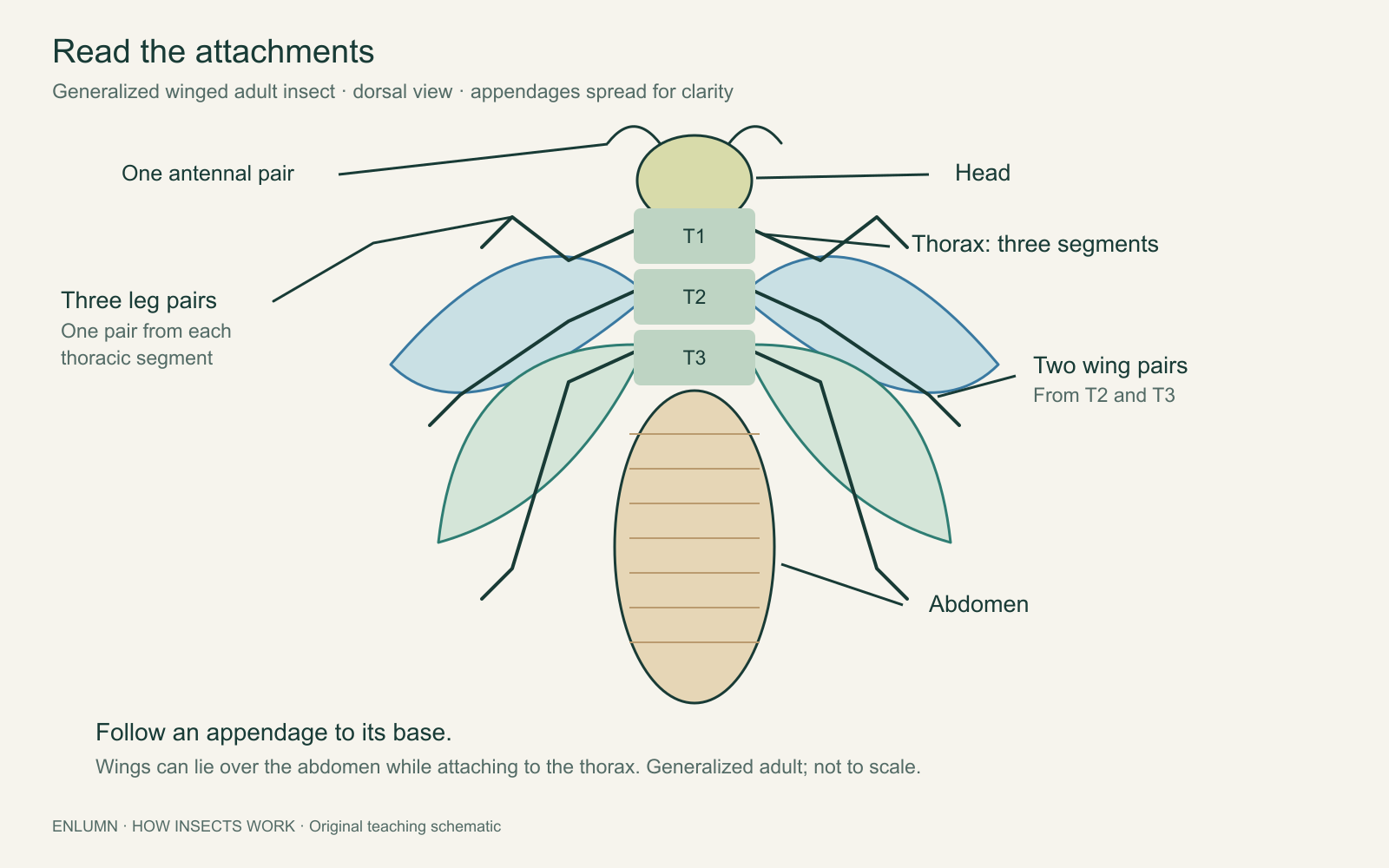
Read the diagram as a map of connections. Its legs are spread apart to expose their origins, and its wings are schematic. An actual grasshopper folds and rotates these parts; an actual moth covers much of the thorax with scales. The diagram removes that visual clutter to answer one question: which structures arise from which body region? It does not predict the posture, proportions or detailed venation of an insect you encounter.
Why a caterpillar does not invalidate the pattern
The front of a hornworm caterpillar includes a distinct head capsule followed by three thoracic segments. Each thoracic segment carries a pair of relatively small jointed legs. Farther back, fleshy abdominal prolegs help the animal hold its support. These are different structures from the thoracic legs. Their presence means that “count everything touching the leaf” is the wrong identification procedure.
Prolegs can grip while the body bends and advances. They do not become the adult moth's three pairs of walking legs. The distinction concerns position and development, not whether a structure deserves to be called a real foot in everyday speech. In Manduca, the abdominal prolegs disappear during metamorphosis. The adult's walking appendages occupy the thorax. We will follow the change in chapter five rather than trying to infer it from resemblance alone.
Now imagine two photographs of the same caterpillar. In the first, the near-side prolegs are visible but the small thoracic legs are hidden behind the stem. In the second, the animal has turned and the thoracic legs can be seen. The first photograph has not documented an animal with no thoracic legs. It has documented a view in which they cannot be counted. Record the limitation rather than completing the hidden side from memory.
The University of Florida account of Manduca sexta supplies a useful stage reference: a leaf-feeding larva, a pupa in soil or litter, and a nectar-feeding adult moth. Its name “tobacco hornworm” describes the larval appearance and a familiar host association. It does not mean the animal remains a wormlike caterpillar throughout life, or that any hornworm found on a tomato plant must be this species. The closely related tomato hornworm is a separate species.
The horn itself is another invitation to overinterpretation. A pointed structure suggests a weapon to a human observer, but shape alone does not establish its operation. Before calling it a sting, ask for anatomy showing a delivery apparatus and evidence that it injects something. This course does not require handling a caterpillar to test the claim. An unsupported label should be removed without replacing it with an equally unsupported story about why the feature evolved.
An external skeleton is a varied surface
An exoskeleton is a supporting outer structure. In insects, the cuticle is the nonliving material secreted by an underlying living epidermis. It is not simply a shell resting on an otherwise finished animal. Its thickness, composition, stiffness and surface properties differ among regions. A hard head capsule and a flexible caterpillar body wall can both belong to the same insect.
Chitin, a structural carbohydrate, occurs in a protein-containing material. The association matters. Saying “made of chitin” is like identifying timber in a building without describing joints, grain or arrangement. Material composition and organization affect what the structure can do. Local hardening, called sclerotization, strengthens selected regions; flexible membranes allow movement between them. The outer surface also helps restrict water loss. Restriction is not complete impermeability.
The NC State account of the exoskeleton identifies these material layers and inward folds used for muscle attachment. An inward projection can act as a place for a muscle to pull, so “external skeleton” does not mean that all supporting material remains on a smooth outer boundary. The boundary can fold inward. Chapter two will use this arrangement to explain a moving joint.
Consider a hypothetical insect that has a uniformly rigid, seamless body covering. Its muscles could contract, but the covering would not permit the ordinary relative motion of adjacent leg segments. Now imagine an entirely soft covering without localized reinforcement. Bending would be possible, but transmitting forces through a long, narrow appendage would present a different problem. Actual bodies combine regions with different mechanical properties. The contrast explains why neither “hard shell” nor “soft skin” is an adequate account by itself.
A surface must also admit information. A sensory bristle is not useful because it decorates the body; movement of the structure can affect a receptor associated with it. Other sensory structures admit chemical stimuli or light. Consequently, a body covering cannot be understood solely as armor. The insect needs a boundary that resists some exchanges while permitting others. Protection, movement and sensing impose different requirements on the same general region.
Distinguish insects from their neighbors
A spider shares an arthropod heritage with an insect: a segmented ancestry, jointed appendages and a cuticular exoskeleton. A typical adult spider nevertheless has four pairs of walking legs, no antennae and a different arrangement of body regions. Its front leglike pedipalps should not be counted as an additional pair of walking legs. A comparison becomes clearer when appendages are named by their connections and identities, rather than by whichever silhouette they resemble.
A centipede extends the comparison in another direction. Its repeated trunk units bear many legs, rather than concentrating three walking pairs on an insect thorax. A woodlouse is a terrestrial crustacean, despite its small size and presence under garden objects. “Lives on land” and “small enough to call a bug” are ecological or conversational descriptions, not the defining characters of the insect group.
These comparisons do not make every six-legged arthropod an insect under every modern classification. Springtails, for example, belong to the broader six-legged group of hexapods but are distinguished from insects in commonly used classifications. You do not need to master that taxonomy here. You do need to avoid turning one convenient adult feature into a complete evolutionary definition. Shared ancestry is inferred from suites of evidence, not a single tally.
There is a second distinction between the everyday word “bug” and its narrower entomological uses. Everyday speech may include spiders, beetles and mosquitoes. A biological account should name the group or species it means. The purpose is not to correct casual conversation at a picnic. It is to prevent a sentence about one lineage's feeding structures or development from being silently applied to everything someone happens to call a bug.
A useful observation has boundaries
Suppose you watch a small winged animal land on a flower. Write the first sentence using only what the view supports: “A six-legged animal with two visible antennae landed on the flower and inserted a long mouthpart.” The observation is compatible with an insect using a proboscis. It does not identify the species, measure nectar uptake or prove pollination. Pollen transfer and successful fertilization are separate events that require their own evidence.
The next sentence can add an interpretation: “The mouthpart appears suited to taking up liquid.” That is a structure–function proposal. If you have a reliable species identification and a documented feeding account, you can strengthen it. If the mouthpart never enters the flower in your view, keep the proposal weaker. Observational precision comes from matching the sentence to the evidence, not from using the longest available anatomical word.
Make a record with four fields: view, visible structures, observed action and unresolved question. For a side-view grasshopper photograph, the visible structures might include one compound eye, an antenna, a large hind femur and folded wings. The action field should say “still photograph; no movement observed.” The unresolved question could concern how the hind leg unfolds during a jump. A photograph of a jumping posture is not a measured sequence of takeoff.
This method also separates identification from explanation. A reliable identification lets you consult relevant work, but it does not explain how the animal accomplishes an action. Conversely, an accurately described joint can support a mechanical explanation even if the photograph cannot be identified to species. State the level at which you are working. “Generalized insect joint” and “measured movement in Schistocerca americana” make different promises.
For our focal grasshopper, the University of Florida species account documents changing wing development through nymphal stages. This gives us a reason to look for wing pads when distinguishing immature from adult forms. It does not let us assign an exact age in days from a distant image. Temperature, developmental conditions and the quality of the view matter. A developmental stage is not a universal calendar date.
Turn the map into questions
The body map now gives us six connected questions. How do muscles move a skeleton located outside them? How does an animal grow when parts of that skeleton are relatively inextensible? How do active tissues obtain oxygen without mammalian lungs? How does a nervous system combine chemical and visual information? How can one individual pass through radically different forms? How can separate individuals coordinate the work of a colony?
Each question requires a different kind of evidence. A joint diagram helps explain force transmission. A sequence of developmental observations establishes the order of molts. Measurements of gas transport test a respiratory account. A controlled comparison can distinguish sensory explanations. Records of individual behavior are needed before a busy group is described as an organized society. No single beautiful insect photograph can answer all six.
Keep the caterpillar and moth beside one another as you proceed. Their differences are not an obstacle to understanding the body plan; they are part of what the plan makes possible through development. Equally, do not assume that every insect must pass through those forms. The grasshopper will supply a different sequence, and the honey bee will show why a life history sometimes includes dependence on other individuals as well as changes within one body.
Check your understanding: A caterpillar has six small jointed legs near its head and several fleshy gripping structures farther back. A photograph shows only one side. Does this contradict the insect body plan, and what can you safely record?
Expected answer: No. The thoracic legs and abdominal prolegs are distinct structures. Record their visible positions and attachments, identify the view, and leave hidden counts uncertain. The photograph alone does not establish the adult anatomy, the exact species or a movement sequence.
Application
Use the linked Manduca and Schistocerca species pages as references. Draw one larval or nymphal form and one adult form, with six labels focused on attachments rather than artistic detail. State whether each drawing is based on a source image, a generalized diagram or your own observation. Do not combine features from different species into an unlabeled specimen.
Add a 200-word explanation of one identification problem: hidden legs, folded wings or abdominal prolegs. A strong answer explains why the visible count is insufficient and identifies the additional view or developmental evidence needed. You may substitute a written anatomical map for drawing. No collection, handling or rearing is required.