Moving and growing in an external skeleton
A grasshopper can launch itself away from a leaf, yet it must also survive a period when its newly exposed covering has not reached its usual stiffness. Those events belong to the same mechanical story. The exoskeleton provides places to transmit force, but growing and replacing it temporarily changes the body's ability to resist that force. Understanding the benefit without the transition would give us only half an explanation.
A muscle pulls across a joint
Imagine two adjacent leg segments connected at a joint. A muscle lies inside the more proximal segment, closer to the body, and attaches through a tendonlike structure to a point on the next segment. When the muscle develops tension, it pulls on that attachment. Because the attachment is displaced from the joint's axis, the pull can rotate the segment. A muscle does not need to sit outside a lever in order to turn it.
The turning effect depends on both force and the perpendicular distance between the line of force and the axis. That distance is the moment arm. In a deliberately simplified numerical example, a force of two arbitrary units acting with a moment arm of three millimeters produces six force-millimeter units of turning effect. The same force at one millimeter produces only two. These are invented teaching values, not measurements of a grasshopper. They show why attachment geometry matters as well as muscle size.
A skeletal muscle produces a pull. Movement in the other direction therefore needs an opposing arrangement: another muscle, elastic recoil or some combination suited to the joint. A flexor generally bends a joint and an extensor generally straightens it, although the exact movement must be defined for the anatomy in question. Their activity is coordinated. A leg is not a collection of independent ropes that can all shorten fully at once without consequences.
The NC State description of leg structure offers the names used to locate those relationships: coxa near the body, then trochanter, femur, tibia and the subdivisions of the tarsus farther out. Memorizing the whole list is less valuable than tracing one force path. The coxa is near the body attachment; the femur and tibia are conspicuous in a grasshopper's hind leg. A diagram should make the connection clear before asking you to remember its name.
Now follow the force farther. During a push against a support, the foot exerts force on the support and the support exerts force on the foot. The resulting forces pass through the leg and body. A contracting muscle in a suspended leg can change the leg's position, but it cannot produce the same whole-body launch as a leg pushing against a sufficiently firm surface. The environment is part of the mechanical explanation.
Why a large hind leg is not the whole jump
A grasshopper's enlarged hind femur gives room for substantial musculature, and the arrangement of the hind leg contributes to forceful extension. But “large muscle” is not a complete account of takeoff. The timing of contraction, joint geometry, elastic structures, contact with the substrate and the direction of force all affect the result. Studies of desert-locust jumps also show the importance of storing and releasing elastic energy. The desert locust, Schistocerca gregaria, is a different species from our American grasshopper. A detailed account of a particular species requires its own measurements.
Distinguish energy from power. Energy is the capacity transferred in doing work; power is the rate of that transfer. If a system stores an amount of elastic energy slowly and releases much of it rapidly, the release can have greater instantaneous power than the muscle supplied while charging it. No energy has been created. The timing has changed. A bow offers a familiar analogy for storage, although a grasshopper leg is not literally a wooden bow or an identical mechanism.
For an original arithmetic exercise, suppose a mechanism stores twelve arbitrary energy units over six time units, then releases nine over one time unit. The average input power during storage is two units per time; the average output during the stated release is nine. Three stored units have not appeared in the useful release described here. They might remain stored or be dissipated, depending on the stipulated mechanism. The example does not establish an efficiency for any insect.
It also explains why impressive performance expressed in body lengths can mislead. Jumping many body lengths is a useful observation, but it does not mean a human enlarged to the insect's proportions could perform the same feat. Mass, supporting area, muscle dimensions and aerodynamic effects do not all scale in the same way. The general scaling lesson from the foundation course applies to the entire mechanical system, not merely to a photograph enlarged on a screen.
Walking adds coordination to this problem. Some insects use an alternating tripod pattern, with three legs supporting the body while the other three advance. This is a useful pattern to recognize, not a rigid rule for all speeds, surfaces or species. Slow walking, climbing and maneuvering can involve different contact sequences. An actual account requires a sequence of frames showing which feet contact the substrate, not a single drawing with six legs arranged symmetrically.
Flexible bodies can still transmit force
A caterpillar illustrates a different arrangement. Its body wall is relatively flexible, and its abdominal prolegs grip the support while muscular activity changes the shape and position of the body. Internal pressure and the way the body interacts with its substrate contribute to movement. Calling the animal soft does not mean that it lacks mechanical organization. A filled, bounded structure can resist and transmit forces in ways an unbounded mass of fluid cannot.
Compare an imaginary empty flexible sleeve with the same sleeve filled with nearly incompressible fluid and closed at both ends. Squeezing one region of the filled sleeve changes pressure and shape elsewhere. This physical comparison is not a full model of a caterpillar, whose organs, tissue attachments and complex muscle activity matter. It does show why a flexible wall does not imply that muscles have nothing useful to act against.
The abdominal prolegs also change the boundary conditions. A gripping contact can prevent one region from slipping while another advances. Release it too early in a hypothetical sequence and the same muscle contraction could produce a different movement. An explanatory drawing therefore needs contacts and motion arrows as well as anatomy. “Muscles contract” is the beginning of a locomotor account, not its conclusion.
The research literature on Manduca distinguishes these proleg structures from the adult's thoracic locomotor system. Weeks and Ernst-Utzschneider's study follows identified proleg motor neurons through metamorphosis and reports that the prolegs and their muscles are lost while some neurons undergo further change. We will use that developmental distinction later. It is enough here to recognize that a larval gripping arrangement does not simply stretch into a moth's walking leg.
Growth requires replacement as well as food
Food supplies materials and energy for growth, but a rigid portion of cuticle cannot expand indefinitely along with the tissues beneath it. Insects solve this through molting: forming a new cuticle and shedding the old one. The visible shedding event is called ecdysis. It is one part of a longer process that begins before the old covering comes away.
The epidermis first separates from the old cuticle, a step called apolysis. New cuticular material is secreted beneath the old covering. Some inner material from the old cuticle is broken down and recovered. At ecdysis, the insect sheds the remaining old covering through a coordinated sequence of movements. Expansion and subsequent changes in the new cuticle then establish the next working form. The NC State morphogenesis overview provides this sequence as a starting map.
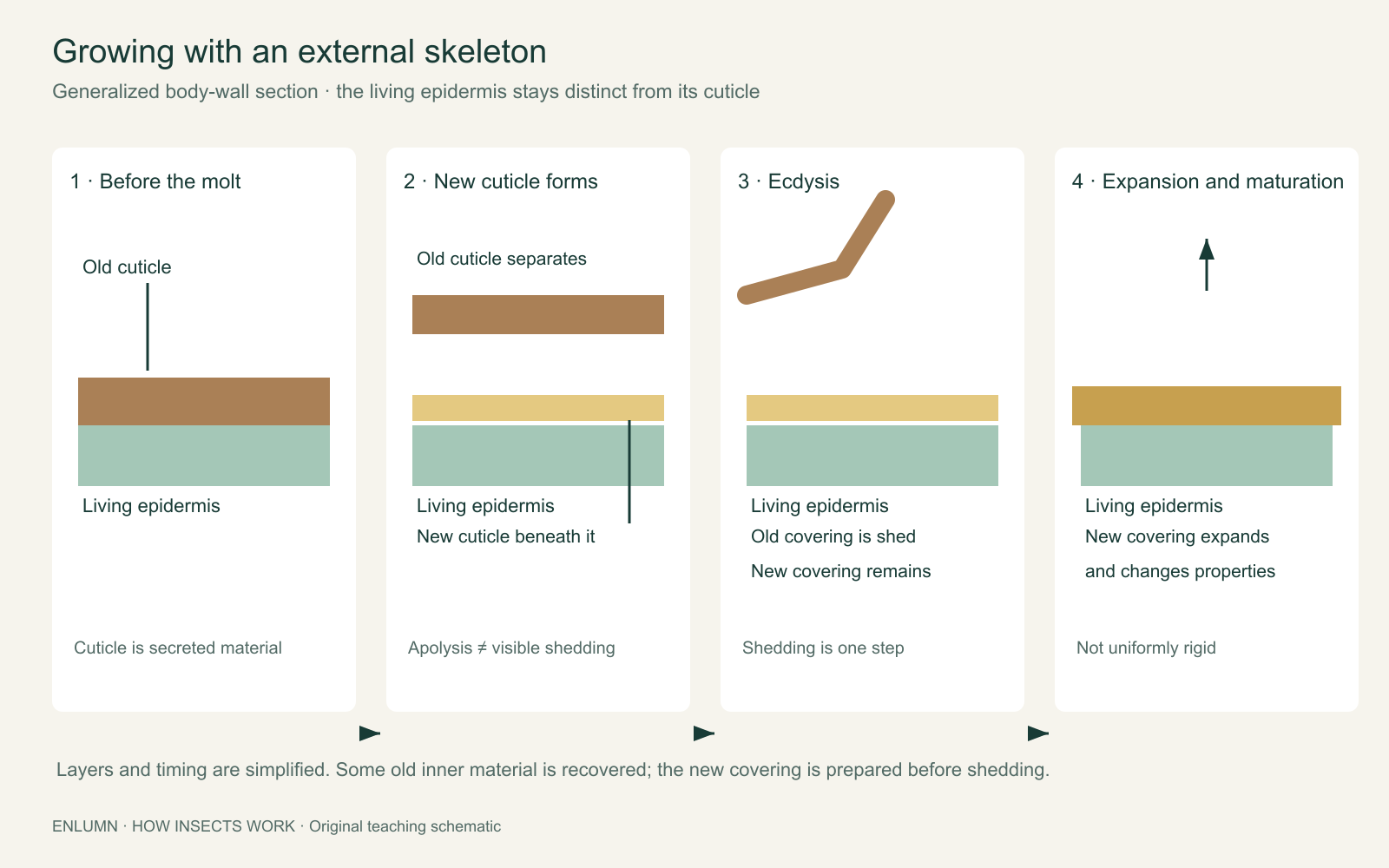
Notice what the sequence rules out. The insect does not first discard all protection and only then begin constructing a replacement from nothing. Nor does the old cuticle become the larger new one by stretching uniformly. Preparation overlaps with continued life inside the previous covering. The exact timing and local material changes vary, but the order gives the animal a way to coordinate growth with a functioning boundary.
The stage between successive molts is an instar. An instar is not a fixed number of days. Two individuals can occupy the same instar after spending different lengths of time developing, and the duration can change with conditions. Nor should a single head or body measurement be turned into an exact stage assignment without a species-appropriate reference. A broad stage sequence is more reliable than an invented calendar.
A molt is controlled, not simply a bursting shell
It is tempting to imagine the animal growing until the covering becomes too tight and tears. That picture misses the physiological coordination required to separate tissues, secrete new material, modify old material and organize shedding behavior. Hormonal signals help coordinate developmental transitions. Ecdysteroids are important regulators of molting and developmental change; juvenile hormone helps influence the developmental character of molts in many insects. The response depends on stage and tissue context.
The word hormone names a signaling substance, not a tiny manager with a blueprint. A tissue must be capable of responding, and the timing of exposure matters. Saying that a hormone is present does not, by itself, tell you which cells will divide, die or change their connections. That requires developmental evidence. Even the phrase “juvenile hormone keeps an insect young” is too loose to substitute for a description of its roles at a particular stage.
An experiment can separate association from contribution. Measuring a hormone before a transition shows timing. Altering its exposure and observing a changed developmental outcome can provide stronger evidence of a regulatory role, subject to controls and other effects of the manipulation. This course asks you to interpret such evidence, not to manipulate living insects. The distinction is the same one used elsewhere in biology: a preceding event can be informative without being sufficient proof of causation.
In the American grasshopper, the successive nymphal stages lead to an adult with fully developed wings. In Manduca, larval molts are followed by a transition to a pupa and then an adult moth. A molt can therefore preserve the broad kind of body or accompany a major developmental transition. Molting and metamorphosis overlap, but they are not synonyms for the same visible event.
The newly exposed body changes the risks
After ecdysis, expansion and maturation of the new cuticle take time. An adult emerging with folded wings cannot be assumed to have the flight performance of a mature individual. The wings must expand and their supporting structures reach a functional state. Similarly, the mechanical properties of a newly exposed body covering differ from those after hardening. A successful transition depends on more than getting out of the old covering.
This creates a period of vulnerability. Reduced stiffness can affect support and force transmission; movement or escape may be restricted during the transition. The animal also needs workable water balance and conditions in which the sequence can proceed. Those connections explain why a molt belongs in an ecological account rather than only in a list of anatomical terms. They do not establish one universal cause of failure or one safe humidity for every species.
Consider a hypothetical observation: an insect remains near a shed covering and its wings look short and folded. Three explanations are possible before further observation: it is newly emerged and still expanding, it is an immature stage with wing pads, or it has a developmental problem. The shed covering helps establish a recent event, but the photograph alone does not resolve the alternatives. A later, noninvasive observation and a reliable species-stage reference would be more informative than touching the wings.
Adults of our focal moth and grasshopper do not continue through additional ordinary growth molts. This is a statement about those life histories. It should not become “every adult insect has stopped molting,” because some primitively wingless insects continue to molt as adults. The recurring lesson is to preserve the boundary around the example that makes a statement true.
Explain a movement across a life stage
We can now assemble a useful account of a grasshopper's leg without treating it as an isolated gadget. The cuticle provides a framework with joints and muscle attachments. Muscles generate tension. Geometry converts tension into turning effects. Contact with a support allows forces to accelerate the body. Elastic elements and timing can shape the release of energy. Growth periodically requires a coordinated replacement of the framework, followed by recovery of its working properties.
For the caterpillar, the account changes. A flexible body, internal pressure, muscular deformation and timed gripping contacts contribute to crawling. Later development removes the abdominal prolegs and establishes a different adult locomotor arrangement. Both animals use cuticle and muscle, yet those shared words conceal important differences in how force is transmitted. A good comparison identifies the common materials and then explains the different arrangements.
Check your understanding: Why is “the insect grows until its shell bursts, then makes a new one” an inadequate account of a molt?
Expected answer: New cuticle formation and separation from the old cuticle begin before visible shedding. Ecdysis is a coordinated part of a longer developmental sequence, followed by expansion and maturation. The account must include living epidermis, regulation and changing mechanical properties, not just pressure against an inert shell.
Application
Draw a four-frame molt sequence using the course diagram. Add a fifth frame showing a functional leg joint after the new cuticle has matured. Use different labels for a muscle, an attachment, a flexible joint region, living epidermis and cuticle. Beneath the drawing, explain one vulnerability created by the transition.
Then solve the invented energy example: twelve units stored in six time units, nine released in one. Report the two average powers and explain why the larger output power does not imply energy creation. A strong response keeps this arithmetic separate from actual measurements of an insect and does not claim that every jump uses an identical storage mechanism.