Rules, routines, and authority
A community center advertises that any resident group can reserve a room. Its website asks for a form, promises a decision, and presents a calendar. One applicant receives confirmation in two days. Another spends three weeks supplying documents that the website never mentioned. Nobody in the building announces an intention to exclude the second group. Nevertheless, the organization has produced unequal access. We will use this fictional center throughout the course to investigate a difficult question: how do arrangements among people produce outcomes that cannot be explained by any one person's intentions?
Start with a relationship rather than a building
An organization is a coordinated body with members, roles and some boundary separating participation from nonparticipation. Our center employs a director, a booking coordinator and facilities workers. It has a budget and can make commitments. An institution is broader: an established arrangement of rules, expectations and practices that organizes an area of social life. Education, employment and professional authority involve many organizations. A school is an organization participating in the institution of education; it does not contain everything education means.
The distinction prevents a familiar mistake. Replacing a school's principal changes one position inside one organization. It need not change credential requirements, family expectations or the assessment practices shared across schools. Conversely, changing a widely recognized qualification can alter decisions in hundreds of organizations without replacing any of their leaders. An institutional explanation must specify the level at which the proposed cause operates.
In the center, residents are not simply customers with equal purchasing power. They appear as applicants, sponsors, neighbors or board members. Each relationship carries different recognized possibilities. A board member can request a policy discussion; an applicant can ask for a booking. The same person might occupy both positions, but their authority does not follow automatically from their personality. It comes partly from the position in which others recognize them.
The institution is therefore visible in ordinary verbs: apply, authorize, certify, appeal, record. Each verb presumes a relationship between people and some standard for what counts as a successful action. Mailing a form to a friend does not constitute an official application. A friendly assurance is not necessarily a booking. Sociology asks how those distinctions become effective, who understands them, and who can challenge them.
Read Weber without making bureaucracy an insult
Max Weber's account of bureaucracy emphasizes specified duties, bounded authority, hierarchy, expert preparation and records. In the primary passage supplied here, section III identifies the importance of “written documents,” while section VI describes administration through “general rules.” These features let an office continue beyond a particular incumbent and distinguish an official decision from a personal favor. Weber's historical generalizations require separate scrutiny; we are using the organizational distinctions, not treating his whole account of world history as established fact. Read Weber's characteristics of bureaucracy.
A rule can be an important protection. Suppose the booking coordinator gives rooms only to people she likes. Publishing eligibility requirements makes her decisions more contestable. A resident can show that an application meets the stated conditions, and another official can review the record. The ability to refer to a standard beyond the official's mood is a practical achievement, not merely paperwork.
But a rule can also encode an exclusion. Requiring a resident group to have an established bank account may be easy for a longstanding association and difficult for a newly organized group. Consistent enforcement would make decisions predictable while preserving this difference. We must distinguish consistency in applying a criterion from justification for choosing that criterion. Neither establishes the other.
Similarly, a hierarchy can provide an appeal and create a bottleneck. If every booking requires the director's signature, the organization has concentrated responsibility, but the director's absence can halt ordinary activity. Decentralizing signatures may improve speed while producing inconsistent decisions. The sociological task is to explain the tradeoff through the distribution of authority and information. Calling hierarchy good or bad before specifying its operation makes the explanation less useful.
Draw the official sequence
Our fictional center publishes four steps: submit a request, receive an eligibility decision, select an available slot, and receive confirmation. Write each step as an action with an actor. The resident submits; the coordinator checks; the resident chooses; the coordinator confirms. This simple exercise reveals ambiguities that a list of nouns can hide. Who is responsible for finding an available slot? Who must respond when no slot fits?
Now add the inputs required at each step. The coordinator needs a completed form and a definition of eligibility. Selecting a slot requires an accurate calendar. Confirmation requires authority to commit the room. If the coordinator sees a calendar but cannot reserve it, information and authority are separated. If she can reserve it but cannot see maintenance closures, authority and information are separated in the opposite direction.
A process map represents this arrangement through nodes and arrows. A node names an action or decision. An arrow states what moves: a request, a document, a decision or a person. Do not allow arrows to become vague symbols for everything happening next. A decision can reach the applicant while failing to reach the facilities team. The booking exists administratively but nobody opens the building.
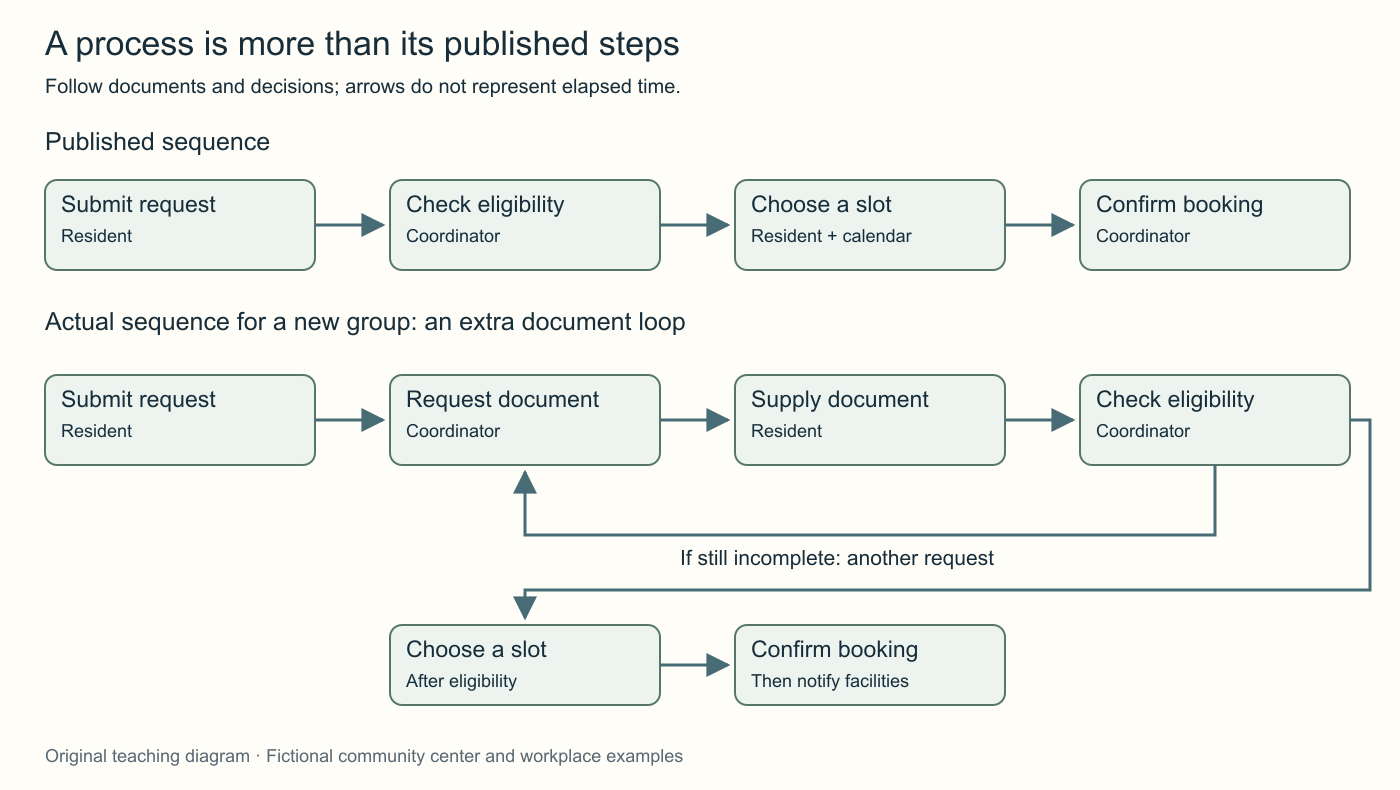
The diagram contrasts a published sequence with a supplied account of actual practice. It is not observational evidence about a real center. Its teaching purpose is to make the missing loop visible. A map that omits repeated requests can look efficient while users experience weeks of delay. Before estimating performance, decide whether your map includes the process people actually encounter.
Follow the routine through an ordinary exception
A routine is a recognizable pattern of activity repeated across occasions. It need not be identical every time. At our center, the coordinator checks whether an applicant has booked before. If so, she reuses an existing contact record. If not, she emails a document request. The official instructions do not mention this distinction, but it shapes the practical sequence.
The coordinator may have a sensible reason. Reusing an existing record reduces work and avoids repeatedly asking established groups for the same information. Yet the routine also privileges organizational experience. New groups face an extra task, an extra response deadline and another opportunity for misunderstanding. We can explain that consequence without deciding in advance whether the coordinator is hostile to newcomers.
Intentions still matter. If she deliberately hides requirements from disfavored groups, that is a different mechanism and demands different evidence. Interviews about motives may help, but so may dated emails, versions of instructions and comparisons between otherwise similar applications. An institutional explanation does not excuse individual wrongdoing. It tests whether the outcome also depends on arrangements that would persist if a different individual took the job.
Consider a replacement who is enthusiastic about inclusion but inherits the same contact database, workload and unwritten practice. If delays recur, the repeated pattern weakens an explanation resting entirely on the former employee's disposition. It does not prove that personalities never matter. The useful counterfactual is narrower: changing the person while preserving the arrangement was insufficient to remove this particular source of delay.
Count what the office does and what the applicant experiences
Suppose twenty new groups and twenty returning groups apply. Eighteen returning groups receive confirmation, while twelve new groups do. The overall confirmation rate is thirty out of forty, or 75 percent. The group-specific rates are 90 and 60 percent. Reporting only the overall rate conceals a thirty-percentage-point difference, but the difference alone does not identify its cause.
Perhaps new groups requested more popular slots. Perhaps the additional document requirement caused withdrawal. Perhaps some were ineligible under a defensible rule. The next step is to locate where the sequences diverged, not to attach a motive to the total. A useful record would distinguish missing documents, unavailable rooms, rejected eligibility and applicants who stopped responding.
Now suppose staff count each email as a completed task. A new group that exchanges six messages contributes six units of recorded work; a returning group confirmed after one message contributes one. The staff activity total rises precisely where access becomes more difficult. Both measurements can be accurate, yet they describe different things. More completed tasks need not mean more completed bookings.
The same principle applies to time. Staff may spend ten minutes on a request spread across three weeks. For the applicant, the uncertainty lasts three weeks. For the worker, it consumes ten minutes. A process evaluation needs both service time and elapsed time because each identifies a different burden. Eliminating idle delay can help users without requiring workers to perform each action faster.
An office record also has a boundary. The forty applications count people who reached submission, not every group that wanted a room. A group discouraged by an unclear website may never enter the database. Studying completed files alone could therefore miss an important source of exclusion. A fuller investigation might compare inquiries with submissions, while recognizing that even inquiries miss people who never contact the center. This is not a reason to abandon administrative records. It is a reason to state which population each record represents and to resist silently turning a count of applicants into a count of everyone who wanted access.
Ask who can revise the arrangement
Authority is a socially recognized capacity to make decisions that others are expected to treat as binding within a domain. It differs from practical influence. The coordinator may know how the system works and persuade the director, while the board alone can revise the eligibility rule. A facilities worker may have no policy authority but can prevent a booking from functioning by failing to receive the opening schedule.
Do not draw authority as a single ladder covering every decision. The board can set room priorities, the director can allocate staffing, and the facilities team can identify whether a room is usable. None of those roles necessarily authorizes access to confidential applicant information. An accurate map attaches a decision domain to each position. Rank by itself is an incomplete description.
This also reveals why reform proposals can miss their target. Telling the coordinator to “be more flexible” cannot create a room that is already occupied. Asking the board to hire friendlier workers does not clarify an ambiguous form. Each proposal assumes a particular cause and a particular location of control. A serious recommendation should name both before promising an improvement.
Sometimes the authority to change a process is itself disputed. Applicants may regard a requirement as an administrative choice; staff may regard it as a board rule. Establishing which document actually authorizes the requirement becomes part of the investigation. The analyst should record uncertainty instead of treating someone's confident description of the rule as the final word.
An objection that improves the explanation
A reasonable critic might say that this approach makes ordinary mistakes sound like deep social structures. Sometimes an employee simply forgets to answer an email. Not every delay needs a theory of institutions. The objection is useful because it requires evidence of repetition, patterned exposure or a mechanism connecting the arrangement to the outcome.
One forgotten message supports a description of one incident. Repeatedly losing messages sent through the same channel suggests a process problem. If only requests requiring a handoff disappear, the handoff is a plausible location for investigation. If delays occur randomly across channels and disappear after one employee's return, an individual or temporary explanation may fit better. Institutional analysis earns its place by improving discrimination among these possibilities.
It should also distinguish a consequence from a function. The extra document loop excludes some newcomers. That does not establish that excluding newcomers is why the loop exists. A practice may persist because it reduces one team's workload, because nobody has authority to remove it, or because managers never see withdrawals. Explaining persistence requires evidence about feedback and decision-making, not just a description of who loses.
Our first map is therefore a hypothesis about an arrangement. It should be revised when records contradict it. The reward for careful mapping is a more precise question: which interaction between rules, information, authority and repeated action generates this outcome? That question gives the remaining chapters a common task while leaving room for schools, workplaces and healthcare to differ in consequential ways.
Check your understanding: The coordinator is replaced, but new applicants still face the same unpublished document loop. What does this establish, and what remains unknown?
Expected answer: It shows that replacing the person did not remove the arrangement producing an extra step. It supports investigating the routine, information and authority behind that step. It does not establish the cause of every rejection, the intentions of either employee, or whether the requirement is justified.
Application
Allow twenty minutes. Draw two maps of the supplied community-center process. The first contains the four published steps. The second adds the new-group document request, its return loop and the handoff to facilities after confirmation. Label every arrow with what moves, and assign an actor to each action.
Write 200–300 words identifying one possible benefit of the extra check, one unequal burden it could create, and two records that would distinguish your explanation from a competing one. Use the fictional totals to calculate overall and group-specific confirmation rates. Keep numerical description separate from causal attribution.
A strong response obtains 75 percent overall, 90 percent for returning groups and 60 percent for new groups. It requests stage-specific reasons and dates rather than claiming that the difference alone proves discrimination. Its reform proposal names who has authority to change the relevant requirement.