Keeping a body warm enough
A northern elephant seal resting on a beach carries insulation useful in cold water. On a sunny day, that same body must avoid retaining more heat than it can tolerate. A big brown bat in winter can reduce its metabolic expenditure through torpor, changing the temperature it maintains. These animals do not solve temperature regulation by holding one universal mammalian number under every condition.
The question is how a body balances heat production, exchange, and temporary storage. Fur, blubber, blood flow, activity, and behavior can all change the account. We will compare them through original physical models and two named studies, keeping measurements of the surface distinct from measurements of the interior.
Warm blood is not an unlimited heat supply
Endothermy concerns the importance of internally generated heat in an animal's thermal biology. It does not mean the body is equally warm everywhere or that temperature never changes. A mammal can rely substantially on metabolic heat while allowing its limbs, surface, or whole-body state to vary.
The distinction between heat and temperature matters. Temperature describes a thermal state; heat transfer describes energy moving because of a temperature difference. Two objects at the same temperature can contain very different amounts of thermal energy because their masses and materials differ. A small warm object can cool rapidly even though its starting temperature matches that of a much larger one.
For an original arithmetic example, imagine one object requiring one energy unit to raise its temperature by a degree and another requiring ten. Removing five units would lower the first by five degrees and the second by half a degree, if their capacities remained constant and no other transfer occurred. These are invented objects, not measured animals. The example shows why a temperature change cannot be interpreted without the amount of material involved.
A living body adds internal heat production and variable exchange. Its temperature can remain approximately steady when those rates balance, even though energy continually passes through it. Steadiness is an outcome of ongoing processes, not evidence that nothing is happening.
Write the heat account before naming a response
A useful account includes metabolic heat production, heat gained from the surroundings, heat lost to the surroundings, and changes in heat stored in the body. External mechanical work also matters when relating total metabolic energy use to heat production. We can simplify the account for a defined case, but we must say what was omitted.
Four exchange routes recur. Conduction occurs through contact; convection involves heat transfer associated with moving air or water; radiation transfers energy electromagnetically; evaporation consumes energy as water becomes vapor. The directions and rates depend on conditions. Air moving past a surface can remove heat when it is cooler, but sufficiently warm air can instead supply heat. OpenStax: mechanisms of heat exchange.
Imagine an invented resting animal producing ten heat units per minute. Suppose its net loss through the surroundings is also ten. Its heat content can remain steady. If sunlight adds three units per minute while all other terms stay fixed, the account now includes an excess of three. The animal must change another term, store the excess temporarily, or undergo a continuing temperature change.
This is why “the air temperature was unchanged” does not establish an unchanged thermal environment. Sunlight, nearby surfaces, wind, water contact, and humidity can change independently. An animal's posture and orientation determine how much of its body encounters those conditions.
Insulation changes a rate
Fur helps retain a relatively still layer of air near the body. Blubber provides a different insulating arrangement beneath the skin. Insulation reduces transfer under a given gradient; it does not generate heat or stop all exchange. Its effect depends on thickness, structure, condition, and the rest of the route between the body and its surroundings.
A simplified resistance model makes the relationship explicit: heat-transfer rate equals the temperature difference divided by thermal resistance. Suppose an invented body surface and its surroundings differ by twenty degrees and the relevant resistance is four units. The modeled transfer rate is five units. Doubling resistance to eight reduces that rate to two and a half, if the gradient and all other conditions remain fixed.
Now keep resistance at four but halve the temperature difference. The same halving of transfer follows in the model, through a different change. A reduced heat-loss rate therefore does not uniquely demonstrate better insulation. It could reflect a smaller gradient, different exposure, altered surface blood flow, or some combination.
Marine mammals do not all rely on the same balance of fur and blubber. NOAA describes blubber as insulation and an energy reserve in Steller sea lions. Monterey Bay Aquarium describes the sea otter’s dependence on dense fur rather than a thick blubber layer. A seal is not a universal thermal template for every mammal entering water. NOAA: Steller sea-lion thermoregulation; Monterey Bay Aquarium: sea-otter fur.
The northern elephant seal's blubber also participates in a resource budget. Stored material can support periods without feeding while contributing to insulation. A change in those reserves can therefore affect more than one function. The amount and distribution of tissue matter; “fat” is not a complete mechanical or physiological description.
A surface can be cool while the interior stays warm
Heat moving from the interior to the environment crosses several regions. The skin or outer coat can be much cooler than deeper tissues while the body remains physiologically active. A low surface temperature may reflect a gradient across effective insulation rather than a cold interior.
A thermal image estimates the temperature of the emitting surface under assumptions about its properties and the measurement arrangement. It does not look through blubber to read core temperature. Different surface regions can also have different temperatures, so one average may conceal the distribution most relevant to exchange.
Codde and colleagues used a thermographic camera on adult female northern elephant seals and pups at Point Reyes during the breeding season. Their abstract reports 782 thermograms from a study of 100 females and their pups, paired with environmental measurements. Sunlight and air temperature were important predictors of surface temperature, and relatively warm surface regions contributed to the interpretation of heat loss. The authors inferred a role for circulatory adjustments around the insulating tissue. This is surface and environmental evidence, not a direct image of every internal blood vessel. Codde and colleagues, 2016: abstract.
The study's measurement types matter as much as its setting. An image supplies a spatial pattern; environmental records supply changing conditions. Together they permit a stronger question than whether a seal “looks hot.” They still require interpretation to connect the pattern with internal mechanisms.
An ordinary photograph supplies less thermal information. A seal's posture or movement may suggest a question about heat balance, but visible appearance is not a thermometer. Keep those observations useful by describing them accurately rather than assigning an unmeasured body temperature.
Circulation redistributes heat
Blood carries heat as well as gases, nutrients, and other materials. Changing flow through peripheral tissues can alter the rate at which heat reaches exposed surfaces. In cool conditions, reducing peripheral flow can help conserve internal heat. Under conditions favoring heat loss, greater surface flow can contribute to dissipation. The result depends on the gradient between surface and environment.
Some anatomical arrangements permit heat transfer between neighboring blood vessels carrying blood in opposite directions. In a countercurrent heat exchanger, warmer outgoing blood can transfer heat to cooler returning blood along the route. This can reduce heat carried all the way to an exposed extremity while warming blood returning inward. The fluids remain in separate vessels.
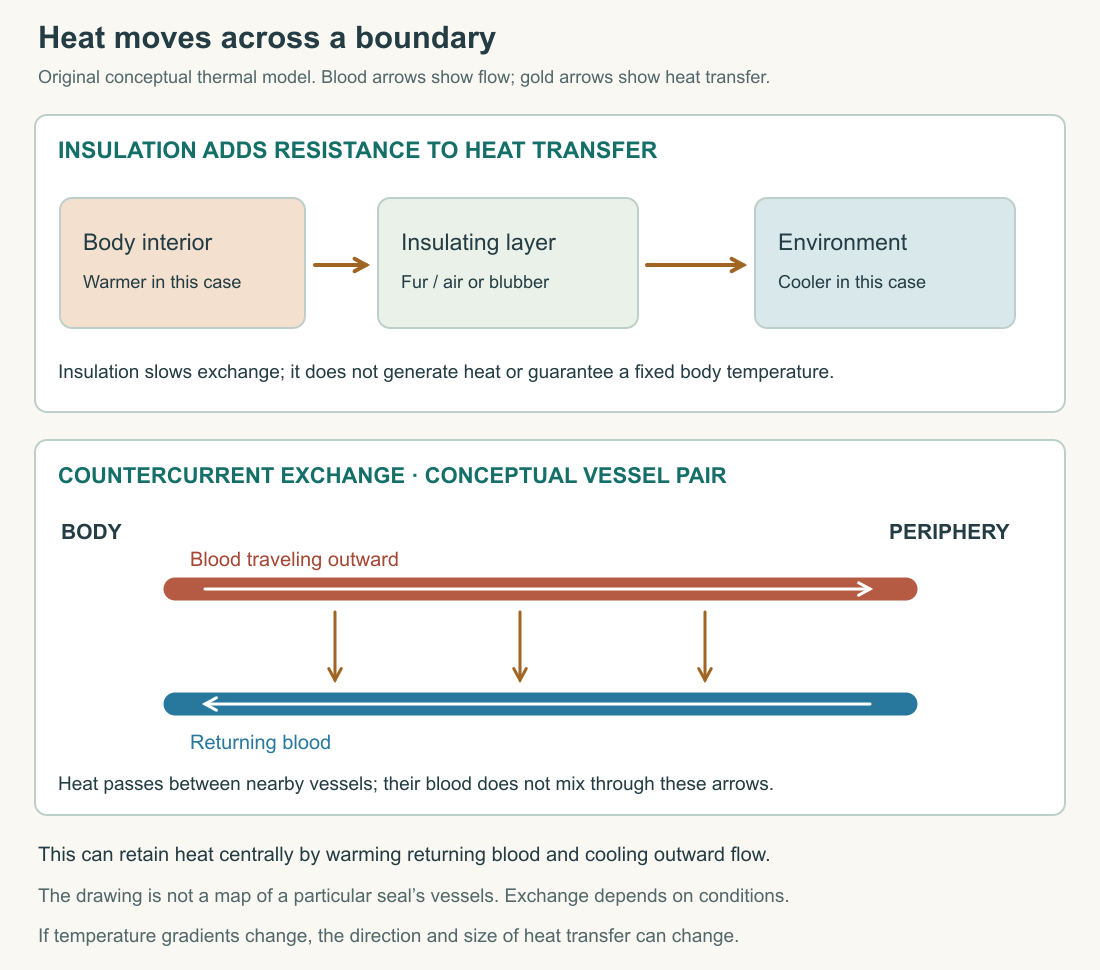
The original diagram is a general explanatory model, not a map of the elephant seal's vessels. Its arrows distinguish blood movement from heat transfer. The distinction is essential: heat can cross between neighboring regions without the blood streams merging.
For a thought experiment, imagine outgoing blood entering a limb at a higher temperature than incoming venous blood. Heat exchange between them reduces the temperature difference. Moving heat back toward the body can be useful when conservation matters. But an arrangement that conserves heat does not provide an unlimited solution when the animal needs to lose it. Flow routing and exposed surfaces can change which outcome is possible.
The circulation thus links local and whole-body problems. A change in a small exposed region can affect heat exchange without requiring the entire coat to change. At the same time, tissues require adequate supply for their other functions. A thermoregulatory response operates within those physiological constraints.
Producing heat consumes resources
Metabolism produces heat during maintenance and activity. Shivering increases muscular activity to produce additional heat. Many mammals also use specialized thermogenic tissue, including brown adipose tissue, in which regulated cellular processes favor heat production. Its importance varies with species, age, and condition; it should not be assigned the same role in every mammal. OpenStax: metabolic heat production.
The useful accounting distinction is between conserving existing heat and producing more. Insulation can reduce the rate at which a body loses heat. Increased metabolism can replace heat that is lost. Both can support a warmer interior, but their resource consequences differ.
Suppose an invented animal must replace six heat units per minute in one setting and three in another. If its only compensating response were additional metabolic production, the first setting would require a larger contribution. But if shelter, posture, or insulation changed the losses, the required production could change as well. We cannot infer an exact food requirement from air temperature alone.
Activity complicates the interpretation further. Work used to find food produces thermal consequences that may be helpful in a cool setting and burdensome in a warm one. A behavioral schedule can therefore affect feeding and thermal regulation simultaneously. The same walk is not assigned a separate, unrelated body for each function.
Torpor changes the maintained state
Torpor involves regulated reductions in metabolic rate and body temperature, with substantial variation among species and situations. Hibernation commonly includes prolonged torpor bouts interrupted by arousals. The entire interval includes cooling, low-rate periods, and returns to a warmer state. It is not accurately represented by multiplying the lowest observed metabolic rate by the whole winter. Geiser, 2004: review abstract.
An original energy model shows the importance of transitions. Imagine ten hours at one energy unit per hour followed by one hour at fifteen. The low-rate interval contributes ten units; the shorter high-rate interval contributes fifteen. A brief event can dominate an account if its rate is sufficiently high. Duration alone does not identify where most expenditure occurs.
Nor is a torpid animal simply an ordinary active animal that accidentally became cold. The physiological state involves regulation, and the relation between environmental temperature, body temperature, and metabolism changes with conditions. A visible lack of movement cannot establish that state without suitable evidence.
For the big brown bat, this connects winter behavior with both energy and water. A low metabolic rate does not stop every loss from the body. Maintaining water balance can influence what happens during arousals, while the structure of a group can change exposure.
A bat experiment separates humidity from temperature
Muise and colleagues kept hibernating female big brown bats at the same temperature but different relative humidities. In the drier treatment, bats formed more compact huddles and drank more often during arousals. Arousal number was similar between treatments, while arousal duration differed; total body-mass loss did not differ detectably. The result supports behavioral flexibility under the tested conditions rather than a rule that dry air must always produce more frequent arousal. Muise and colleagues, 2024: abstract and figure descriptions.
The comparison is valuable because temperature alone would not describe the two environments. Holding it constant made the humidity contrast more informative. The measured outcomes also differed in kind: group arrangement, drinking, arousal timing, and mass change are related but not interchangeable.
The result does not make humidity irrelevant simply because total mass loss was similar. A maintained outcome can reflect compensating responses. Imagine two travelers arriving with the same water reserve after different routes; one may have drunk more along the way. Equal endpoints do not imply identical processes.
This reasoning transfers to our elephant seal comparison. Similar internal temperatures under different environmental conditions could be evidence of effective regulation, rather than evidence that the environment has no effect. To understand the regulation, measure the responses that help maintain the outcome.
Changing size changes the account
Consider two geometrically similar, invented bodies made from the same material. If every length doubles, surface area increases fourfold while volume increases eightfold. The larger body has less surface per unit volume. Under equal surface conditions, this changes the relation between potential exchange area and the amount of tissue retaining heat. It does not establish an exact metabolic rate for a real deer or bat: their shapes, insulation, circulation and behavior differ. The calculation supplies a prediction to examine, not a substitute for those measurements. It also explains why scaling a drawing up without changing its proportions can still change the physical problem.
Put the mammal back into its setting
A deer in cover, a bat in a roost, and a seal on a beach encounter different combinations of gradients, surfaces, and resources. The right question is not which animal has the warmest blood. It is how each maintains workable conditions while continuing the rest of its life.
An observation can begin with posture, exposure, activity, and timing. A supported explanation then connects those observations with an appropriate mechanism and names what remains unmeasured. For example, a change from sun to shade changes radiative exposure; whether thermal regulation caused that particular movement requires more evidence.
The chapter's central relationship is now clear. Insulation alters transfer, circulation redistributes heat, metabolism supplies heat, and behavior changes exposure or operating state. Each intervention in the account has consequences for resources or other functions. Temperature regulation is a coordinated process within a whole animal, and that coordination becomes especially visible when the environment changes.
Application
Use the original thermal diagram to explain two invented conditions: a mammal conserving heat in cool surroundings and the same body needing to release excess heat. Label temperature differences, blood flow, heat transfer and one possible behavioral change. State which anatomical features are generalized rather than measured in a particular species.
Write a 400-word comparison of the seal and bat studies. Identify what each measured, one inference supported by the design, and one conclusion it cannot establish. Include an explicitly hypothetical rate-times-duration calculation. No animal handling, roost entry or environmental manipulation is required.
Check your understanding: Why can two groups lose similar total body mass while responding differently to humidity?
Expected answer: Similar endpoints can result from different compensating processes. Differences in huddling, drinking or arousal duration can help maintain a similar overall outcome. Mass change also does not identify every energy and water pathway separately.