Teeth, guts, and a food supply
A cow and a horse can feed in the same pasture without processing that pasture in the same way. A raccoon belongs to the order Carnivora while eating both plant and animal foods. A large northern elephant seal can build reserves by repeatedly capturing small prey. These examples make a useful starting point: neither body size, a taxonomic name, nor the appearance of one tooth gives us a complete feeding biology.
A meal must be obtained, physically processed, chemically broken down and absorbed. Those steps take time and resources. The food then contributes to maintenance, movement, growth, reproduction or storage. This chapter follows the route from a tooth meeting food to an animal meeting its needs across a day. We will use cattle as a familiar grazing reference, return to the mule deer, and compare both with mammals that obtain animal foods.
Begin with the material being eaten
“Plant food” covers leaves, fruit, seeds, roots and many other materials. Their water content, chemical composition and mechanical resistance differ. “Animal food” is equally broad: a soft-bodied prey item and an armored insect present different handling problems. A feeding category is a first description, not a specification of everything entering a mouth.
Separate three questions. How difficult is the item to acquire? What must happen to reduce it physically? Which chemical components can the animal and its associated microbes use? A readily captured item can still be difficult to break apart; something easy to swallow may be expensive to find.
An original comparison helps. Imagine two food patches containing the same gross energy. In one, the food is accessible in small exposed portions. In the other, it is enclosed in resistant coverings that take time to open. Equal energy on the landscape does not mean equal energy available per minute. Now imagine a third patch whose energy is largely in material the consumer cannot digest. The amount present and the amount usable have come apart again.
This is why feeding explanations need both a body and a setting. We can describe a tooth's contact surface precisely while still needing observations of what the animal encounters, selects and successfully consumes.
Teeth perform different mechanical jobs
A pointed contact can concentrate force over a small area. Opposing edges can shear a material as they pass one another. Broader surfaces can crush or grind it. In each case, the useful description involves the shape, the direction of movement, and the properties of the food. A photograph of an isolated tooth leaves two of those partly unknown.
Many mammals have differentiated incisors, canines, premolars and molars. The names indicate positions and relationships within the dentition, while the actual shapes and uses vary. In many terrestrial carnivorans, the upper fourth premolar and lower first molar form the carnassial pair, with a shearing action. Raccoons and seals illustrate substantial modifications of that pattern. Membership in Carnivora does not require the same cutting apparatus or an exclusively meat diet. Animal Diversity Web: Carnivora.
A mechanical analogy is useful if we keep its limits visible. Scissors work because two blades meet in a particular way; knowing that one blade is sharp does not show how the pair closes. Likewise, upper and lower teeth must be considered together. Jaw movement and muscle forces help determine what the contacting surfaces accomplish.
The term occlusion concerns how the opposing teeth meet. A change in contact can change where force is applied and how food moves. This lets us move beyond the familiar classroom exercise of labeling one tooth “meat” and another “plants.” Those labels can suggest hypotheses, but the interacting apparatus provides a better explanation.
The raccoon makes the inference testable
The northern raccoon, Procyon lotor, is a generalist whose recorded foods include fruits, nuts, insects, crustaceans and vertebrate material. Availability varies across habitats and seasons. Calling it omnivorous does not imply that every individual eats the same mixture or that all foods are equally profitable. Animal Diversity Web: raccoon food habits.
Koomen, Lang and Martin examined raccoon cheek teeth using wear evidence and an analysis of opposing tooth contacts. Their 2026 paper reports a sample of 26 skulls, divided between wear-facet analysis and a dentine-exposure series. The reconstructed power stroke had a substantial horizontal component; the authors interpreted the surfaces and contacts as evidence for important grinding and crushing functions. This is an anatomical and functional investigation, not a record of every meal those animals ate. Koomen and colleagues, 2026: abstract.
Notice what the study adds to a diet list. Knowing that raccoons eat varied foods tells us what the apparatus handles. Examining tooth contacts asks how the apparatus can handle them. Neither evidence type replaces the other.
Imagine finding wear on an unidentified museum tooth. The wear may help reconstruct contact or abrasion, but an exact menu still requires further evidence. Several foods can impose similar mechanical demands. Age, previous wear and the condition of the specimen also affect what remains visible. The disciplined conclusion is a constrained inference about function, followed by a question about diet.
Chewing opens access; it does not finish digestion
Reducing a piece of food changes its size and exposed surfaces. It can help digestive substances reach material that was previously enclosed. But physically breaking a plant stem does not automatically break the chemical bonds in its cellulose into products the mammal can absorb.
For a geometrical model, take a cube with sides one unit long. Its total surface area is six square units. Divide it into eight equal cubes without losing material. Their combined area is twelve square units, although the total volume remains one cubic unit. Real food has pores, fibers and irregular shapes, so this is not a measured digestion rate. It demonstrates how subdivision can increase exposure without adding food.
The chemical problem remains. Mammalian digestion combines the animal's own secretions with microbial activity whose location and contribution vary. Absorption is a further step: a useful product must cross an appropriate lining and enter transport pathways. A full stomach and a well-supplied body are therefore different states.
A cow's foregut changes what a grass meal can provide
A cow's stomach has four interconnected compartments: rumen, reticulum, omasum and abomasum. The rumen and reticulum form a connected region in which material mixes and microbial processing occurs. During rumination, a portion returns to the mouth for further chewing and is swallowed again. The abomasum is the acid-secreting compartment leading onward toward the small intestine. FDA: cow digestion.
Microbes ferment plant material, producing short-chain fatty acids, often called volatile fatty acids in this context. These products can be absorbed through the rumen wall and used by the animal. Microbial cells passing farther along also provide protein that can be digested. Thus a cow benefits both from products made by microbes and from the microbial material itself. University of Minnesota: foregut fermentation.
Think of this as a sequence of transformations rather than a container that makes grass disappear. Plant material enters; microbial metabolism changes what is available; products cross a lining; some remaining material and microbes continue along the tract. The arrows do different jobs. Movement along the gut is not the same as absorption across its wall.
A larger chamber alone would not explain the result. The chamber must support an appropriate community, mixing and retention. Its contents are a changing biological environment. If we drew only an enlarged stomach outline, we would miss the central mechanism that makes the comparison interesting.
A horse puts major fermentation farther along
The horse provides a decisive contrast because it also eats forage but has a simple stomach. Much of its microbial fiber fermentation occurs in the cecum and large colon, beyond the small intestine. Fermentation products can be absorbed there. Its mouth and cheek teeth perform substantial initial processing, while the hindgut supplies a different arrangement for obtaining useful products from fiber. University of Maryland: equine digestive anatomy.
Position changes the opportunities downstream. In a foregut fermenter, microbial material passes into later regions that digest and absorb protein. In a horse, the main fermentation region lies after the small intestine, so microbial protein does not enter the same subsequent route. The animal still obtains fermentation products; the two arrangements are not nutritionally identical. University of Minnesota: hindgut fermentation.
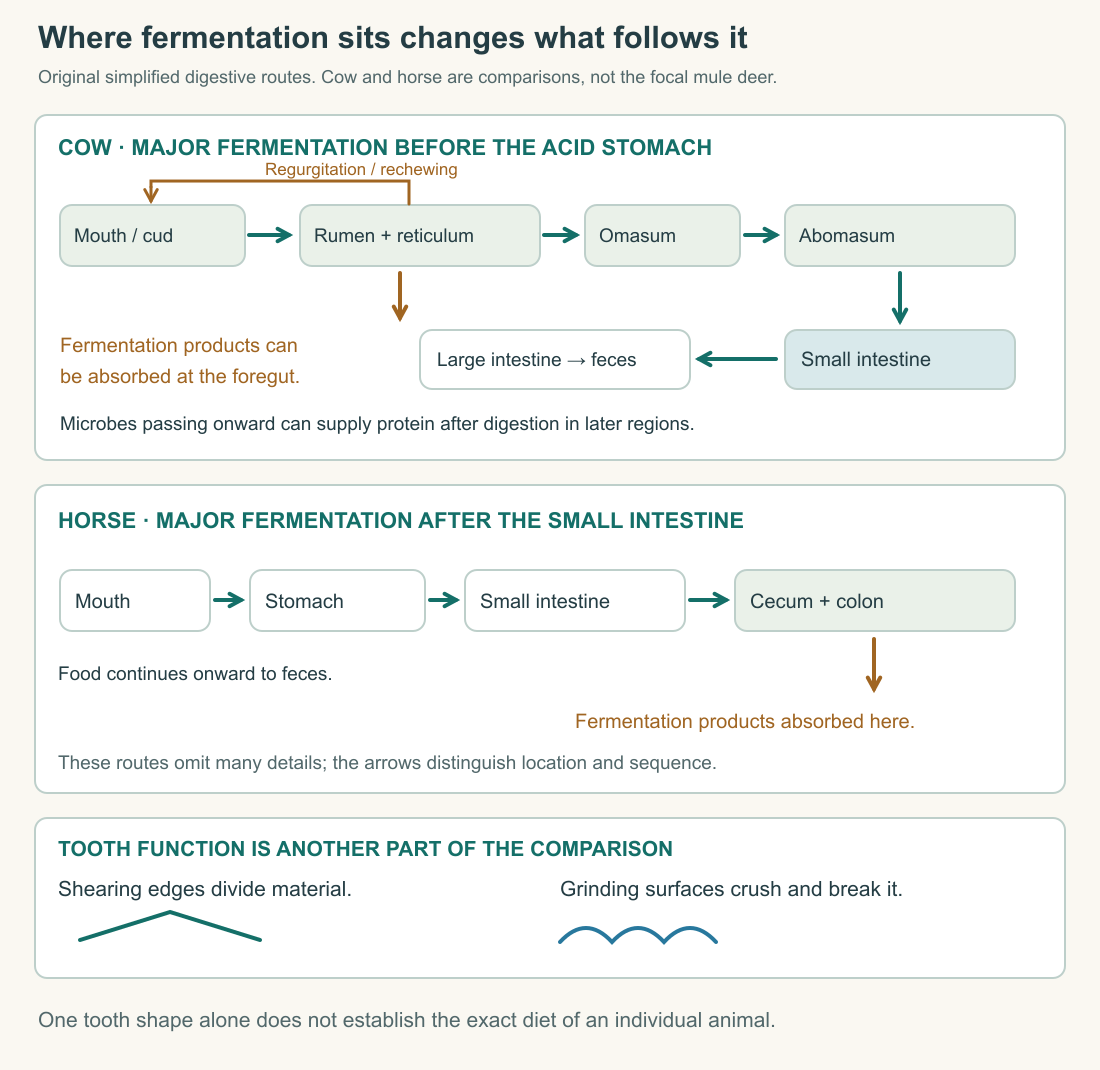
The diagram is an original functional map, not a dissection drawing. Trace the horse route before the cow route. Locate the small intestine each time. Then follow an absorption arrow rather than the arrow showing movement of contents. You should be able to explain the difference without memorizing a list of compartment sizes.
This comparison also protects against a common mistake: observing two grazers and assigning both the cow's four-compartment stomach. Similar diets can be supported by different inherited structures and processing sequences. A shared ecological task does not require identical anatomy.
Return to the mule deer
The mule deer is a ruminant, but its food habits should not be reduced to “a small cow eating grass.” Its recorded diet includes woody browse and herbaceous plants, with changes in selection and availability. Animal Diversity Web describes it as an intermediate feeder between strict browsing and grazing patterns. Animal Diversity Web: mule-deer food habits.
Suppose a deer is visible at the edge of a clearing. A photograph can show the plant part in its mouth if the view is clear enough. It cannot establish the proportions of its seasonal diet. Nor does a pause between bites reveal how much fermentation is occurring internally. The observer sees one segment of a longer process.
A better field question would specify the interval and resource: which visible plant parts does this animal select during the observed feeding bout? A stronger seasonal claim requires repeated, appropriate evidence. We can connect the animal with ruminant physiology while keeping the observed meal distinct from its full dietary history.
The distinction has practical explanatory value. A landscape can look green yet offer different food quality, accessibility or cover from another green landscape. The abundance of vegetation alone does not establish that it meets the same needs for a particular deer.
An insect eater is also eating animals
The big brown bat’s recorded prey includes beetles and other insects. Calling it insectivorous specifies a major kind of animal food; it does not place insects outside the animal kingdom. Nor does that diet make the bat a member of Carnivora. Dietary vocabulary and evolutionary classification answer different questions. Animal Diversity Web: big brown bat.
A bat catching an insect must bring the prey within reach before its teeth can process it. This creates a sequence with potential limits at several points: detecting the target, intercepting it, securing it and handling the material. A successful approach need not end in a swallowed meal. If an observer records only approaches, the resulting count describes attempts rather than intake.
For an invented example, ten approaches with eight captures and six swallowed items yield three different totals, all correctly counted. Reporting ten meals would silently collapse the sequence. This is the same reason that a feeding study must explain what its sensor recognizes. The anatomy supplies capabilities; the observation method determines which events we can actually count.
The seal connects feeding to a daily schedule
Adachi and colleagues studied adult female northern elephant seals during postbreeding migrations. Jaw-motion sensors recorded feeding-related events, while animal-borne video helped identify prey. The work linked frequent feeding on small fish with a large daily allocation to foraging and an index of lipid gain based on changes in buoyancy. Most tracked animals followed a pelagic strategy; a few used a different, benthic one. Adachi and colleagues, 2021.
There are two distinctions worth carrying forward. A sensor event is evidence interpreted as feeding, rather than a weighed meal. Also, the paper's foraging-time measure includes dive cycles with their following surface intervals. It does not mean the animals spent the entire stated interval underwater without breathing. The full paper defines these measures and describes the sample and exceptions. Study text in the St Andrews repository.
A predator's body size therefore need not predict the size of each prey item by itself. A supply of small items can contribute substantially if enough are encountered and captured. Whether that strategy pays depends on the rate of return and the time and expenditure required to achieve it.
Build an account with rates and limits
Use an original, deliberately simplified foraging model. An animal captures twelve items per hour, each providing five usable energy units, while searching and handling cost twenty units per hour. Its net return is forty units per hour before other daily costs. If capture rate falls to eight with the other terms unchanged, net return falls to twenty. A one-third reduction in capture rate has halved this modeled net return.
The calculation is not an estimate for an elephant seal. It exposes the subtraction hidden inside “food is available.” Gross intake, assimilation and expenditure are separate quantities. A smaller gross change can have a larger effect on the remainder after costs.
Now suppose the animal needs eighty net units from foraging. The first condition takes two hours; the second takes four. If only three hours are available, adding effort cannot solve the whole shortfall under the stated assumptions. The animal would need another change in food, capture success, costs, reserves or requirements.
Real animals face additional constraints, including digestion and the need to perform other activities. Those constraints explain why a feeding strategy must be evaluated over an interval. A spectacular capture can be memorable while an ordinary sequence of small captures contributes more to the daily account.
For our three focal mammals, the route is now more specific. The bat obtains animal prey while flying; the deer selects vegetation and uses ruminant processing; the seal connects underwater feeding with repeated returns to air. Teeth and guts help make those lives possible, but neither organ operates independently of movement, sensing or time. The next chapter examines the structures that bring the animal to its food in the first place.
Application
Create a one-page comparison of a cow, horse and raccoon. For each, distinguish a recorded diet from a proposed mechanical function. For the two grazers, draw the position of major fermentation relative to the small intestine. Use the original diagram, then redraw it from memory and check the routes.
Write a 350-word explanation of why a photograph of a tooth cannot establish an exact diet. Use the raccoon study as evidence, identify its measurement type, and name one additional kind of evidence you would want.
Finish with an original foraging calculation in which gross intake falls by 20 percent. Choose and label invented values, subtract a fixed cost, and calculate the resulting percentage change in net return. Explain one reason the result should not be treated as a prediction for a real seal.
Check your understanding: Does a horse's simple stomach mean that microbes contribute little to its use of forage?
Expected answer: No. Much of the relevant fermentation occurs farther along, in the cecum and large colon. Stomach shape alone does not show the location or contribution of microbial processing.