A kitchen you can work in
You have bought the ingredients. The recipe is open. Then you discover that the board fits on the counter only if you move the drying dishes, that the pan you need is beneath two others, and that there is nowhere to put the lid once it is hot. None of these problems appears in the ingredient list. Together, they can make a simple dinner feel like an examination for which you have studied the wrong subject.
Our first problem is therefore very ordinary: where will the work happen? Before learning to brown, season, or improvise, you need a place where you can see the next action and carry it out. Organization becomes useful when it prevents an interruption, a collision, or a forgotten step. A beautiful counter is optional.
Imagine a small kitchen with one clear section of counter between the sink and stove. You want to prepare carrots, open a can of beans, and cook a starch. There are three kinds of movement: ingredients move toward readiness, used tools move toward washing, and finished food moves toward serving. If those movements repeatedly cross the same square of counter, you will spend much of dinner preparation moving objects that were already in your way five minutes ago.
Give the next action a place
Begin with the board, because it usually occupies the largest uninterrupted working area. Put it on a stable surface with enough room for your hands and the full movement of the knife. Leave a visible resting place for the knife beside the board, away from the counter edge. The board must not wobble or slide. Use a suitable nonslip support if needed, and check stability before bringing food to it.
Now give prepared ingredients a destination. A plate may be sufficient for the carrots; you do not need six little bowls. Give peelings and other waste a separate destination that can be emptied easily. Finally, identify where the hot pan will go if you must remove it from the burner. That last space is easy to forget because it begins empty. Keep it empty until needed, with a suitable heatproof support.
This produces four useful places: preparation, ingredients ready to use, waste, and hot equipment. They need not be permanent stations. On a small counter, one place can serve two purposes at different times. It should not serve incompatible purposes at the same time. A serving plate cannot also be the place where you have left dirty utensils and food packaging.
The diagram shows a sequence, not a required kitchen layout. Reverse it to suit your room or dominant hand. The important property is that food can progress without repeatedly passing through a dirty area.
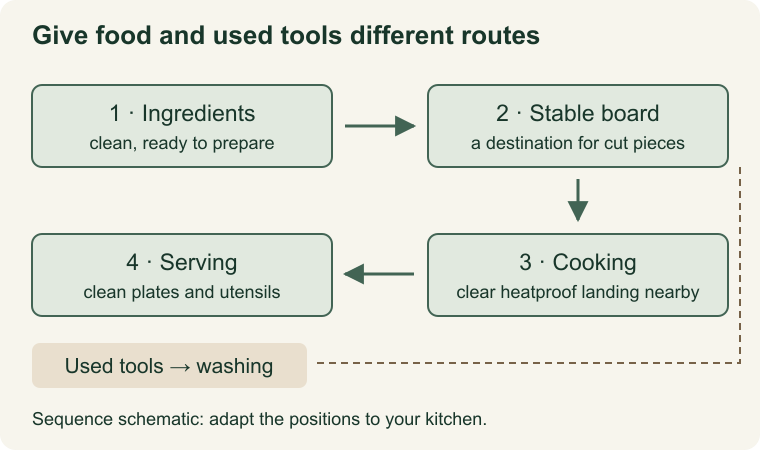
Consider two ways of using the same little kitchen. In the first, you peel a carrot, carry its peelings to the bin, return for another carrot, and then discover that the plate for the chopped pieces is under a shopping bag. In the second, you collect the carrots, set out the plate, place a waste bowl nearby, and complete the preparation. The second arrangement saves decisions as well as footsteps. Its advantage does not depend on moving faster.
There is a limit to this idea. Filling every available bowl before beginning can create another problem: no space left to work and a mountain of washing. Prepare what the next demanding stretch of cooking needs. If an ingredient will be added much later and is straightforward to prepare, it may wait. In your first attempts, however, keep knife work separate from active cooking. You can learn to overlap tasks after you know how much attention each actually demands.
Find the missing verb
A tool earns its place by doing a job. For our simple meal the jobs might be cutting, measuring, stirring, lifting, draining, checking temperature, and serving. Saying those verbs aloud can reveal an omission that a generic equipment checklist misses. You remembered the pot but forgot how you would drain it. You remembered the pan but have only a metal implement that its manufacturer says could damage the surface.
Choose equipment for the actual action. A pot should have enough room for its contents and for the stirring or boiling required by the recipe. Its handle should be secure. A colander needs a stable place where it can receive food without tipping. A towel used for wiping the counter is not automatically an appropriate substitute for a dry oven mitt. Before heating anything, make sure you can lift and place the vessel safely when it is full.
You do not have to solve every future cooking problem today. A knife that feels controllable, a stable board, a suitable pot or pan, basic measuring tools, and a food thermometer will take you through many foundational tasks. Existing equipment is a good starting point when it is sound and suitable. If something is missing, first ask whether the method can change. A meal that requires no draining might suit a kitchen where carrying a heavy pot to the sink is difficult.
This is also how to distinguish a useful purchase from a promise. Suppose opening a can is the recurring obstacle. A reliable opener that you can operate comfortably addresses a specific problem. Buying an elaborate knife set because cooking feels difficult does not yet identify what needs fixing. Learn which action is awkward before buying its proposed solution.
Set up for the person doing the cooking
The layout should fit your reach, vision, stamina, and movement. Put frequently used items where you can obtain them without reaching across heat. Keep the recipe readable from the preparation area. If standing is tiring, arrange a seated preparation task at a suitable stable height and leave the hot lifting for a method you can manage safely. Purchased chopped vegetables are a legitimate way to reduce a task that is painful or inaccessible.
These choices change what the exercise demonstrates. Someone who uses prepared carrots can still demonstrate planning, measuring, and cooking coordination. They have not demonstrated cutting those carrots. There is no need to pretend otherwise, and no educational reason to make every skill a barrier to learning the next one.
Sharing the room requires similar specificity. “Help me cook” gives another person little information about the space. “Wash these carrots, put them on this plate, then leave the board clear” gives a task, a destination, and a stopping point. If two people work together, decide who controls the hot area. An unexpected reach across a pan is avoidable even in a crowded room.
A phone can be a recipe, timer, and distraction in the same object. Place it somewhere it will not be splashed and where checking a line does not require moving the board. Set the screen and recipe before handling ingredients. If you touch it during preparation, treat that touch as part of your handling sequence and wash hands when needed. Do not try to hold a phone and cut at the same time.
A pause before the burner
Read the whole method before turning on heat. Identify the first step that will demand continuing attention. The ingredients and tools for that stretch should be ready before it begins. If the method says to add several ingredients in rapid succession, measuring the second one after the first is already in the pan may be too late.
Walk through the actions with cold equipment. Where will the lid rest? Can the spoon reach the bottom comfortably? Which hand will lift the handle? Where will you put the finished food? This rehearsal may feel overly deliberate for a familiar meal. For an unfamiliar task, it exposes problems when the consequences are still small.
A pan left heating while you search a cupboard has become an additional task, whether you intended it or not. If preparation is not ready, leave the heat off. Once cooking begins, stay present and follow the equipment's instructions. Keep handles from protruding into a walking route, keep combustible items away from heat, and plan access so children and pets do not cross the working area. Knowing how to turn an appliance off is part of knowing how to use it.
The same pause helps with emotional urgency. Being hungry can make every delay seem intolerable. Choosing a simpler meal, setting out a small ready-to-eat snack if appropriate, or beginning earlier can reduce the temptation to skip preparation. A realistic cooking plan includes the person who will execute it at the end of a long day.
Cleaning is a transition
Cleaning becomes easier to understand if you connect it to the next use of an object. You need the board ready for another ingredient, the counter free for serving, or the sink available for washing. Those are concrete purposes. “Keep everything spotless” is much less useful while several tasks are underway.
US food-safety guidance calls for washing hands and cleaning utensils and surfaces, separating foods that could contaminate one another, cooking appropriately, and controlling storage temperatures. For this chapter, begin by washing your hands with soap and water and making the preparation surfaces and utensils clean. The complete handling sequence belongs to chapter five; read it before carrying out the course's cooking exercises. FoodSafety.gov: four steps
A used tool needs a visible, deliberate destination. Do not leave a knife hidden under dishes or submerged in a sink where someone could reach for it. Clean and dry it carefully, following its care instructions, and store it with the edge protected. The Utah State knife-skills handout makes the sink hazard particularly clear. Utah State University Extension: knife skills
You can wash an empty bowl while food is safely cooking under appropriate supervision, but cleaning must not draw you away from a task that needs attention. The phrase “clean as you go” does not mean “wash something at every available instant.” Sometimes the correct action is to watch the pan. Sometimes it is to turn the heat off before dealing with a spill.
A reset can be small. Once the vegetables have left the board, dispose of the scraps, put the knife away, and clean the surface as required. You now have room for serving without having to clear the entire kitchen at the last minute. The reset separates one phase of dinner from the next.
Work with one counter
Return to our imagined meal. The beans remain in their unopened can while you prepare the carrots. The plate of prepared carrots occupies the ingredient space. The cutting tools then move to cleaning and storage, freeing the counter for measuring the starch and opening the beans. You have not increased the size of the kitchen. You have changed which tasks compete for it.
Suppose instead that the plan requires a salad served uncooked alongside a raw animal ingredient. That introduces a separation problem absent from our bean meal. The solution is not to squeeze another pile onto the same board. Use appropriate separate equipment and a handling sequence that prevents cross-contamination. A plan that was adequate for one menu may be inadequate for another.
Likewise, adding another diner may increase the quantity beyond the pan's comfortable capacity. Organization includes recognizing when the meal has changed enough to require a different vessel, separate batches, or a simpler menu. The kitchen is a system of limited spaces and tools. It will not become unlimited because the recipe's quantities were multiplied correctly.
After your first setup, notice the first unnecessary interruption. Perhaps it was looking for the opener, moving a dish rack, or finding nowhere to put a wet spoon. Fix that particular problem on the next attempt. A kitchen becomes workable through these small revisions, each tied to something you actually tried to do.
Application
Before cooking, read chapter five. Then choose a familiar simple recipe or the meal framework in chapter six. With all appliances off, lay out its equipment and rehearse the sequence. Draw a rough plan showing the preparation area, ingredient destination, washing route, and hot-vessel landing place. Name one item you deliberately leave out until later.
Check: A cook has arranged every ingredient in separate bowls, filling the counter. The board now overlaps the sink, and the only place for a hot lid is on a serving plate. Is this good preparation?
Model interpretation: The ingredients are organized, but the work is not. The board needs a stable usable position, and hot equipment needs a suitable clear destination. Combine compatible ingredients where the method permits, keep later ingredients stored, or change the sequence to release space. Success is an arrangement that supports the actual actions safely, rather than the greatest number of ingredients displayed at once.
Without kitchen access: Draw two layouts for the imagined one-counter kitchen. Explain which task must finish before the shared space changes use. This demonstrates planning; it does not certify practical knife or hot-equipment handling.