Measuring and observing
Two cooks follow the same cake recipe. Both use one cup of flour. One fills the cup lightly; the other pushes it through a compacted bag and taps it down before leveling. The cups may occupy the same volume while containing different amounts of flour. The instruction looks precise, but its meaning depends on how the measurement was made.
Now consider a vegetable soup. One carrot is somewhat larger than another. The recipe may tolerate that variation without losing its identity. These examples raise a practical question: where does precision help, and where is a careful observation more useful than another number?
You need both. Measurement helps reproduce conditions and detect differences. Observation tells you what the food is doing under those conditions. Neither is an excuse to abandon the other. A displayed temperature needs correct probe placement; a pleasing aroma cannot establish a safe internal temperature.
Ask what the number measures
Mass describes how much matter an ingredient contains. Volume describes the space it occupies. Temperature describes a thermal condition. Time describes an interval. These quantities answer different questions. A recipe's number becomes useful when you know which question it is answering and how the writer obtained it.
A kitchen scale reports mass in grams or ounces. A measuring cup reports volume. A fluid ounce is a unit of volume, while an ounce on a scale is a unit of mass. Treating them as interchangeable can create errors that remain hidden because the word ounce appears in both places. Read the whole unit.
The relationship between mass and volume depends on the ingredient and its arrangement. A cup of loosely packed leaves and a cup of water do not contain the same mass. Even a powder's mass per cup can change when it is compacted. A conversion chart is therefore making assumptions about the ingredient and its condition; it is not discovering a universal identity between cups and grams.
Recipes also come from different measurement conventions. Where a source supplies grams or milliliters, use those stated values rather than an improvised conversion. If it relies on cups and spoons, check which conventions it uses. A household drinking cup or dining spoon is not necessarily a calibrated measure. The object has a familiar name without necessarily having the specified capacity.
Use the scale as an instrument
Place the scale on a stable level surface and select the intended unit. Put the empty bowl on it, then use the tare function to subtract the bowl's mass. Add the ingredient until the displayed amount reaches the target. If you forget to tare, the number includes the bowl. A plausible-looking display can still answer the wrong question.
For several ingredients, you can tare between additions, but this convenience changes the consequences of overshooting. Removing excess flour from a bowl of flour is straightforward. Removing it after it has mixed with another ingredient may be impossible to do accurately. Measure a sensitive or small addition separately when that reduces risk.
The number of decimal places is not a guarantee of accuracy. A scale that displays whole grams is not well suited to measuring a tiny fraction of a gram. Its stated resolution, minimum useful load, and operating instructions matter. Use an appropriate measuring spoon or a different scale when the recipe calls for an amount your instrument cannot resolve dependably.
Keep a short measurement habit: unit, tare, amount, confirmation. Say the ingredient name before adding it if several similar containers are present. A scale cannot tell salt from sugar. Measurement supports attention; it does not replace identifying the object being measured.
Learn from a cup of flour
King Arthur specifies 120 grams for a cup of its all-purpose flour in its recipe convention and recommends a scale or its stated light-filling technique. That number belongs to that source's recipes and method. It should not be treated as a measured fact about every cup filled with every flour. How to Measure Flour
For a small comparison, first read chapter five. Prepare a clean dry cup, spoon, bowl, and scale. Measure the mass of a lightly filled and leveled cup, then compare it with a deliberately more compacted filling of the same cup. Avoid making flour dust, keep flour away from ready-to-eat food, and clean hands and equipment afterward. Do not taste raw flour, dough, or batter: FDA treats flour as a raw food that can carry harmful microorganisms. FDA: Handling Flour Safely
The result to record is your actual measurement. Do not copy a number from a demonstration and call it your own. If the readings are close, describe that. A small comparison does not have to produce a dramatic result to teach you how to observe. The method, flour, cup, scale, and filling procedure all belong in the record.
Here is a separate hypothetical example for practicing arithmetic. Suppose one filling reads 120 grams and another 150 grams. The second contains 30 grams more. Relative to the first, that is 30 divided by 120, or 25 percent more. It is not 30 percent more merely because the difference is 30 grams. The reference quantity matters.
This does not tell you how much a particular cake will change. That would require a specified formula and an actual baking comparison. The measurement establishes a difference in the input. Explaining the final texture requires further evidence. Keeping those two claims separate makes the exercise more informative.
A recipe can be precise about the wrong thing
Suppose a recipe gives an exact cooking time but says only “one large carrot.” The ingredient's size, its cut, the vessel, and the starting conditions may vary. The timer controls one part of the process while leaving others unspecified. You should use it to prompt inspection rather than regard it as a complete description of what is happening.
Conversely, an instruction such as “add enough liquid to cover” deliberately specifies a relationship rather than a fixed quantity. Its usefulness depends on the dish and vessel. It may work well in one method and be inadequate in another that depends on a precise ratio. Do not replace every relational instruction with a number merely because numbers feel more authoritative.
Ask what a change would affect. An extra spoonful of chopped parsley may primarily alter flavor and appearance. A changed quantity of flour can alter the structure and proportions of a batter. Neither ingredient is inherently beyond measurement. Their roles make the same relative error matter differently in different preparations.
Safety is a separate category. You may adjust seasoning to preference, but you should not lower an applicable safety threshold because the food looks attractive. The source of flexibility should be explicit: a tested recipe variation, a method that tolerates a range, or a personal taste preference. “I usually guess” does not establish any of those.
Observe with a useful vocabulary
“It looks wrong” is a beginning, but it does not direct the next action. Name the feature you see. Are pieces different sizes? Is liquid collecting around them? Is the surface pale, golden, dark brown, or blackened? Does a sauce coat the spoon or run off like water? These descriptions turn a general impression into something you can compare.
Use more than one observation where appropriate. A vegetable's color and resistance to a utensil answer different questions. A pan's sound may change as its contents change, but sound alone does not reveal the internal condition of every piece. Observe safely, without putting your face over steam or touching hot surfaces to test them.
Taste is useful only when the food is safe and suitable to taste. Use a clean utensil and avoid returning a used tasting spoon to food that others will eat. Taste a small cooled sample rather than burn your mouth. A hot sample may also make nuanced comparison difficult. Record the conditions of a tasting comparison so that temperature changes are not mistaken for seasoning effects.
Comparative language is often more reliable than a score without a reference. “The second sample tastes saltier than the first” states a relationship you can examine. “This is a seven” requires an explanation of the scale. For learning, describe what changed and whether the change served the dish's purpose.
Put the thermometer in the food you mean to measure
A food thermometer senses a particular region of its probe. Read its instructions to learn the required insertion depth and waiting time. Some instruments sense close to the tip; others need a larger length of the stem inside the food. A probe that partly measures air or touches the pan can display a number that does not represent the food's interior.
USDA advises measuring an appropriate thick region, avoiding bone, fat, and gristle, and approaching thin foods from the side when needed to place the sensing region in the center. Different pieces and irregular shapes may need several checks. The exact placement depends on both the food and the instrument. USDA: Food Thermometers
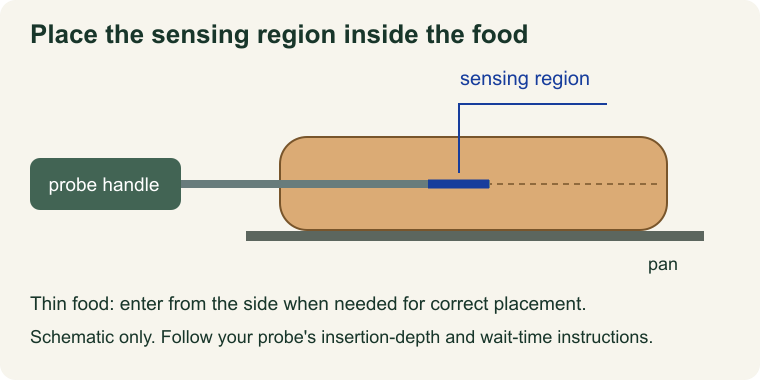
Imagine a fictional thermometer reading of 165°F obtained with its sensing region against a hot pan. The number resembles a familiar safety target. It does not establish that the center of the food reached that target. Correct the measurement before drawing the conclusion. A measurement is a procedure plus a result, not a result alone.
Similarly, an oven's setting is a control input, not a direct measurement of the center of the food. Air, surfaces, and ingredients can have different temperatures. The Heat, Flavor, and Texture course develops that mechanism. For now, specify what temperature you mean whenever you write one down.
Keep a record that can change your next attempt
A useful cooking note connects conditions, observations, and a possible adjustment. “Too wet” is less helpful than “I used the smaller pan, the vegetables formed two layers, and liquid remained at the end.” The second note offers several plausible variables to investigate. It does not yet prove which caused the result.
Change one important variable at a time when a comparison is the purpose. If you change the cut, pan, quantity, and heat setting together, you may improve dinner but learn little about which change mattered. Both activities are legitimate: sometimes the immediate goal is a meal, sometimes a controlled lesson. State which you are doing.
Do not let recording become another task that disrupts safe cooking. Write setup details before heating, use a timer or a brief note when safe, and complete the account afterward. An honest approximate observation is more useful than a fabricated exact one. If you forgot when a step began, record that uncertainty.
Over time, measurements and observations become partners. You recognize a useful size because you first compared pieces deliberately. You know when to check a texture because earlier attempts established a time range. Experience does not abolish measurement; it helps you place it where it answers the most important question.
Application
Perform the flour comparison with the precautions above, or work only with the labeled hypothetical readings. Record the method, values, absolute difference, and percentage difference relative to the first measurement. Explain what the comparison establishes and what would require an actual baking trial.
Check: A learner weighs 200 grams into a bowl but forgot to tare the scale. The bowl weighs 80 grams. How much ingredient is present, and what should the learner do?
Model interpretation: Assuming the reading includes only bowl and ingredient, 120 grams of ingredient are present. Tare correctly or account for the bowl's mass, then add the missing amount if the recipe requires 200 grams and the mixture is still separable. Confirm the unit. A precise display did not prevent a procedural error.
Transfer: Write one observation that can guide a texture decision and one measurement needed for a safety decision. Explain why they answer different questions.