Power you can and cannot see
A fictional transit board votes unanimously to renovate a station entrance. The public minutes show a grant, three presentations and a successful motion. A neighborhood group had wanted a late-night bus service instead, but that proposal never reached the agenda because operating costs were outside the grant's rules. Who exercised power: the board, the grant maker, the staff who interpreted the rules, or the group that failed to obtain a hearing?
The answer depends on the question. The board made a decision about renovation. The grant shaped which alternatives could be considered. Staff may have had discretion over how proposals were classified. Residents may have had influence in another venue, even though they lost here. A vote is an important event, but it is not the complete boundary of an explanation.
This course asks how people coordinate, accept authority and change institutions. We begin with power because cooperation and conflict both occur within arrangements that distribute the ability to act. The aim is to recognize those arrangements without turning every disappointment into proof of secret control. A claim about power should specify a relationship, an outcome and the evidence connecting them.
Start with a relationship
Saying that someone is powerful leaves several questions open. Powerful over whom, concerning what, for how long and through which means? A director may control a budget but have little influence over a professional standard. A popular campaigner may influence public attention but lack authority to sign a contract. An employee with a rare skill may be difficult to replace while remaining unable to change the organization's formal policy.
Think of power as an ability to shape conduct, choices or outcomes within a relationship. The relationship matters because a resource acquires force through someone else's dependence or through rules that make it consequential. Owning a vehicle helps a transport campaign only if the vehicle can be used, maintained and connected to people needing rides. A title matters when others recognize the office or when its holder can enforce a decision.
Distinguish a resource from its successful use. A large budget is evidence of capacity, not proof that its holder achieved every desired result. A group with money can misjudge a situation, face legal constraints or encounter effective opposition. Conversely, a small group may obtain a specific concession because it controls a resource that is unusually important at that moment.
The distinction prevents circular reasoning. If we define the most powerful actor as whoever won, then explain the victory by that actor's power, we have renamed the outcome. Instead, identify the relevant capacities before the decision and trace how they affected the process. Evidence of failure is useful because it reveals the limits of those capacities.
Decisions and the boundaries of decision
In their 1962 article Two Faces of Power, Peter Bachrach and Morton Baratz argued that research focused only on visible decisions could miss how institutional practices keep threatening issues outside consideration. Their phrase “two faces of power” directs attention both to contested decisions and to the arrangements shaping which contests occur. They also rejected simply assuming that a reputed elite controls everything. The article is a theoretical and methodological argument, not a universal finding about every community.
Return to the transit board. A study of votes might find that several groups regularly win different grants and conclude that influence is dispersed. That conclusion could be reasonable for the allocation of eligible capital projects. It would not establish that residents can obtain a hearing on operating service, fare rules or routes. The list of studied decisions already limits what the research can reveal.
An agenda is the set of matters an institution considers. Agenda control can arise through explicit authority to schedule an item, through eligibility rules or through expectations about what counts as a serious proposal. These mechanisms need not have the same origin. A donor may deliberately exclude operating costs. A clerk may apply that restriction routinely. A resident may stop submitting proposals after repeated rejections.
Calling all three a conspiracy would erase their differences. We can study how a rule privileges some demands without inventing a secret meeting. At the same time, describing a restriction as routine does not show that it is neutral in effect. The research problem is to establish the pathway from rule to exclusion and the distribution of opportunities it creates.
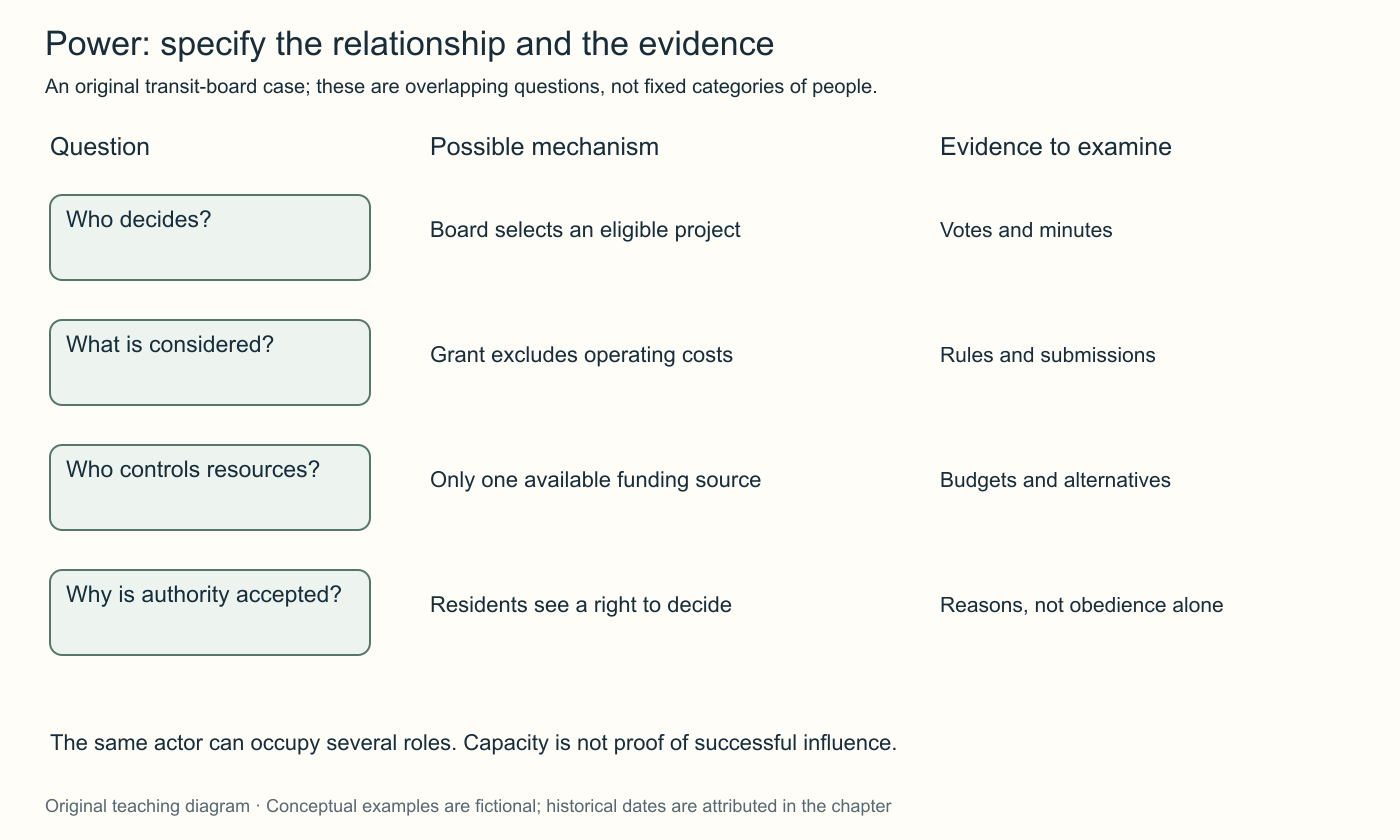
Original conceptual comparison. The categories overlap; they are questions for investigation, not mutually exclusive types of people.
Absence requires evidence too
A missing proposal is harder to interpret than a recorded vote. Perhaps no one wanted the service. Perhaps people wanted it but expected rejection. Perhaps a different agency had responsibility. Perhaps the group missed a deadline. Each possibility can produce the same visible absence while implying a different account of power.
Useful evidence could include submission records, correspondence, published jurisdiction, earlier requests and accounts from people who considered participating. A comparison with another funding process might show whether the same demand enters discussion under different rules. None of these sources is perfect. A participant's later explanation may be shaped by the outcome, and an official file may preserve formal submissions while omitting informal discouragement.
Look for evidence that could weaken the exclusion account. If the board repeatedly funded similar operating proposals under the same rules, our initial reading of the restriction would need revision. If residents had an accessible, effective route to a different decision maker, a claim that the issue was excluded from all public consideration would be too broad. It might still be excluded from this board, which is a narrower finding.
Silence is therefore neither proof of consent nor automatic proof of suppression. Its meaning depends on how speech becomes possible and what records survive. A careful investigator gives the uncertainty a location: we know the item was absent from the agenda, but have incomplete evidence about whether residents tried to submit it. That statement is more useful than filling the gap with confidence.
Resources, dependence and alternatives
In our fictional case, suppose the board can finance renovation only through one donor. The donor's conditions matter because the board lacks an alternative source. If a second fund becomes available, the first donor's bargaining position may change even before either donor changes its behavior. Power can depend on the available alternatives, not only on the amount of money currently held.
Now suppose a group threatens to withdraw volunteer maintenance unless the late-night proposal receives a hearing. The threat matters only if the board needs the work, cannot easily replace it and believes the group can sustain the withdrawal. Announcing an intention and possessing a credible capacity are different. A group may also decide that withdrawal would harm the riders it wants to help.
This reveals a tension between power and cost. Having an effective option does not make the option cheap or desirable. Employees can sometimes leave a workplace, but departure may mean lost income, relationships or specialized experience. A resident can move, but that possibility may be constrained by housing and care obligations. “They could leave” does not establish an equal bargaining position.
Nor does dependence necessarily mean total subordination. The board depends on residents' knowledge of transport needs, while residents depend on the board's formal authority. These dependencies can be unequal and still run in both directions. Mapping them gives a more precise account than assigning every participant to a permanent category of powerful or powerless.
Legitimacy is a different question
An order can be followed because people fear punishment, expect a benefit, habitually comply or believe the authority is entitled to decide. Legitimacy, in the sociological sense used here, concerns that belief in a rightful claim to authority. It is an empirical question about acceptance. Whether the authority actually deserves acceptance is a further normative question.
The fictional board may be legally authorized to allocate a grant and still be distrusted by residents. Conversely, a respected community organizer may have considerable accepted authority without holding public office. Neither example makes legal rules irrelevant. It shows why legal authorization, actual compliance and perceived rightfulness should not be treated as interchangeable measurements.
Imagine that the board rejects the group's proposal after an open hearing and clear explanation. Some residents may regard the process as legitimate while disagreeing with the result. Others may see the hearing as hollow because the available options were fixed elsewhere. The same procedural event can be interpreted differently depending on expectations and prior experience.
Evidence of legitimacy would require more than attendance or obedience. Participants might comply because they have no practical alternative. A survey could ask about rightfulness, fairness or willingness to accept an adverse decision, but those questions measure different things. Interviews could reveal reasons, while still requiring care about who was included. The next chapter examines those measurement choices directly.
Power can enable joint action
So far the examples emphasize whose preferences prevail. But groups also create capacities that none of their members possesses alone. Residents pooling knowledge can identify an overlooked route problem. A board combining funds can make a station accessible. An organization can preserve records and coordinate work across time. Studying power includes this ability to accomplish something together.
Joint capacity and unequal influence can coexist. A transport coalition may become more effective while giving its professional staff greater control over strategy. That arrangement could improve coordination and reduce the influence of occasional volunteers. We should examine both consequences rather than assuming that collective purpose eliminates internal hierarchy.
Consider an original numerical example. Ten people each have two available volunteer hours. The group has twenty hours in total, but a task requiring four people at the same time cannot be staffed simply by adding every hour on paper. Scheduling, location and dependable commitments determine usable capacity. An organizer who solves these problems contributes something real, though that contribution does not automatically justify unrestricted authority.
This is why resources should be described in operational terms. Twenty pledged hours differ from twenty completed hours. A mailing list differs from people who will read, respond and act. An admired leader differs from a functioning organization able to continue during the leader's absence. Capacity is assembled through relationships and procedures, not stored entirely in a charismatic personality.
The objection: does this make everything power?
A critic might worry that the concept has expanded until it explains nothing. If every rule, relationship and preference is called power, how could a researcher identify a case in which power did not matter? The answer is to return to a specified outcome and a proposed mechanism. We are not required to label every feature of social life before analyzing one decision.
Suppose the late-night route was rejected because no safe vehicle was available at the required time. That is a practical constraint. It becomes part of a power explanation if we can show how control over vehicles, priorities or acceptable risk shaped the decision. It does not become domination merely because the result disappointed someone. Material limits and political choices can interact without becoming the same thing.
Another objection is that looking behind visible decisions encourages distrust of every stated reason. It need not. A published rule may accurately describe what happened. The task is to test whether it explains the outcome and whether relevant choices occurred earlier. Evidence can confirm the official account, qualify it or contradict it. Suspicion is a question-generating stance, not a substitute for findings.
The strongest analysis also states its scope. A donor may control eligibility for one grant without controlling the city's whole transport system. A residents' group may win one concession without transforming every relationship. Such boundaries do not diminish the significance of a finding; they make it possible to compare that finding with other cases.
Write a claim someone could investigate
A weak sentence says, “The elites stopped change.” It leaves actors, actions and outcomes unspecified. A stronger sentence says, “The capital-only eligibility rule prevented the proposed operating service from receiving a vote in this grant round.” That claim can be checked against rules and records. A further claim about why the rule exists would require additional evidence.
An even fuller account identifies who could revise the rule, who benefited from its continuation, what alternatives existed and how participants understood the restriction. Benefit alone does not establish authorship: someone may gain from a rule they neither designed nor defended. Intent, mechanism and consequence should be connected where evidence permits, rather than collapsed into one accusation.
This approach makes disagreement productive. One researcher may argue that the restriction protects a limited fund's purpose; another may argue that the same design systematically sidelines operating needs. Both claims could be true. The factual issue concerns how the rule works and whom it affects. The normative issue concerns whether those priorities are defensible and who should have a voice in setting them.
Check your understanding: A group loses no recorded votes because its proposal never reaches the agenda. What evidence would distinguish agenda exclusion from lack of interest or responsibility elsewhere?
Expected answer: Examine submissions, rules, jurisdiction, correspondence and earlier attempts, alongside participants' accounts and available alternative venues. The absence of a vote alone establishes neither consent nor suppression; specify the mechanism and scope of the claim.
Application
Allow twenty-five minutes. Map the fictional transit dispute in four columns: visible decision, agenda rules, controlled resources and claims to legitimate authority. For each column, identify an actor, a possible mechanism and a record that could support or weaken the explanation.
Write a 150-word account that does not use the words powerful or powerless. This forces you to name what people can actually do. Then add one sentence distinguishing the observed effect of the rule from your judgment of its fairness. Keep the map for the final chapter's comparison of agency and constraint.