A vocabulary for the whole object
Two people look at the same watch photograph. One calls it a beautiful automatic. The other notices that the minute hand reaches the minute track, the crown sits below the horizontal centerline, and the day and date occupy a pale rectangle. Both may be enjoying the object. Only the second has given us several things we can check in the picture. This course begins with that difference: learning to see enough to make a description useful to somebody else.
An attractive object invites an immediate verdict. We supply its pedigree, imagine its weight, and sometimes decide what sort of person would wear it before identifying its parts. Slow description interrupts that process. It does not prohibit affection. It makes affection more articulate and prevents it from masquerading as measurement. Our first task is to establish a vocabulary that locates what we see, explains its possible function, and leaves room for what the image does not reveal.
Begin at the outside
The case is the enclosure of the watch. From the front, you usually see only part of it: the surrounding body and the projections that meet the attachment. A side view reveals height and profile; a back view reveals the case back. Think of the case as a three-dimensional enclosure rather than a flat circle around a dial. Its shape matters for carrying the movement, holding the front covering, providing controls, and connecting the watch to the wrist.
The transparent protective covering over the display is conventionally called the crystal. That word names a component, not a guarantee of a particular substance. A specification may identify resin, mineral glass, or synthetic sapphire. A clear front photograph will rarely distinguish those reliably. The bezel is the surrounding rim or frame at the front of the case; depending on construction, it may help retain the crystal or carry a separate scale. Some bezels rotate. Others are fixed. A toothed edge is a visual clue worth investigating, not sufficient proof of an operating function.
The dial is the face on which an analog watch presents its indications. The hands move in relation to markings, numerals, or other reference points. An hour marker is often called an index, whether it is a dot, a baton, or another shape. A chapter ring is a ring carrying divisions around the display; terminology and construction vary, so explain the location if a specialized label would create confusion. A minute track is simply the sequence of marks used to read minutes. Its name describes the scale's use rather than the material from which it was made.
The crown is a control, commonly a small projecting knob used for setting and, on some watches, winding. A pusher is a button operated by pressing. Do not turn every visible control into a crown: a digital watch may have several pushers and no conventional winding crown. Lugs are the extensions or attachment structures where a strap or bracelet joins the case. The strap is usually flexible material such as leather, fabric, or polymer; a bracelet generally consists of linked or articulated parts. These ordinary distinctions let us discuss construction without guessing which movement is inside.
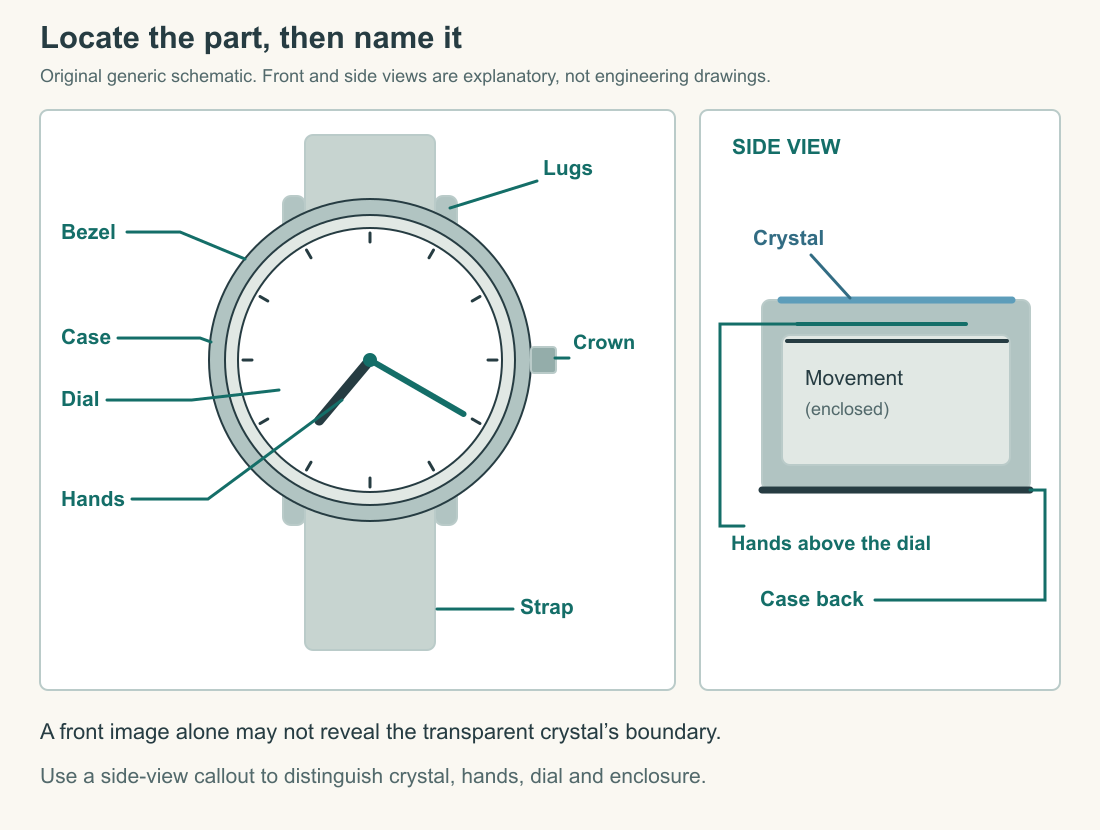
The illustration is a teaching schematic, not an engineering drawing of a commercial model. Follow each leader line to its endpoint. In particular, the crystal lies above the hands and dial, while the case back closes the other side of the enclosure. A line that merely points somewhere near the middle of the watch cannot distinguish these layers. Accurate annotation depends as much on where the line ends as on choosing the right word.
A location system that survives unfamiliar shapes
Watch descriptions often borrow the positions of an ordinary twelve-hour dial. A crown near four o'clock is below and to the right of the center when the watch is viewed upright. This vocabulary can also locate features on a rectangular watch or a digital display. It describes orientation rather than the time currently shown. A date window at three o'clock remains there when the hands indicate eleven twenty.
An aperture is an opening through which information appears, such as a date disc. A subdial is a smaller display within the main face. Those terms describe arrangements, not necessarily functions. A small circular display could show running seconds, elapsed minutes, a second time zone, or another indication. Its scale and the exact manual tell you which. Counting circles is no substitute for identifying what each counts.
Now imagine describing a dark line in a photograph. “There is a defect on the watch” jumps past several unanswered questions. Is the line on the crystal, the dial, the bezel, or a reflected surface? Does it cross underlying features without interruption? Is it visible in another angle? A useful first record might say: “A narrow pale line runs diagonally across the upper-right portion of the front image; its depth and location are unresolved.” This is not timid writing. It gives the next observer a precise target.
Location also prevents false comparisons. One writer praises a brushed bezel; another criticizes the polished case side. They may be describing different surfaces on the same object. Before arguing about execution, establish which face, edge, or transition each person means. The photograph's orientation and lighting should travel with the description. “Left” without specifying whether the watch is viewed from the front or back can reverse the intended location.
Read one photograph carefully
Open the official front image on Seiko's SRPE55 page. This is the first of three documented examples we will revisit. In the inspected image, a dark round dial carries pale markers with different shapes at key positions. The longer broad hand has an arrow-shaped end. A day/date opening sits to the right of center. The crown projects near four o'clock, and the case joins a metal-colored linked bracelet. These are descriptions of the displayed image, not findings from handling a physical specimen.
Look at the minute markings before reading the writing. Then examine how the hands differ in length, width, and tip shape. Look again at the opening: the information appears on a light background, which creates its own patch of contrast. You can now explain why the face is not simply a uniform collection of bright objects. Its parts have separate visual jobs, even if you have not yet decided how successfully they perform them.
Write three short lines. In the first, record something visible. In the second, record a statement from the manufacturer's specification. In the third, explain a plausible consequence. For example, a visible arrow tip is an observation; the named movement belongs to the documentation; the suggestion that differing hand shapes may aid identification is an inference. The inference is reasonable, but a photograph alone has not established a measured reading advantage for every user.
This three-part habit will matter throughout the course. An observation can be mistaken, a specification can contain an error, and an inference can be weak. They are not a ranking from perfect truth to useless opinion. They are different kinds of evidence that call for different checks. Reinspect the picture to check an observation. Consult a more exact document to clarify a specification. Test or qualify the reasoning that links a feature to an expected consequence.
A digital watch changes the vocabulary's emphasis
The official Casio F-91W-1 page provides our second example. Its inspected front image shows dark digits on a pale rectangular display, surrounded by printed labels and a dark case. Hours and minutes occupy more visual space than the smaller seconds and calendar information. The case and attachment form a different outline from the round analog example. There are no time-indicating hands to name.
Here the useful question is how areas of the display and the surrounding labels divide the reader's attention. A button label is not itself a readout. A printed reference to an alarm does not tell you whether the alarm is currently enabled. A mode indicator, when present, can determine how the same digits should be interpreted. The object therefore has two layers of reading: extracting the characters and understanding the display state in which those characters appear.
Do not describe the digital display as a mechanical dial with missing parts. It solves the information problem through a different interface. Nor should you infer the full electronic architecture from its visible segments. Our earlier course, How a Wristwatch Works, traced energy and timing mechanisms. Here we ask what the user can actually see and how that surface makes information available. The boundary keeps this course from repeating the mechanism lesson under a new title.
Suppose a cropped image contains only “12:34.” You cannot know whether it represents a time of day, an elapsed interval, or a setting field without additional context. More digits do not automatically produce a more complete statement. Their meaning depends on units and state, just as a number in a laboratory report needs a label. Restore the surrounding display before making a confident reading.
The movement does not live on the front surface
The movement is the mechanism or assembly that keeps time and drives the indications. A caliber is an identified movement design or designation. A reference number usually identifies a watch model or variant; it is not interchangeable with a caliber designation. Several references may use a related movement, and similar-looking references can contain different ones. Record the exact identifiers from documentation rather than treating a family name as a technical specification.
An analog face does not prove a mechanical movement. Quartz watches can have hands, dates, and chronographs. A sweeping-looking seconds hand does not, by itself, establish every detail of regulation either. A still image cannot show a sweep at all. The word “automatic” printed on a dial is visible lettering; the claim about winding becomes stronger when linked to the manufacturer's identified movement description. That distinction is especially useful when the question concerns an individual used object rather than a current catalogue image.
Some watches expose part of a movement through an opening in the dial or a transparent case back. An open view gives more evidence, but not unlimited evidence. A rotor may obscure components underneath it. An opening may reveal one moving assembly while leaving the rest covered. You can name what you can locate, then use a technical diagram to understand the hidden relationships. Do not draw a complete gear train over an attractive photograph merely because you remember one from another watch.
The public FHH discussion of dial making emphasizes that movement architecture constrains the placement of indications. This gives us a useful design question: which arrangements are choices of presentation, and which follow from the underlying mechanism? A photograph can prompt the question; it rarely answers the manufacturing history by itself. Keep the inquiry open without pretending every dial is an unconstrained graphic composition.
Turn a list of nouns into a description
A catalogue of parts is only the beginning. Useful description explains relationships. “A large date opening” is incomplete unless we know large relative to what. “The date opening replaces an hour marker and introduces a contrasting rectangular area beside the central hands” tells us how the face is organized. “The bracelet is substantial” is weaker than identifying the width of its first links, its taper, and the way it meets the case, while acknowledging what the front photograph conceals.
Try describing an unfamiliar watch in four sentences. First establish its overall arrangement and orientation. Next explain the main time display. Then locate additional information and controls. Finally identify a material or construction question that requires documentation. This forces selection. You do not need every possible term; you need the terms that allow another reader to find and understand the important features.
A good description also leaves room for change. “The silver-colored case appears reflective in this image” survives a later discovery that the case is a coated alloy. “The solid steel case has excellent polishing” might fail at both material identification and evaluation. Specificity is not the same as overclaiming. The most useful sentence is often exact about appearance and modest about its cause.
You have now acquired a way to slow down looking without draining it of pleasure. You can move from whole object to component, locate features, separate the display from the mechanism, and distinguish observation from a supported claim. In the next chapter, these nouns become design questions: which feature attracts the eye, which helps a particular reading task, and which dimension matters when a flat image becomes an object on a wrist?
Application
Use the supplied exterior schematic and the linked official Seiko front photograph. On a personal sketch, locate case, bezel, crystal, dial, hands, crown, lugs, and attachment. For the crystal, use a side-view callout or explicitly state that the front image does not show its boundary clearly. Do not copy the manufacturer's photograph into a public submission without permission; a linked image and your own numbered sketch are sufficient.
Write a 150–200-word description with three marked statements: Observation, Manufacturer claim, and Inference. Then identify one thing the photograph cannot establish and the additional evidence you would need. You may work entirely from the supplied reading material; no watch purchase or disassembly is required.
Model interpretation: The crown is near four o'clock and the calendar opening is right of center. Those locations are visible. The movement designation comes from documentation. Different marker shapes may support orientation, but a claimed improvement in reading speed would need a suitable comparison. A transparent-looking front does not identify its material, and a product photograph does not establish an individual watch's condition.