Water, salts, and microbial activity
Two samples of intestinal contents can contain similar dry material but behave very differently because of their water content. They can also contain similar water amounts but differ in the molecules and organisms present. The colon changes both fluid balance and chemical composition, through processes performed by its own cells and by microbes living in the lumen. Those contributors interact without becoming the same system.
This chapter follows a sodium ion and a fermentable carbohydrate fragment. The sodium ion helps reveal how epithelial transport supports water recovery. The carbohydrate fragment reveals how microbes transform material that escaped small-intestinal digestion. We then examine what a microbiome measurement can establish about either process, and what a change in a laboratory marker does not prove about health.
Water follows conditions created by solute movement
The colon does not mechanically wring water from contents like a hand squeezing a cloth. Its epithelium transports ions and other solutes, creating local conditions that support osmotic water movement. Water can move through cellular and paracellular routes. The observed result reflects opposing movements and the changing composition of the fluid on each side.
Osmosis concerns water movement across a selectively permeable boundary in relation to effective solute differences. The relevant particles and their permeability matter. A substance that remains in the lumen can influence water distribution differently from one rapidly absorbed or transformed. A total mass of dissolved material does not identify the number of effective particles or how long they remain there.
For an original comparison, imagine two solutions containing equal masses of different solutes. If one solute has molecules twice as massive as the other, the same mass contains half as many molecules. If both behave as nondissociating solutes under the chosen assumptions, particle counts differ. If one dissociates into ions, the comparison changes again. This is why “more grams” is not a complete osmotic explanation.
The living colon continually changes these conditions by absorption, secretion and microbial transformation. An initially large molecule can be broken into smaller products, increasing particle number; subsequent uptake can remove those products. The resulting water movement depends on the sequence, not just the composition of material when it first arrived.
Sodium absorption uses coordinated membrane machinery
Several pathways contribute to colonic sodium absorption. One involves sodium–hydrogen exchange at the apical membrane, coordinated with chloride–bicarbonate exchange to support net sodium chloride absorption. Another uses epithelial sodium channels, particularly important in distal colonic regions. These are selected mechanisms, not an exhaustive map of every ion pathway.
At the basolateral membrane, the sodium–potassium ATPase helps maintain the sodium gradient by using ATP to move sodium out of the cell and potassium inward. Sodium entering through an apical channel is moving down an electrochemical gradient; the channel itself is not an ATP-driven pump. Whole-epithelium absorption depends on the coordinated system even though its individual components use different mechanisms.
The distinction between channel and pump prevents a common error. A channel permits movement according to its selectivity, gating and driving conditions. A pump can maintain an unequal distribution through energy expenditure. Calling both “active sodium transporters” without explaining the arrangement obscures where the energy is used and why direction is maintained.
The 2022 colonic transport review describes multiple absorption and secretion pathways and their regional regulation. We use selected accessible passages for this overview; the diagram does not claim that one pathway performs all transport in every region. Nor should the crypt and surface be divided into an absolute “only secretion” and “only absorption” pair.
Secretion belongs in the balance
The colon can secrete ions and fluid as well as absorb them. Chloride secretion is one route that can influence movement of other ions and water. Bicarbonate secretion contributes to local acid–base conditions, including an environment affected by microbial metabolism. Potassium handling can also vary. The organ's net effect is therefore not simply the amount its absorptive cells take up.
Imagine a fictional region receiving 500 fluid units from upstream in an hour. It adds 100 by secretion and removes 450 by absorption, leaving 150 to move onward if its stored volume is unchanged. A second region receives 500, secretes 200 and absorbs 550. It also leaves 150, despite greater secretion and greater absorption.
The same output can conceal different underlying activity. Conversely, the same absorption can produce different outputs if secretion or input changes. This logic becomes especially important when discussing diarrhea. Watery output does not uniquely identify rapid transit, failed absorption, excessive secretion or an upstream source of extra fluid.
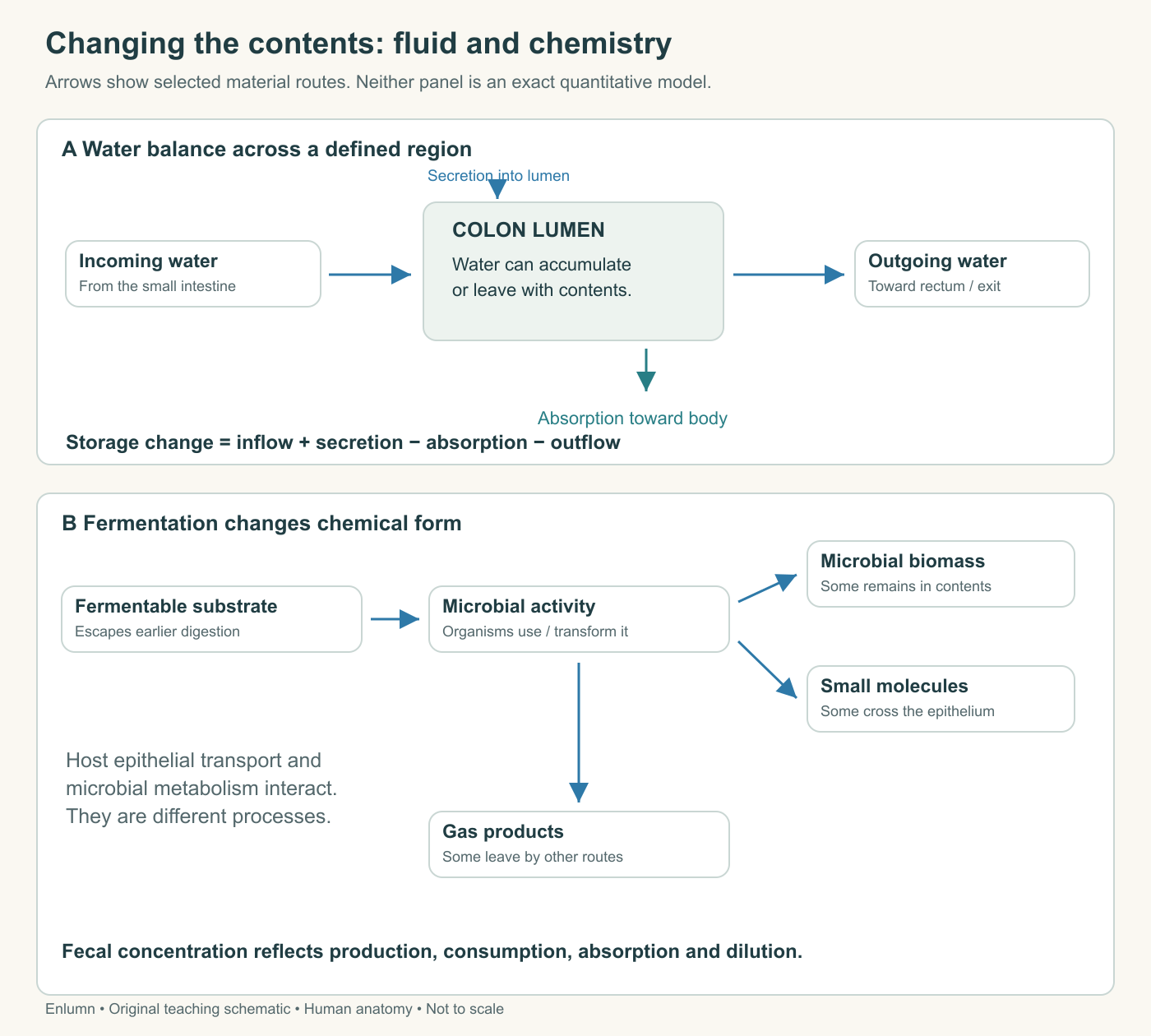
The diagram separates movement across the host epithelium from transformations within the lumen. Its numbers are fictional balances. Microbial products can be absorbed, retained, transformed again or leave through different routes.
Microbes can use what the host did not digest
Some carbohydrates reaching the colon resist the human enzymes acting upstream. Microbes can possess enzymes that make particular substrates accessible. Fermentation allows them to obtain energy and produces a range of smaller compounds under the largely anaerobic conditions of the colonic lumen. Different organisms and substrates support different pathways.
Acetate, propionate and butyrate are prominent short-chain fatty-acid products. Colonic epithelial cells can absorb these compounds, and butyrate is an important fuel for many colonocytes. Other products reach portal blood and undergo further handling. The contribution depends on what is produced, where it is absorbed and how it is used. It is not the same as absorbing the original carbohydrate intact.
Microbial metabolism can also produce gases, and other microbes can consume some of those products. A community contains exchanges among organisms as well as exchanges with the host. One organism's released intermediate may be another's substrate. Consequently, the behavior of a species isolated in a laboratory need not predict its net effect within an interacting community.
Suppose a fictional community receives 100 labeled carbon units. During an interval, 40 appear in small organic molecules, 20 enter new microbial biomass, 10 leave in gaseous products and 30 remain in other material. The carbon balance is complete, but only the first category is even potentially available through the selected small-molecule absorption route. Whether all 40 cross the wall requires another measurement.
This is an elemental accounting model, not a fermentation equation or a human energy budget. It preserves labeled carbon while allowing molecules to change. It also demonstrates why a stool analysis alone misses material absorbed earlier or released as gas. The contents that leave are a residue of many processes, not a complete report of production.
Production is not the same as stool concentration
Imagine that microbes produce 60 units of a selected short-chain fatty acid during one interval. If the host absorbs 50 and microbes consume or transform 5, only 5 remain for the measured output, assuming no storage change. In a second interval, production is 40, absorption 20 and microbial consumption 5, leaving 15. More appears downstream when production is lower because removal is also lower.
Now change the water volume in the sample. Five amount units in one volume unit produces concentration 5; the same amount in five volume units produces concentration 1. A lower stool concentration can therefore arise without lower production or lower total output. Timing, mixing and sampling add further complications in real studies.
These examples do not make stool measurements useless. They define what a measurement is: a concentration or amount in an output sample under particular conditions. Combining it with other evidence can answer stronger questions. Interpreting it as the microbial production rate without accounting for removal and dilution exceeds what it directly shows.
The same caution applies to vitamins synthesized by microbes. Production somewhere in the lumen does not automatically establish sufficient absorption at the appropriate site, in the appropriate form, to meet human requirements. A list of microbial biochemical capabilities is not a nutritional guarantee.
A community has composition and function
Microbiota refers to the organisms in a community; microbiome is often used more broadly for their collective genetic and ecological context. Usage varies, so a study should specify whether it measured organisms, DNA, expressed proteins, metabolites or host responses. Those measurements answer different questions.
A DNA sequence can indicate potential capability without establishing that a pathway was active at the sampled time. A protein measurement moves closer to expressed machinery but still does not directly quantify every reaction rate. A metabolite concentration reflects production and removal. A host inflammatory marker adds another level, which need not be caused by the microbial feature measured alongside it.
Relative abundance deserves particular care. Suppose a fictional sample contains 20 organisms of group A and 80 of group B. A represents 20 percent. Later, A remains at 20 while B falls to 30, so A now represents 40 percent. Its relative abundance doubled without any increase in its absolute count.
The reverse can happen too. If A rises from 20 to 40 and B from 80 to 160, A remains at 20 percent despite doubling in number. A percentage is a relationship to a denominator. To claim growth or depletion in absolute terms, a study needs evidence that supports that interpretation.
Diversity is not a universal score for health
Richness concerns how many different types are represented under a chosen definition. Evenness concerns their distribution. A community with ten equally common types differs from one with the same ten types dominated by a single member. Diversity measures combine aspects of these patterns in different ways.
Higher diversity is not automatically better in every body site or clinical context. The function of the organisms, the location, the host state and the outcome of interest all matter. A number that summarizes community structure cannot replace an explanation of how that community interacts with a particular tissue.
Likewise, finding a microbial difference between people with and without a condition does not establish which came first. Diet, medication, transit, inflammation and other host characteristics can affect both the condition and the community. Disease may change the habitat; the changed community may then contribute further effects. A one-time comparison cannot untangle every direction of influence.
An experiment can narrow these questions, but it must be interpreted at the level of what was manipulated. Randomizing a dietary pattern tests the consequences of that dietary assignment under study conditions. It does not automatically isolate a particular microbe as the mediator of every observed host response.
Read a human study at the right level
A 2021 study by Wastyk and colleagues compared higher-fiber and higher-fermented-food diets, with 18 analyzed participants per arm in a 17-week protocol. The paper reports that two participants assigned to the fiber arm were not randomized. There was no unchanged-diet control group. Some microbial and inflammatory measures changed, but the primary cytokine-response outcome did not significantly change in either arm; its analysis excluded the nonrandomized participants.
These details matter when assessing a headline. The study provides evidence about measured responses in a small, generally healthy cohort. It does not establish treatment of colitis, prove that increased microbial diversity caused an immune change, or show that one specific food explains the entire response. The authors identify limited generalizability and uncertain durability among the study's limitations.
Now apply the general reasoning from our fictional examples. A changed stool metabolite could reflect altered production, absorption or dilution. A changed relative abundance need not mean absolute growth. An association between two changing measures does not identify the intervening mechanism. The study becomes more interesting when these questions are visible, because it can guide a next experiment rather than serve as a slogan.
Check your understanding: A microbial group's relative abundance doubles and a stool metabolite concentration falls. What two tempting conclusions are not yet established?
Expected answer: The group did not necessarily double in absolute number; another group may have declined. The metabolite's production did not necessarily fall, because absorption, further microbial use, output volume and dilution also affect its stool concentration.
Application
Spend 15 minutes revising this fictional headline: “A higher microbiome score proves that this food heals the colon.” Replace the vague score with a specific measurable quantity and write one question about study design, one about mechanism and one about the claimed clinical outcome.
Then calculate group A's relative abundance if its count rises from 20 to 30 while B stays at 80. Explain how this differs from the earlier example in which A stayed at 20 while B fell.
Model interpretation: A becomes about 27.3 percent of 110 organisms. Its absolute count increased by 50 percent, while its relative share changed from 20 to about 27.3 percent. A defensible headline names the studied population, comparison and measured outcome; it does not convert community composition into demonstrated disease treatment.