Making air move
A door can stand open while nobody passes through it. An airway can likewise be open at a moment when there is no net airflow. The opening supplies a route; movement requires a pressure difference along that route. To explain a breath, we need both the anatomy of the passage and a sequence that creates, changes and eventually removes the driving difference.
This chapter follows one quiet breath in a simplified adult respiratory system. The person breathes spontaneously through an open airway. We are not describing every posture, illness, exertion or form of assisted ventilation. Those boundaries let us make a clear model and then identify which parts would need changing in another situation.
Give every pressure an address
Atmospheric pressure refers to the surrounding air. Alveolar pressure refers to gas within an alveolar region. Pleural pressure belongs to the thin space outside the lung between its coverings. Ventilation depends on a pressure difference between the airway opening and the alveolar region, while the lung's expansion also depends on forces across its boundary. NCI SEER: mechanics of ventilation.
Write the location after every pressure in your notes. A statement such as pressure falls is incomplete until we know where. Lowering pressure inside the alveolus relative to the mouth favors inward flow. Lowering the pressure around the lung can increase its distending pressure. These statements describe different differences, even when they participate in the same breath.
We often choose the surrounding atmosphere as a reference zero. Negative on that scale means below the reference, not less than an absolute vacuum. OpenStax uses this relative convention in its account of breathing. OpenStax: pressure relationships.
For an original arithmetic example, suppose a room is at an absolute pressure of 100 invented units and a connected chamber at 99. The chamber is at minus one relative to the room, but its absolute pressure remains 99. If someone calls it a vacuum simply because the relative reading is negative, the error is in the interpretation of zero.
The diaphragm changes the enclosure
During inspiration, contraction of the diaphragm moves it downward and increases thoracic volume. Rib movements also contribute to expansion. The lungs follow the changing enclosure through their mechanical relationship with the pleural surfaces, allowing alveolar pressure to fall below the pressure at the airway opening as air enters. NHLBI: breathing movements.
The diaphragm is therefore not a piston that pushes inhaled air directly through the throat. It acts on the shape and pressures of the chest. Nor does its downward motion send air into the abdominal cavity. The changing boundary lies below the lungs; the gas follows the airway route established in chapter one.
Consider two original drawings. In the first, the diaphragm moves downward while an arrow carries air downward through an intact trachea. In the second, the arrow passes through a hole in the diaphragm. Only the first preserves the connection between mechanical action and the actual air route. A moving wall and an opening in that wall are entirely different things.
This is a useful habit for anatomical explanations: separate the structure that supplies force from the space through which material travels. Otherwise, a diagram can accidentally turn every moving boundary into a pipe.
A gas law is a model with conditions
For a fixed amount of ideal gas at constant temperature, pressure multiplied by volume is constant. Enlarging that closed volume lowers pressure. The relationship helps explain why expansion can initiate a pressure difference, but a breathing lung is an open system that admits or releases gas. OpenStax: Boyle's law.
Work through an invented sealed chamber. At pressure 100 and volume 10, its pressure–volume product is 1,000. If volume rises to 12.5 while the specified conditions hold, pressure becomes 80. The calculation is exact within this simple model. It does not predict the pressure of a real alveolus at the end of an ordinary inspiration.
Now connect the chamber to the room through a passage. As the chamber expands, gas can enter. The fixed-amount assumption no longer describes the entire event. The initial tendency toward a lower pressure can drive inflow, and that inflow changes how much gas the chamber contains.
This resolves an apparent puzzle: a lung can contain more air at the end of inspiration while its alveolar pressure has returned close to atmospheric pressure. Volume and gas amount have both changed. Applying the sealed-chamber equation across an open breath without accounting for exchanged gas would erase the very process we are trying to explain.
Four moments make a more useful picture than one arrow
At the end of a quiet expiration, an open-airway model has no net flow when alveolar and atmospheric pressures match. Inspiratory muscle activity then expands the system, creating a small inward-driving pressure difference. As inspiration ends, flow returns toward zero. Relaxation and elastic recoil subsequently favor outward flow until pressures again approach equality. NCI SEER: inspiration and expiration.
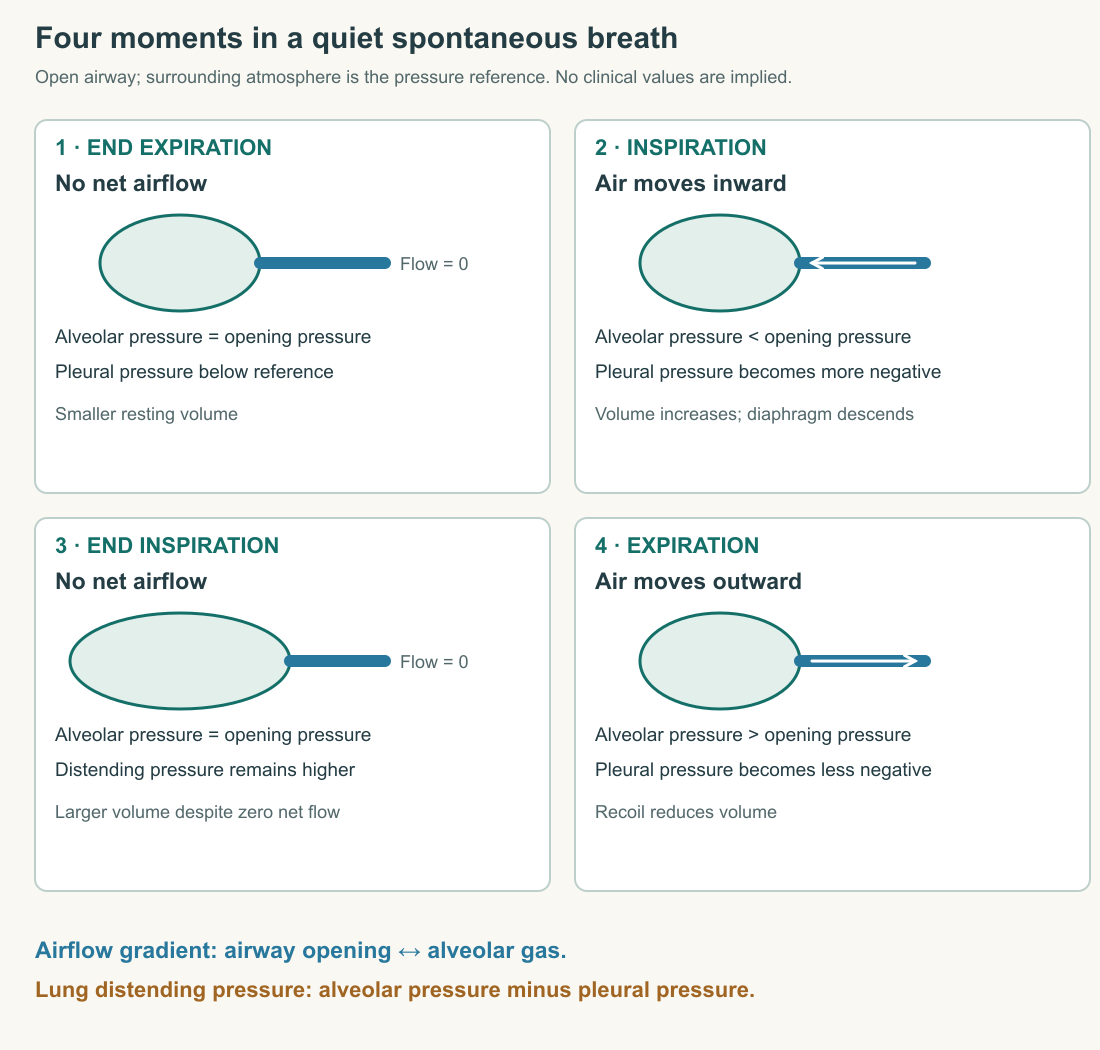
Use the drawing as a sequence rather than four unrelated anatomy pictures. The two no-flow moments differ in lung volume. The arrows during inspiration and expiration represent a direction of movement, not the total amount already present.
An original classroom animation could show a dot moving through an airway while a separate bar records lung volume. The dot stops when flow reaches zero; the volume bar does not disappear. If the animation instead empties the lung whenever the dot stops, it has confused the rate of change with the amount held.
The distinction is familiar in other measurements. A reservoir can have no current inflow while still holding water. Here, too, the useful question is whether a number describes an amount, a rate, or a pressure. They cannot substitute for one another merely because all change during a breath.
Distending pressure is not the airflow gradient
For the lung, transpulmonary pressure is commonly expressed as alveolar pressure minus pleural pressure. In clinical measurements, an airway pressure can represent alveolar pressure under appropriate no-flow conditions; interpreting the measurement requires attention to location and regional variation. Grieco, Chen and Brochard discuss those limits in a review of transpulmonary pressure. Review abstract, 2017.
Our original model uses relative units. At one no-flow moment, alveolar pressure is zero and pleural pressure is minus four. The difference across the lung is four. At another no-flow moment, alveolar pressure is still zero but pleural pressure is minus seven. The difference is now seven.
Both moments can have no net flow through the open airway because the opening and alveolar pressures match. Yet the distending differences are unequal. A model that uses only the pressure difference from mouth to alveolus cannot, by itself, describe the lung's expanded state.
Keep the subtraction in order. Zero minus a negative four is positive four. Reversing the labels changes the sign and can produce the false conclusion that the surrounding pressure is pushing inward more strongly in the second case. These numbers are invented to teach subtraction and location; they are not expected patient readings or treatment targets.
Compliance asks how much volume changes
Compliance describes a change in volume per change in the relevant distending pressure. Static assessment separates elastic behavior from the pressure needed to sustain flow. The lung and chest wall both contribute to respiratory mechanics, and pressure–volume behavior need not be linear over the full range. Grinnan and Truwit: respiratory mechanics review.
Imagine two original model compartments measured under comparable no-flow conditions. A two-unit rise in distending pressure enlarges compartment A by six volume units and B by two. Over that interval, A has a compliance of three volume units per pressure unit; B has a compliance of one. We have compared their response to a specified change, not assigned a moral ranking to softness.
High compliance is not automatically the same as healthy tissue. A structure may expand readily while providing less effective recoil. Conversely, a stiff structure may require a larger pressure change for the same increase in volume. Later disease examples will distinguish those consequences instead of treating maximum expansion as the sole goal.
A further pair of measurements can test whether the response stays proportional. If the next two pressure units add only three volume units to compartment A, one constant no longer summarizes the entire curve. State the interval and conditions whenever a single compliance value is used to explain a changing system.
Resistance asks what pressure difference sustains flow
Airflow resistance relates the pressure difference along an airway to the resulting flow. In a steady laminar model of a rigid circular tube, Poiseuille's relation makes resistance strongly sensitive to radius, as well as length and gas viscosity. Real airways branch, change caliber and can have more complex flow. Grinnan and Truwit: resistance.
Begin with an original linear example: a pressure difference of six produces a flow of three, giving a resistance of two in the corresponding units. With the same model resistance, a pressure difference of eight produces a flow of four. If resistance doubles while the difference remains six, flow falls to one and a half.
These calculations do not require the wall to be stiff. Resistance concerns movement along the route; compliance concerns a volume response to distension. A soft chamber attached to a narrow tube can have high compliance and high route resistance at the same time. Drawing them as separate components makes the distinction harder to lose.
The fourth-power radius relationship is striking: reducing radius to half would multiply resistance by sixteen in that specified tube model. It is not a license to declare that any halving anywhere in a person's airway tree produces exactly sixteen times the total resistance. Parallel routes, altered flow patterns and living walls change the problem.
Recoil returns stored energy, but expiration is not always passive
Quiet expiration commonly relies on relaxation of inspiratory muscles and elastic recoil. More forceful expiration can recruit abdominal and other expiratory muscles. The muscular pattern therefore depends on the kind of breath being described. NHLBI: breathing movements; OpenStax: forced breathing.
Think of an original spring model. Work done in extending the spring can be partly returned as it recoils. Calling the return passive describes the absence of a new active pull in that direction; it does not mean the earlier loading required no energy. The respiratory tissues are more complex than a metal spring, but this limited comparison clarifies the energy bookkeeping.
Nor does the lung return to an empty state after a quiet breath. A remaining volume and opposing lung–chest wall recoil belong to the resting mechanical arrangement. Grinnan and Truwit: equilibrium and work.
If your model collapses every air space at each ordinary expiration and then rebuilds the whole organ at the next inspiration, it has introduced a large fictional task. An explanation should match the cycle being considered, including its starting and ending states.
Flow needs time to become a volume
An instantaneous flow reading is not the volume moved during the entire breath. To recover a volume from a flow record, we must account for how long each rate lasts. This is ordinary rate arithmetic, and it gives the changing arrows in our sequence a quantitative meaning.
In an original stepped record, inward flow is two volume units per second for half a second, then one unit per second for another half second. The first interval contributes one unit and the second contributes half a unit. Total inspired volume in this record is one and a half units, despite a peak flow of two.
Compare a second invented record that holds one unit per second for two seconds. Its peak is lower, but its total is larger. Ranking breaths solely by the tallest point on a flow trace would reverse their ranking by moved volume in this example.
A real flow curve usually changes continuously, so its accumulated volume corresponds to the area under the curve over the chosen interval. Our rectangles make that accumulation visible without calculus. They also force us to label the horizontal axis: a picture with no time scale cannot establish how much gas moved from the height of its curve alone.
A chest movement is evidence, not a complete ventilation measurement
Suppose an invented simulator has a visibly moving enclosure, a flexible inner chamber and a connecting tube. An observer reports that the enclosure moved normally. That observation does not establish how much gas passed through the tube. The tube could have changed, the coupling could differ, or the chamber could respond differently to the same enclosure motion.
Add three records: enclosure displacement, chamber volume and flow through the opening. Together they let you distinguish cases that looked identical from outside. This is a reasoning exercise, not a method for assessing someone else's breathing at home. Its point is that measurements answer the questions their locations and definitions permit.
The same restraint applies to our diagrams. They show how pressure differences, tissue properties and muscle action can fit together. They do not contain an individual's complete anatomy, regional variations, metabolism or gas measurements. A successful explanation is specific about what the model establishes and leaves the next question open.
We can now make air move in an account that preserves the route and the mechanics. The next chapter asks what happens after that air reaches an exchange surface. A well-explained breath supplies a necessary part of that story; transferring oxygen across tissue still requires its own mechanism.
Application
Reconstruct the four stages of the original pressure diagram without copying its arrows. At each stage, record the direction of net airflow, whether lung volume is changing, and which two pressures determine the direction through the airway. Explain why the two no-flow stages need not have the same volume.
For a fictional chamber, alveolar pressure is zero and surrounding pressure changes from minus three to minus six. Calculate both distending differences. Separately, calculate flow when an airway pressure difference is eight and its stipulated linear resistance is four. Explain why these are different calculations.
Write 300–450 words comparing a stiff chamber on a wide tube with a compliant chamber on a narrow tube. Identify which change concerns compliance and which concerns resistance. These are paper models; no breath-holding, forced breathing or personal physiological experiment is required.
Check your understanding: Can a lung be at a larger volume while airflow is zero, and does negative relative pressure mean a complete vacuum?
Expected answer: Yes to the first and no to the second. At the end of inspiration, an open-airway model can have matching atmospheric and alveolar pressures while the lung remains expanded. A negative pressure reading relative to the atmosphere means below that reference, not below absolute zero pressure.