Across the exchange surface
Imagine a perfectly ventilated room separated from a bloodstream by a thick, impermeable wall. Air could arrive and leave all day without supplying oxygen to that blood. The thought experiment identifies the missing part of a lung explanation: the properties of the interface, and the physical conditions on its two sides.
The alveolar surface solves a demanding problem. It places gas and blood close enough for rapid molecular transfer while maintaining a boundary between them. In this chapter we examine that boundary, distinguish the pressure of one gas from the pressure of a mixture, and learn why an oxygen measurement can describe several different things.
The barrier must be thin and remain a barrier
The blood–gas barrier includes an air-facing epithelial layer, extracellular material and capillary endothelium. Its thinner regions favor diffusion, while the surrounding architecture supplies support. Maina and West's review examines the tension between reducing diffusion distance and preserving mechanical integrity. Its anatomical account distinguishes thin and thicker portions of an alveolar septum. Maina and West, 2005.
A diagram that shows only the shortest crossing route is useful but selective. Follow it from alveolar gas through the surface lining and tissue layers, then into plasma and toward a red blood cell. The red cell does not occupy the air space, and its hemoglobin is not painted onto the outside of the alveolar wall.
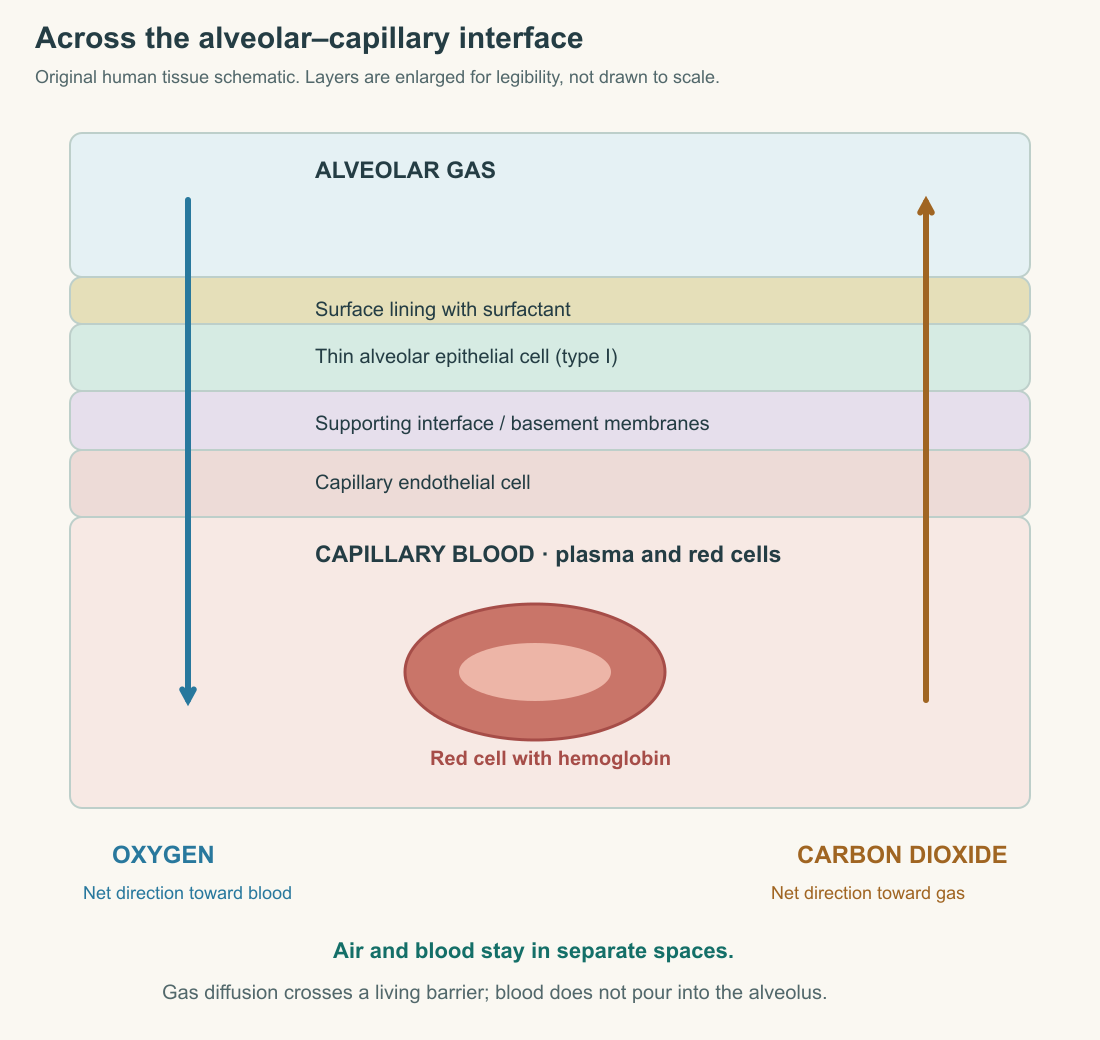
The familiar instruction make it thinner is therefore incomplete. Removing every boundary would eliminate the separation that allows the system to function. The relevant question is how a living structure provides a short transfer path while retaining its integrity, not how closely it can resemble a hole.
The surface lining changes the mechanical problem
Surfactant in the alveolar lining lowers surface tension. It therefore helps the exchange region function as a changing air–liquid interface, rather than behaving like an untreated liquid surface. This chemical contribution sits alongside the structural support described above. Maina and West: alveolar surface lining.
Keep two functions separate on your diagram. A substance that alters the lining's surface properties is not the blood protein that carries oxygen. The first acts at the air-facing interface; the second is inside red cells beyond the barrier. Giving both a vague label such as helps oxygen enter conceals their different locations and mechanisms.
The distinction also shows why an anatomical boundary cannot be represented fully by its outline. Its material properties matter. A shape can remain recognizable on the page while its chemical surface behavior changes, with consequences for the work needed to expand the region. Our enlarged drawing locates the lining but does not attempt to model its complete behavior during a breath.
Diffusion does not require a molecular pump at the wall
For a simple membrane model, gas transfer increases with available area and the gas's partial-pressure difference, and decreases with barrier thickness. A coefficient incorporates the gas and material properties. This is a respiratory form of Fick's diffusion relationship. Pittman: gas exchange and diffusion.
Picture molecules moving in both directions across a permeable boundary. If conditions favor more crossings one way than the other, there is net transfer in that direction. The word net matters: it describes the difference between opposing movements, not a rule that every molecule must travel along the same arrow.
An original counting model makes the distinction visible. During one interval, 140 marked particles cross from A to B and 90 cross from B to A. Net transfer is 50 from A to B. In another interval, 100 cross each way. Net transfer is zero, although 200 crossings still occurred.
The example is not a microscopic simulation of an alveolus. It simply prevents zero net transfer from being mistaken for complete molecular stillness. A diffusion arrow summarizes a population-level result. It is not a conveyor belt on which each oxygen molecule takes an instructed journey toward the heart.
A partial pressure belongs to one gas
In an ideal mixture, each component contributes a partial pressure, and those contributions sum to total pressure. A component's fraction multiplied by the total gives its partial pressure. This lets us discuss oxygen separately from nitrogen, carbon dioxide and water vapor. Pittman: respiratory gas laws.
Use a dry, invented mixture at total pressure 100 units. If oxygen accounts for one quarter of its molecules, its partial pressure is 25 units. A second mixture can have the same total pressure but only one eighth oxygen, giving an oxygen partial pressure of 12.5. Equal total pressure does not mean equal oxygen conditions.
This is the bridge from the preceding chapter. There, a total gas-pressure difference along an airway explained bulk airflow. Here, the partial-pressure difference of an individual gas across an interface explains its net diffusion. One measurement does not replace the other.
Now hold the fraction constant and lower total pressure from 100 to 80 in the invented mixture. Oxygen's partial pressure falls from 25 to 20. The fraction did not change, yet the partial pressure did. Reporting a percentage without the surrounding pressure therefore leaves out information needed for a gas-exchange calculation.
The two sides need not contain the same amount at equilibrium
Dissolved gas has a partial pressure related to its dissolved concentration through solubility. At equilibrium between gas and liquid, matching partial pressures does not require equal concentrations in the two phases. Chemically bound gas is distinct from the freely dissolved portion. Pittman: Henry's law and gas carriage.
For a paper model, stipulate that liquid A dissolves two amount units per pressure unit and liquid B dissolves five. At the same gas partial pressure of four, their dissolved concentrations are eight and twenty. The arithmetic shows why concentration cannot be compared across different media without considering how each medium holds the gas.
This also exposes a weakness in the phrase oxygen moves from where there is more to where there is less. More of what, measured in which phase and in which form? An account that combines dissolved oxygen, bound oxygen and gas-phase concentration into one unlabeled number can give the wrong impression of the driving condition.
We use partial pressure here because it permits a consistent comparison across the relevant gas and liquid interface under the stated physical assumptions. It does not erase chemistry. It gives us a way to connect the chemistry with the direction of net molecular transfer.
Area and thickness have different consequences
The membrane relationship can be explored without inserting patient values. Let transfer in an invented model equal a coefficient of one multiplied by area and pressure difference, divided by thickness. With area six, difference four and thickness two, the result is twelve transfer units per interval.
Doubling area to twelve gives twenty-four. Doubling thickness instead, from two to four, gives six. Doubling both area and thickness leaves the original result unchanged. Each answer follows from changing one factor while holding the others fixed; it does not establish that two actual tissue changes would cancel perfectly.
A useful next question is whether visible surface equals available exchange surface. A folded membrane could look extensive yet have part of its area unavailable to the relevant air or blood route. In the model, that inaccessible portion should not be counted as fully operating exchange area merely because it appears in a drawing.
Likewise, a single average thickness may hide variation. A wall with thin and thick regions is not necessarily represented adequately by treating every point as equally thick. Maina and West discuss why structural thickness measurements and thickness measures used to describe diffusion resistance answer different questions. Review: measuring the blood–gas barrier.
A maintained gradient requires more than an initial difference
Suppose two closed model compartments begin with unequal oxygen partial pressures and exchange across a permeable barrier. As net transfer proceeds, their conditions approach one another. The driving difference changes. It would be a mistake to use the initial difference as though it remained unchanged indefinitely.
Now replace those closed compartments with continuously renewed ones. One route supplies gas; another brings in and removes liquid. Their renewal can maintain a difference that a closed pair would gradually lose. This is an inference from the transport model, and it shows why ventilation and circulation belong in the same explanation as diffusion.
In the lung, blood arriving at a capillary changes as exchange occurs along its path. A single arrow from alveolus to blood can hide that progression. The question is not merely whether an initial difference exists, but how transfer and transit interact before blood leaves the exchange region. Pittman's account discusses the distinction between diffusion and perfusion limitations. Pittman: oxygen transfer.
Our drawing deliberately has an entering and leaving blood route. Without them, it would resemble a static cup of blood that reaches equilibrium once and then serves the body forever. The next chapter will make regional renewal the central problem rather than a background detail.
Hemoglobin changes how much oxygen blood can carry
Most oxygen carried in blood is bound to hemoglobin rather than simply dissolved. Oxygen saturation describes the fraction of available hemoglobin binding capacity occupied by oxygen; oxygen content describes an amount per quantity of blood. The relation between oxygen partial pressure and hemoglobin saturation is curved rather than linear. Pittman: oxygen binding and saturation.
Consider two invented carriers with the same kinds of binding sites under the same binding conditions. Sample A has 100 available sites and sample B has 50. If each is 90 percent occupied, A holds 90 bound units and B holds 45. Equal saturation has not produced equal bound amounts.
Add a small stipulated dissolved amount to each sample. The total now includes both bound and dissolved components, but the difference in available sites remains consequential. We have not calculated actual blood oxygen content; we have shown why a percentage needs a denominator before it can establish a transported quantity.
The curve introduces a second caution. Doubling a partial pressure does not necessarily double saturation. A quantity bounded by full occupancy cannot rise proportionally without limit. When reading a graph, identify whether its vertical axis is saturation, content or something else before interpreting the change.
Carbon dioxide follows its own chemistry
Carbon dioxide travels in blood in several forms, including dissolved gas, protein-bound forms and bicarbonate. Reversible chemical reactions connect these forms, allowing carbon dioxide produced in tissues to be carried and later released toward the lungs. Its partial pressure refers to the freely dissolved gas, not to all carbon carried in bicarbonate. Pittman: forms of gas carriage.
Draw the oxygen arrow and carbon dioxide arrow separately. Their opposite net directions in an exchanging lung region do not imply a turnstile that admits exactly one oxygen molecule only when one carbon dioxide molecule exits. Each gas has its own conditions and transport chemistry.
This distinction matters in the interpretation of words such as exchange. Everyday exchange can mean an equal trade between two people. Physiological gas exchange describes transfers across an interface; it does not, by itself, state a one-for-one molecular bargain.
An original accounting example illustrates the difference. A model boundary might transfer eight units of one substance inward and six of another outward during the same interval. Both transfers can be real without numerical equality. To explain the actual quantities in a body, we would need information about metabolism, storage, ventilation and blood transport, not just the presence of two arrows.
A large breath cannot answer every oxygen question
Return to the imagined room behind a wall. We can now alter four distinct features: how air is renewed, how permeable the interface is, how much circulating carrier reaches it and how much binding capacity that carrier contains. A change in one does not tell us the condition of the others.
Consider a fictional laboratory report with an unchanged gas supply and lower transfer into a circulating liquid. Three explanations remain compatible with that observation: less available membrane area, a larger transfer distance, or a smaller maintained partial-pressure difference. The finding alone does not select among them.
A discriminating follow-up would measure or control one of those features. If thickness and area remain fixed while the difference falls, the model favors one explanation. If the difference is maintained and area is reduced, it favors another. This is the logic of controlled comparison, not a checklist for diagnosing a person's symptoms.
The quality of the answer depends on preserving alternatives until evidence separates them. Naming a mechanism is stronger than repeating that exchange is poor, but a named mechanism still needs support. The equations help organize what to look for; they cannot supply observations that have not been made.
Check the units before comparing the results
Imagine one report gives transfer as twelve units per minute and another gives one unit every five seconds. The numbers look different, but the rates are equal. A comparison that ignores the time unit manufactures a difference that is absent from the model.
Now imagine one report gives oxygen amount per sample and another gives oxygen amount per unit volume. Those cannot be compared until sample volume is known. A larger sample can contain more total oxygen while having the same concentration as a smaller sample.
These checks are deliberately simple. They belong beside the anatomical drawing because a correct route can still be paired with incorrect arithmetic. Every numerical explanation should preserve what was counted, the quantity it was divided by, and the conditions under which the measurement was made.
Read the whole route at several scales
At the organ scale, air and blood arrive through separate branching systems. At the microscopic scale, molecules cross a living interface. At the blood-transport scale, binding changes how much oxygen can be carried at a given dissolved condition. Each scale adds something the previous picture omitted.
Try telling the story with only one scale. Airway anatomy alone cannot establish diffusion through a membrane. A membrane equation alone cannot establish whether blood reaches it. A saturation percentage alone cannot establish how much oxygen-bearing blood leaves for the tissues. The explanation becomes reliable when the scales connect without merging their quantities.
You should now be able to label the crossing path, calculate a hypothetical change in transfer, and distinguish partial pressure, saturation and content. Those are practical intellectual tools for the next chapter: a lung can contain many locally different regions, and successful exchange depends on how air and blood are distributed among them.
Application
Redraw the interface with air, tissue layers, plasma and a red blood cell in their correct sequence. Add separate oxygen and carbon dioxide arrows. State which parts of your drawing concern bulk flow and which concern molecular diffusion.
Use the stipulated transfer model coefficient × area × pressure difference ÷ thickness. Begin with coefficient one, area eight, difference three and thickness two. Calculate the starting value, then the value after halving area, doubling thickness, and making both changes together. Keep these cases separate.
Write 350–500 words explaining why two fictional samples at 90 percent saturation can carry different bound amounts when their available binding capacities differ. Include one sentence distinguishing dissolved partial pressure from total oxygen content, and one explaining why opposite gas arrows do not imply a one-for-one exchange.
Check your understanding: Does matching total gas pressure guarantee matching oxygen partial pressure? Does matching saturation guarantee matching oxygen content?
Expected answer: Neither follows. Gas mixtures can have equal total pressure but different oxygen fractions. Samples with equal saturation can contain different amounts of hemoglobin and therefore different bound oxygen amounts; total content also includes dissolved oxygen.