Play that lets a cat be a cat
The toy is excellent. It has feathers, a bell, three attachments, and a name suggesting a military aircraft. Its owner waves it directly in front of the cat's face. The cat watches for a moment, then leaves. The owner concludes that the cat does not play.
Ten minutes later, a plain fabric mouse slides partly behind a chair leg. The cat lowers its body, waits, and pounces. The difference is not necessarily the toy. It may be the movement, distance, concealment, timing, or opportunity to act.
Play is something we arrange together. We provide safe materials and possibilities; the cat supplies choices. This chapter teaches you to design those possibilities, adjust difficulty, and recognize engagement without confusing it with exhaustion.
What the game offers
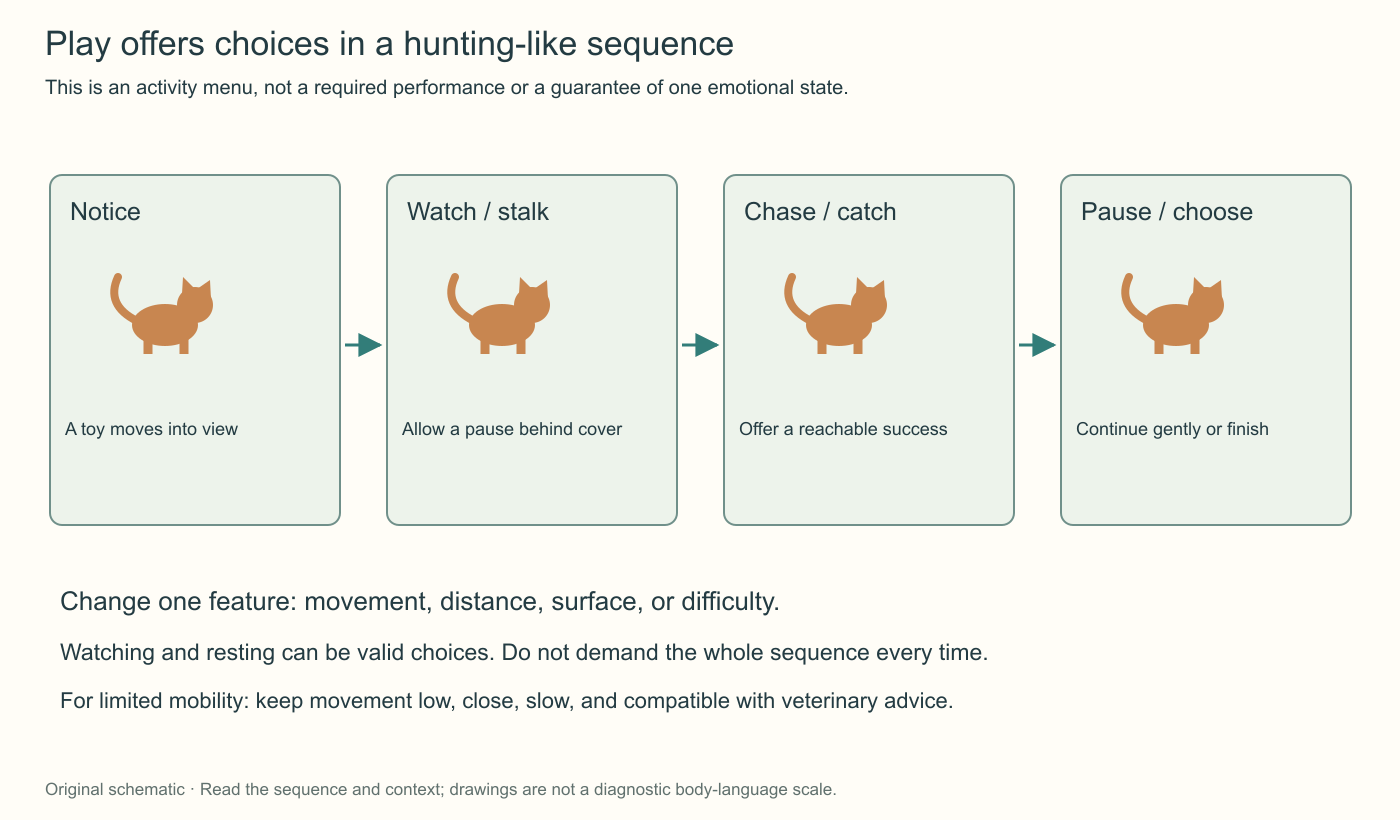
Predatory play can include noticing, orienting, watching, approaching, chasing, pouncing, grasping, and manipulating. A session need not display every action in that order. The list helps us offer a range of opportunities rather than reduce play to running after an object.
Notice how much of that sequence can occur before a chase. A still cat watching an object disappear behind an edge may be engaged. If you move the toy constantly because the cat is “doing nothing,” you may remove the moment that makes the approach interesting.
The FelineVMA's play guidance recommends opportunities for appropriate play and emphasizes that interaction should suit the cat. At home, useful variables include the toy's size, texture, speed, route, sound, and distance. Change these thoughtfully and observe which features seem to matter.
Start with an object that can be pursued away from the cat rather than repeatedly pushed toward its face. Let it pause, partly disappear, and become available again. Allow safe capture. A toy that remains forever unreachable may create activity without offering a satisfying way to participate.
This is a design principle, not a claim that every cat needs to complete an exact hunting ritual after every game. Some prefer batting a soft object; others enjoy a short chase; others investigate a food-search arrangement. The individual's response tells you where to begin.
A first session, step by step
Choose a safe area with traction and room to move. Remove fragile objects and avoid routes that require dangerous jumps or abrupt landings. Use an appropriate toy in good condition, with attachments that cannot be easily swallowed. Keep string or wand toys under active supervision and put them away afterward.
Invite interest with a small movement at a comfortable distance. Pause. If the cat watches, give it time. If it approaches, let the toy move a little farther away or behind a safe edge. If it disengages, stop or make the invitation easier. The cat need not be chased around the room to discover that play is available.
Allow a capture appropriate to the toy. Keep your hands away from the grasping and kicking zone. Release tension rather than turning the toy into a tugging contest the cat did not choose. When it lets go or shifts attention, you can offer another small movement.
End after a few manageable opportunities while the cat can settle or move to another activity. The exact duration varies with age, health, interest, and the session's intensity. A brief successful game can be more useful than a long one that ends in frustration.
If the cat shows breathing difficulty, collapse, marked weakness, or another alarming change, stop and seek veterinary help. Do not interpret physical distress as admirable effort. For cats with medical or mobility restrictions, obtain an activity plan from the treating team and adapt games within it.
Your hands should remain people
A kitten pouncing on fingers can appear charming. As the animal grows, the same game may become painful. The relevant lesson is not that the cat suddenly became bad; the target and consequences were part of its learning.
Use suitable objects for grabbing, biting, and kicking. Keep hands involved in moving toys safely or delivering rewards rather than functioning as prey. If a cat begins targeting hands or feet, examine when it happens, what games preceded it, and what alternatives are available. The behavior may have several contributors, so do not diagnose every bite as play.
An original example illustrates the timing problem. Rowan wiggles his fingers under a blanket, laughs when the kitten pounces, and later protests when it attacks his moving toes. The kitten has encountered similar moving shapes under fabric, but Rowan has changed the rule without teaching an alternative. He can stop using body parts as targets, protect himself from rehearsals, and offer appropriate play at predictable times.
Avoid turning withdrawal into another chase. Move calmly and use safe separation when needed. If the pattern is intense, persistent, or associated with fear or pain, consult the veterinary team and a qualified behavior professional. A course exercise is not a substitute for assessing a risky interaction.
Difficulty has several dimensions
We often make a game harder by moving faster. But speed is only one variable. Distance, concealment, required movement, novelty, sound, and the number of steps between action and reward all change difficulty.
Suppose a cat easily retrieves food from an open shallow compartment. You can make the next version slightly more challenging by changing one feature: a little less visibility or a slightly different opening, provided the design remains safe. If you simultaneously add a lid, movement, noise, and a new location, failure tells you little about which change mattered.
The same principle applies to a toy. A cautious cat may engage with a slow ground-level movement but avoid a noisy toy in the air. Progress might mean a longer comfortable investigation or a slightly wider route, not a higher jump.
Watch for the difference between effort and frustration. Productive effort includes continued voluntary engagement and opportunities for success. Repeated striking, abrupt abandonment, escalating agitation, or inability to obtain any reward may indicate that the arrangement needs to become easier. No single sign diagnoses frustration, but the pattern should change your plan.
Keep an easy version available. A successful familiar activity is not educationally worthless because the cat already knows it. Enjoyment and competence can be reasons to repeat a game. Challenge should add interest without making all rewards difficult to obtain.
Food searches and puzzles
Food activities combine exploration with a tangible consequence. They can be as simple as a few pieces of appropriate food placed in visible, accessible locations. The food belongs within the feeding plan, and the cat must retain reliable access to adequate nutrition.
A 2016 clinical review by Dantas, Delgado, Johnson, and Buffington discusses food puzzles as a way to provide opportunities for cats to obtain food through activity. Such recommendations are not proof that a particular commercial puzzle improves every cat's health. Match the device and difficulty to the animal, introduce it gradually, and observe actual use.
For a beginner, start with food plainly visible in a stable, easily reached arrangement. Let the cat discover success before adding difficulty. Avoid tight spaces that can trap a jaw or paw, sharp cut edges, loose parts, or materials the cat chews and swallows. Supervise homemade designs and discard damaged ones.
An example uses a clean, shallow, stable tray with a few suitable food pieces spaced apart. The cat can see and reach them. A later version might place some pieces beside safe fixed obstacles that require a small change in approach. The goal is easy discovery followed by modest problem-solving, not a homemade engineering obstacle course.
Wet-food activities require appropriate materials and prompt cleaning. Consider temperature and perishability. Dry-food devices also need regular washing and drying according to their design. Enrichment equipment is food equipment when food touches it.
In multi-cat homes, offer activities separately when necessary. A puzzle that one cat controls can reduce another cat's access. Observe who participates, who waits, and who leaves. Household totals again conceal individual experience.
Variety without constant disruption
Toy rotation can restore interest, but novelty is not automatically better than familiarity. Keep a small selection and alternate opportunities while preserving some known favorites. Store supervised toys securely rather than leaving every attachment scattered across the floor.
Think in categories of activity. One day may offer a short moving-toy game; another may emphasize searching; another may include exploration of a safe box arrangement. Quiet observation and rest remain part of the day. A cat does not need a full entertainment schedule to deserve a nap.
For an original weekly menu, imagine Juniper, a healthy adult who enjoys ground-level games. Monday offers a fabric toy moving around two chair legs. Tuesday offers an easy food search in accessible locations. Wednesday repeats the favorite toy with a different pause pattern. Thursday adds a safe open box to investigate. Friday includes a brief target-training session. The weekend repeats the activities Juniper actually chose.
The menu is not a prescription. Its value is the reasoning: different opportunities, manageable sessions, familiar options, and observations that determine what stays. If Juniper dislikes the box, Thursday has produced information. The box need not become a permanent monument to the owner's effort.
Play for different bodies and ages
An older cat can remain interested in investigating and manipulating objects even when rapid pursuit or jumping is inappropriate. Bring the activity within comfortable reach, improve traction, shorten movement demands, and allow more pauses. A new decline in activity should be assessed rather than attributed automatically to age.
A cat with visual or hearing impairment may benefit from different cues, predictable placement, and an environment adapted to its abilities. Avoid startling it with an object it cannot detect well. Ask the veterinary team for individualized guidance when sensory or mobility changes affect safe activity.
Kittens may offer frequent bursts of energy and need suitable outlets, but they also need rest and safe supervision. A small body does not make string, elastic, or swallowable attachments harmless. Choose objects for the actual way the kitten uses them.
For any cat, adapt the challenge to the ability you observe today. An activity that worked last year may need revision. The pleasure of play can survive a change in speed, height, or duration. Preserving participation often matters more than preserving the old performance.
When a game does not work
If the cat ignores an invitation, check the simple variables first. Is it resting? Has it just eaten? Is the toy too close, noisy, fast, or difficult? Is another animal watching? Is the surface slippery? Has the cat shown a broader change in activity or comfort?
Change one plausible feature and offer another low-pressure invitation later. Do not keep escalating until you obtain a reaction. A defensive swipe is not evidence that you have finally found the cat's favorite game.
If a toy creates frantic attention without useful engagement, choose a more controllable activity. Physical toys that can be safely caught often give clearer opportunities than an unreachable light or screen image. The objective is an enjoyable activity in the cat's world, not a visually dramatic response in yours.
Persistent changes in willingness or ability to play deserve assessment, particularly when accompanied by changes in eating, movement, breathing, grooming, or interaction. The play log can help describe the change, but it cannot decide whether the cause is medical.
A measure of success you can actually use
Record three things after a session: what the cat chose to do, what adjustment helped, and how the session ended. “Ran a lot” is less informative than “watched from behind the chair, approached when the toy paused, caught it twice, then walked to the water bowl.”
You can also record participation across sessions. Does the cat approach the setup voluntarily? Does it have successful opportunities? Can it disengage? Does the activity fit its physical ability and the household's routine? These questions offer a more useful measure than a fixed number of minutes or calories supposedly burned.
One good game repeated reliably can be a strong foundation. Add variety because it offers something worthwhile, not because the cat's life must constantly look new. Play is a conversation carried out through movement and consequences. The best part is often discovering the small adjustment that makes the animal decide, yes, this is interesting.
Check your understanding: A cat succeeds with an open food tray but gives up when the owner adds a lid, moves it into a busy hallway, and makes it roll. What should the owner change next?
Expected answer: Return to an easy familiar arrangement and change only one manageable feature at a time, while preserving adequate food access. The combined changes do not reveal which feature caused difficulty. Observe voluntary participation and success rather than using hunger to force persistence.
Application
Build a three-activity menu: a moving-toy game, a simple search or puzzle, and an accessible low-movement option. For each, write an easy starting version, one possible increase in difficulty, a reason to stop, and a safe storage or cleaning step.
Model menu: A fabric toy travels slowly away along a nonslip floor, later disappearing briefly behind a chair leg. A few pieces of appropriate food begin openly visible on a stable tray, later separated by safe fixed obstacles. A less mobile cat can investigate or bat a suitable object within comfortable reach. The owner supervises, accounts for food, stops if engagement becomes uncomfortable, and stores strings and loose attachments afterward.
Evaluation guide: The plan gives the cat meaningful choices, contains achievable success, and matches movement demands to the animal. It does not require owning a cat: you can evaluate a supplied fictional profile and explain what observations you would need before putting the plan into practice.