Skills that make ordinary life easier
Luca can spin twice, touch a yellow cone, and put his chin in a hand. At the apartment entrance he still pulls his person through the door. His training is real; it simply answers different questions from the ones the entrance asks. A useful household curriculum begins with the actual situations a dog encounters: coming away from an interesting object, moving beside a person, waiting somewhere comfortable, releasing something safely, and finding an appropriate toilet. These skills buy freedom by making daily arrangements easier to trust.
Design the job before choosing the word
“Behave” gives a dog no particular action to perform. Describe the destination instead. For a recall, the dog turns, approaches, and stays close enough for the next safe step. For walking, the leash hangs without sustained tension; the dog need not stare into your eyes. For a station, the dog goes to a designated surface and remains until a release. Each definition lets you notice success before you become annoyed by failure.
Also identify what the skill cannot do. A recall does not replace a fence beside traffic. A mat does not make a frightened dog comfortable with a visitor. Toilet training does not give a puppy an adult bladder. The practical arrangement and the learned behavior support each other. Asking the behavior to replace every arrangement creates risks precisely when the dog is least able to meet your expectation.
Choose one task for a short session. Prepare the reward, clear the area, and decide the easiest version the dog already nearly succeeds at. Finish while you can still give a useful reward. A minute of clear practice may contribute more than a long argument in which the dog rehearses something entirely different.
Coming back should predict something worthwhile
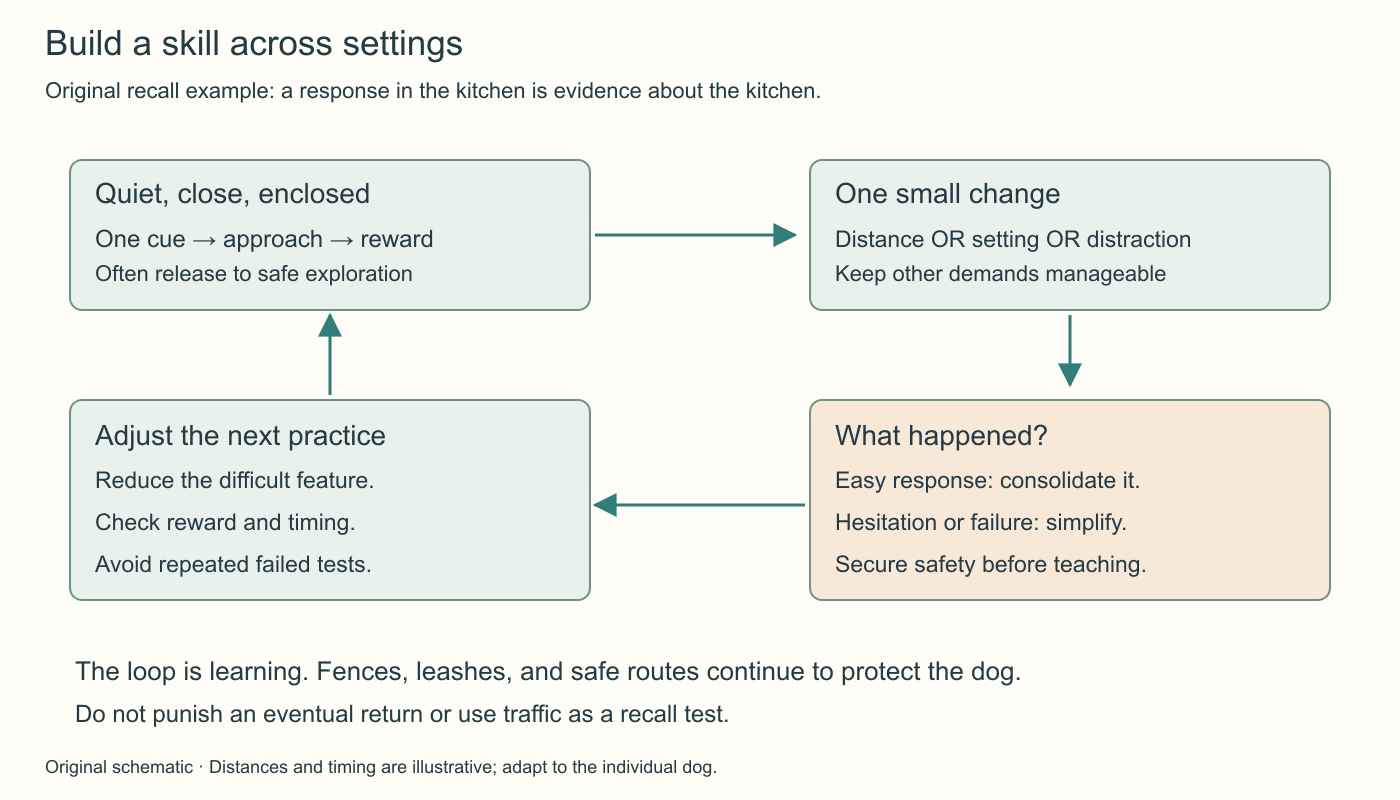
Begin in a quiet enclosed place at a small distance. When the dog is available to engage, give your chosen cue once and make returning inviting. Mark the approach you wanted, reward close to you, and then often release the dog to resume a safe activity. You are building a history in which arriving is valuable, rather than teaching that every arrival ends the enjoyable part of life.
Increase difficulty gradually. Distance, competing smells, moving animals, unfamiliar places, and excitement all change the task. A reliable response across the living room provides evidence about that living room. It does not certify a beach. Practice an easier version in each new setting, with physical management that prevents a failed trial from becoming an escape. The San Francisco SPCA's recall guidance emphasizes rewarding return and building the behavior under manageable conditions.
A long line can provide controlled room to explore where its use is safe and permitted. Use suitable equipment fitted for the dog, usually a harness for this purpose, and obtain practical instruction if line handling is unfamiliar. Avoid traffic, cyclists, tangled vegetation, other dogs, and places where a running dog could hit the end with force. A line is neither a brake to jerk nor a promise that every open space is suitable.
Suppose Luca looks up when called but resumes sniffing. Repeating the word louder does not identify the missing step. The distance may be too large, the scent unusually absorbing, or the reward history too weak here. Secure the situation, help him move on without a confrontation, and design the next practice at an easier distance. Record what he could do: he oriented, but did not approach. That is more actionable than “ignored me.”
Never punish a dog for finally returning. Whatever happened earlier, the consequence now meets the return. If the dog arrives after an alarming delay, secure him and let your own breathing settle. You can reconsider the location and management afterward. A person who becomes safe and rewarding upon reunion is a person the dog has reason to approach again.
Include the end of the recall in practice. Some dogs approach and then dodge the hand because a collar grab predicts restraint. Teach comfortable, brief equipment contact separately, pairing a small tolerated touch with a reward and release. Do not chase or corner a dog to prove that the recall is finished. If reaching toward the dog causes fear, work on handling with appropriate help before combining the pieces.
Walking together without making the walk disappear
Loose-leash walking is a compromise between species with different preferred speeds and interests. Define a generous zone in which the dog can move without pulling. Reward moments in that zone and take only a few steps initially. The RSPCA's walking guidance supports rewarding a loose lead and avoiding progress that continually pays for pulling. The goal is a learnable pattern, not a prolonged contest of strength.
Choose an undemanding practice location after urgent toilet needs are addressed. Reward near the position you want to make valuable. If every reward lands ahead of your knee, you may repeatedly restart the surge you dislike. If the dog can take two easy steps beside you, reward those before asking for twenty. Increase the stretch only as the current one becomes comfortable.
Access to a safe smell can also be a reward. Pause at a manageable distance, wait for slack without hauling the dog backward, then move together toward the sniffing spot. This gives the dog a way to obtain something the walk is for. You do not need to compete with every smell using increasingly magnificent cheese. You can make cooperation part of reaching the environment.
If the leash tightens, avoid a jerk. In a safe situation, pause or change your route gently and make the next opportunity easier. A narrow pavement beside fast traffic may be a place for efficient management rather than a lesson. Cross before the difficult encounter, choose a quieter route, or shorten the training portion. The dog still needs movement and toileting while learning; a perfect walk cannot be the admission requirement for going outdoors.
Consider Luca at the entrance. Inside, he can walk three steps on a loose leash. Outside, a delivery cart rattles past. His person initially calls this the same exercise. It is not: sound, motion, threshold excitement, and available space have changed together. Practice the doorway when it is quiet, reward a small successful transition, and keep actual exits secure while the skill develops.
Avoid turning every walk into continuous obedience. Sniffing, pausing, and moving at a suitable pace are part of the dog's experience. Use a clear transition when you need close walking through a constrained area, then allow more exploration where appropriate. A dog who gets genuine opportunities to investigate has a more reasonable bargain to accept when you briefly ask for precision.
A station gives the dog an address
A mat is useful because it makes an otherwise vague request visible. Introduce a comfortable, nonslip surface in a quiet place. Reward looking toward it, stepping onto it, or another small approximation suited to the dog. As stepping on becomes predictable, reward there. Add your cue when it can meaningfully predict the action. Teach a release so departure also has a clear place in the exercise.
Build duration in small increments while you remain nearby. Deliver rewards on the mat rather than luring the dog off it to collect payment. Then separately practice a little distance or a mild distraction. If you step away, open a cupboard, and demand a minute of stillness at once, you have changed several dimensions of the task. Return to a version the dog can understand.
Stationing and relaxation overlap but are not identical. A dog can hold a trained position while remaining tense. Look for the whole animal: posture, scanning, breathing in context, and ability to disengage. A mat near the kitchen may be an excellent waiting place during quiet preparation and a poor refuge during a crowded party. Do not ask a trained location to erase distress caused by its surroundings.
Use the skill for brief practical moments before extending it. Luca can stand on his mat while a person puts on shoes. Later he can remain there while one familiar adult carries a bag past at a comfortable distance. If he repeatedly leaves, examine difficulty, comfort, and reward timing. Preventing departure by intimidation would remove the information that tells you the present exercise is too hard.
Releasing an object can preserve trust
An exchange begins with an object the dog can safely possess and comfortably relinquish. In a calm game, offer a reward the dog values. As the dog voluntarily releases the object, mark that event and give the reward. When safe, return the object and continue. Releasing then predicts a useful exchange rather than inevitable confiscation. Add a verbal cue once the action is becoming predictable.
Practice with ordinary low-stakes toys, not a stolen chicken bone or something the dog already guards. Keep hands away from the mouth and avoid prying. If the dog freezes, hardens, growls, retreats with the object, or otherwise shows discomfort, stop the exercise and arrange qualified help. Resource guarding is a safety and emotional problem, not an opportunity to demonstrate who owns the furniture.
A real emergency needs its own response. If a dog may have swallowed something dangerous, contact veterinary help promptly and follow their instructions; do not substitute a training game or induce vomiting without direction. Keep hazards inaccessible in the first place. Prevention is especially useful with an animal whose investigative equipment is a mouth.
An exchange cue also differs from leaving something alone before taking it. Teach these as separate actions if both are useful. Confusing them leads to a household in which the dog must pick up a sock to discover what “leave it” means today. Clear distinctions make training kinder because the animal does not have to guess which part of the sequence you intended.
Toilet training is an opportunity schedule
A dog learns where to eliminate through repeated access and timely consequences, within the limits of age and health. Provide appropriate toilet opportunities after waking, eating, drinking, active play, and at other intervals suited to the individual. Accompany the dog so you can observe and reward promptly after completion. The Dogs Trust house-training guide treats regular opportunities, observation, and immediate rewards as central; it also directs health concerns to a veterinarian.
Keep a simple record for several days: sleep, meals, outings, successful elimination, and accidents. You are looking for a workable pattern, not testing how long the dog can hold on. A young puppy may need frequent access and overnight care. An adult newly arrived in a different home may not know which door leads outside or how to ask. Make the route understandable before assuming a deliberate refusal.
Reward outdoors when the dog finishes, not several minutes later at the food cupboard. Allow a little suitable exploration afterward when possible, so elimination does not always end the outing. If nothing happens, return to supervision and offer another opportunity soon. Do not interpret an unproductive trip as proof that the dog can now be left for a long period.
Accidents require cleaning and adjustment. Punishment can teach a dog that eliminating near a person is unsafe, which makes outdoor observation harder. Use an appropriate pet-safe cleaning product according to its label, and reconsider access, timing, and supervision. Restricting drinking water to protect the rug is not a humane substitute for an adequate toilet plan.
A sudden change in an established pattern deserves veterinary discussion. Increased thirst, pain, repeated straining, blood, or difficulty producing urine changes the question from training to health; inability to pass urine warrants urgent veterinary attention. Age, illness, medication, mobility, and anxiety can all affect a routine. Record the change accurately without trying to diagnose it from the location of a puddle.
In an apartment, include elevator time and the distance to the permitted toilet area. A schedule that works for a ground-floor house may fail on the twelfth floor. Discuss puppy infection risks and appropriate outdoor access with the veterinary team. If an interim designated indoor toilet is necessary, keep its purpose and location consistent and plan the later transition. Practical constraints deserve a plan rather than embarrassment.
Make reliability visible
Choose a small measure for each skill. For recall, record the setting, distance, distraction, and whether one cue produced an approach. For walking, note a short stretch with slack rather than assigning the entire outing a moral grade. For stationing, record a manageable duration with the person at a known distance. These details reveal the next teachable increment.
A successful session might contain four easy repetitions and one indication to simplify. It need not culminate in the hardest possible trial. Generalization means learning that the behavior works across relevant situations; it develops through practice, not through declaring the dog trained. Continue using fences, leashes, barriers, and sensible supervision when failure would have serious consequences.
The reward for this work is ordinary ease. Someone can open a cupboard, pass a neighbor, or collect a delivered package without six simultaneous negotiations. The dog also gains understandable ways to make good things happen. That shared predictability is a substantial household achievement, even if nobody would pay to watch a demonstration of it.
Check your understanding: Luca recalls promptly indoors but fails beside an absorbing smell outdoors. What should change before the next trial, and why is punishment on his eventual return especially unhelpful?
Expected answer: Reduce difficulty, secure the setting, and practice an easier distance or distraction with a worthwhile consequence. The indoor response has not yet generalized to this setting. Punishment delivered at reunion can make returning to the person less attractive rather than teaching the earlier missing response.
Application
Design a seven-day practice plan for a fictional dog, Hazel, who pulls toward the apartment exit, comes when called in the kitchen, and has two afternoon toilet accidents. Choose one training skill and one management change. State an observable criterion, a reward, a safety arrangement, and a reason to seek veterinary advice.
Model response: Practice two loose-leash steps toward the closed exit during quiet periods, reward beside the person, and stop before the busy hallway overwhelms her. Continue managing actual exits securely. Add an afternoon toilet opportunity based on a diary of meals and naps, accompanying Hazel and rewarding immediately after outdoor elimination. Sudden increased thirst, straining, or a new change in a previously reliable adult warrants veterinary assessment. Success is a clearer pattern and easier repetitions, not a claim that all walking or toileting is solved in a week.
Evaluate your work: Does the plan distinguish learning from bodily capacity? Can another caregiver perform the same steps? Is the dog protected if the trained response fails? Replace any instruction such as “be firm” with a concrete action the dog can understand.