Roasting and sautéing
The tray looks orderly when it enters the oven: carrot chunks on one side, broccoli on the other, all coated with oil. Later, the broccoli tips are dark but the carrots still resist a fork. Turning up the oven would expose the tips to more heat while the carrot interiors continue their slower journey. The problem began before the tray went in. One batch contained different structures, and the cook gave them an identical schedule.
This is an imagined kitchen case, not a measured trial. It is useful because it separates two results that a recipe may compress into one word. Browned describes a surface. Tender describes resistance within the piece. A successful preparation has to bring both to the states you want. A vegetable can arrive at either state first.
Heat, Flavor, and Texture explained how surface moisture and heat affect browning. Here we use that foundation to make decisions about actual groups of vegetables. The main tools are preparation, spacing, sequence, and separate endpoints. A hotter oven or another spoonful of oil can change a result, but neither can substitute for a coherent plan for what is sharing the tray.
Two endpoints, two observations
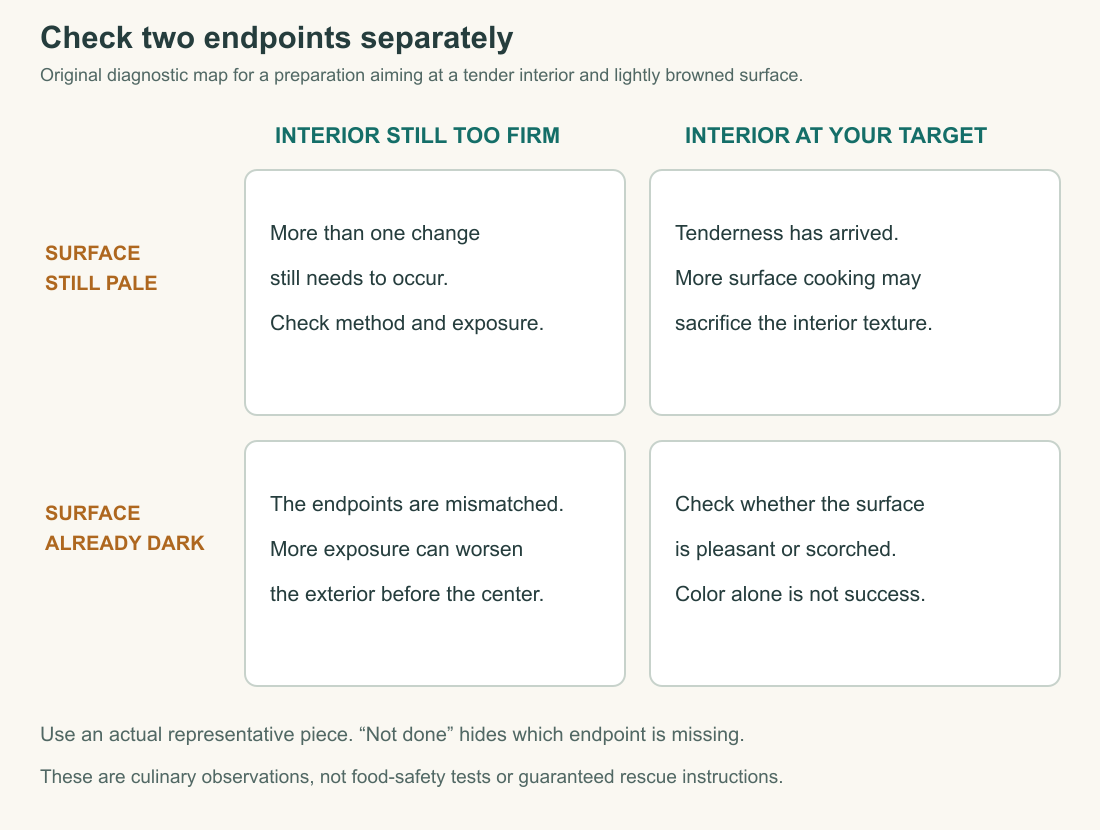
To judge the imagined carrots, examine more than their color. A browned face can coexist with a resistant center. To judge the broccoli, examine more than the crown. A fork entering a small branch says less about a thick attached stalk. Choose a representative substantial piece and check the part most likely to lag, using a stable utensil and protecting yourself from the hot pan and food.
The endpoint also depends on the meal. A carrot intended to remain a distinct forkful can retain more resistance than a carrot destined for a smooth mash. The relevant question is whether it meets your chosen purpose. If you change that purpose halfway through cooking, acknowledge the change. Otherwise a perfectly consistent method may appear unreliable simply because you started asking it to produce a different texture.
Build a two-part note: surface and interior. For example, pale surface and firm interior suggests a different next step from dark surface and firm interior. Pale surface and tender interior presents a third situation. These descriptions do not dictate one universal rescue, but they prevent a vague diagnosis such as not done from hiding the actual constraint.
Consider the third situation. If the interior is already pleasantly tender, prolonged cooking to obtain a deeply browned exterior may sacrifice the texture you wanted. Serving it with a different finish can be a reasonable choice. In the second situation, chasing tenderness through more exposure may burn the outside. The successful cook recognizes when one endpoint is limiting the available path toward the other.
Begin from a published roasting method
Food Hero's Roasted Vegetables uses a 425°F oven, a single layer, and pieces of similar size. Its directions distinguish thin vegetables from pieces around half an inch thick, give conditional timings, and ask for tenderness with lightly browned edges. Use the full linked procedure for quantities, preparation, turning, and handling. The fifteen-minute label at the top of the page is not a promise that every vegetable or cut will finish together.
For a first trial, choosing one listed vegetable makes the observations easier to interpret. You can learn what the source's cut and endpoint look like in your pan before introducing a second ingredient. A single-vegetable trial is still dinner: the cooked component can join ready-to-use beans and a separately prepared starch. Complexity is not a requirement for learning something useful.
Next, imagine adding broccoli to the carrots. The source supplies a starting preparation, but the mixed tray remains your planning problem. If the carrot pieces have a much thicker solid interior than the broccoli stems, changing the carrots' thickness may improve compatibility. If you want the large carrots for their particular bite, preserve that cut and give them their own schedule. The method should serve the intended food rather than force everything into one convenient clock.
An oven tray is not necessarily one indivisible batch. Keeping ingredients in recognizable areas makes selective removal possible. Separate trays offer more independence but use more equipment and oven space. Both choices carry a cost. The simplest useful arrangement is the one that lets you inspect and remove the components you actually expect to finish at different times.
Choose between a changed cut and a changed sequence
Return to the resistant carrots and dark broccoli. There are two different next-attempt designs. In the first, keep a shared start but cut the carrots more thinly, following a preparation appropriate to the selected recipe. In the second, preserve the carrot size but begin them separately and add or cook the broccoli later. These designs address the mismatch from opposite directions: one changes the food's geometry, the other changes its exposure time.
Neither design supplies a tested number of minutes merely by being plausible. Use an inspected recipe for each component and record what happens with your actual pieces. A prediction such as carrots will need a head start is more honest than inventing an exact delay from the imagined case. The delay depends on the sizes, tray, amount, and endpoint you choose.
What would count as improvement? The carrots should reach the desired interior texture while the broccoli retains the surface and tenderness you want. A shorter total time is not necessary. Nor is identical color. The goal is a workable relationship between the foods, not visual uniformity across ingredients whose structures differ.
Suppose thinning the carrots solves their interior problem but creates a pile of fragile pieces that breaks apart when served. That is evidence that the new cut conflicts with the eating design. A longer separate schedule may then be the better choice. Good adjustment preserves the whole purpose of the dish. Optimizing cooking speed alone can quietly destroy the reason for choosing that preparation.
Space is an ingredient in the method
Doubling vegetables without changing the tray is a consequential substitution. More pieces compete for the same area, and overlapping food exposes a different arrangement of surfaces to the hot environment. The oven temperature printed in the recipe has not changed, but the situation around each piece has. This is the practical application of the moisture model from C2.
Imagine that a recipe amount fits in one layer with visible gaps. Two recipe amounts now form a mound. It is misleading to describe the second attempt as exactly the same method for twice as many people. The amount changed the layer, which changed the local conditions. Use sufficient tray space or work in batches when the recipe depends on a single layer.
Batching introduces its own planning question: what happens to the first portion while the second cooks? If crisp edges matter, piling the first batch in a covered bowl changes its environment again. You may decide the meal tolerates a softer result, choose a serving order, or use enough oven space to finish closer together. There is no virtue in obtaining a perfect edge that disappears during an unplanned wait.
Tray position can also produce differences within one batch. Treat an uneven result as a reason to inspect placement and follow the source's turning directions, not as proof that you mismeasured seasoning. Make notes about where the darker pieces sat. You are mapping a working kitchen, not trying to prove that a home oven creates perfectly identical conditions everywhere.
There is a difference between a crowded tray and a large portion served from a spacious tray. The final plate can look equally abundant in both cases. What matters during cooking is the arrangement at that stage, not the serving's eventual appearance. This distinction helps when adapting a recipe for company: calculate the preparation space before increasing the shopping amount. If you only have room for one tray, choosing a second component that uses a pot may be more workable than expecting the oven to accommodate everything at once.
Sautéing gives you another kind of control
In a skillet, you can observe, move, and remove pieces more directly than inside a closed oven. That convenience comes with attention demands. The cook is part of the method: deciding when to stir, when to leave contact undisturbed, and when one ingredient should leave the pan. A pan full of vegetables does not become sautéed simply because the recipe title uses the word.
Use the published cabbage-and-carrot preparation from the previous chapter as a baseline. Its thin cuts suit a mixture that can be moved through the skillet. Compare that design with large broccoli pieces that have substantial stalks and small branching tips. The broccoli may call for a different preparation or a combined moist-heat method. Reusing the same pan does not require reusing the same process.
A useful skillet plan names three decisions before the burner goes on: which pieces begin together, what observation marks their readiness, and what happens if one group arrives first. Those decisions can be simple. For example, a published preparation may already specify a sequence; your job is to recognize its purpose and keep the ingredient groups identifiable until their entry points.
Moving food constantly is not a substitute for making those decisions. Nor is leaving everything untouched. The appropriate movement depends on the published method and the desired contact. If you want to investigate stirring frequency later, hold the cut, amount, pan, and starting condition reasonably consistent. Otherwise the result may reflect several changes at once, and a confident lesson about stirring would exceed the evidence.
A mixed tray as an explanation problem
Here is a supplied observation set for readers who cannot cook the exercise. Attempt A contains thick carrot pieces and broccoli florets with slender stalks. The broccoli reaches the desired texture first; several tips darken further while the carrots remain resistant. Attempt B uses the same ingredient amounts and a thinner carrot cut, but also uses two trays instead of one. Both components finish acceptably in the cook's judgment.
What does this show? The revised arrangement worked better for that cook. It does not isolate the carrot cut as the sole cause. The available space changed too. A good account names both changes and proposes a more focused comparison if explaining the mechanism is important. A good dinner and a well-controlled experiment are related achievements, but they are not identical.
Now suppose Attempt C repeats the thinner cut while returning to the original tray area. If it also works, that would support the cut as a useful contributor under those conditions. It still would not establish a universal recipe for all carrots and broccoli. The scope of the conclusion should remain close to what was actually compared.
This discipline can sound excessive until you notice how often kitchen folklore begins with one confounded success. Someone changes the oil, pan, temperature, and cut, obtains a better result, then announces a law about oil. You do not need a laboratory notebook to avoid that mistake. A sentence recording the major changes is enough to keep useful experience from hardening into an unsupported rule.
Finish the actual dish
Once the vegetables meet their intended endpoints, consider what will accompany them. A browned vegetable already contributes a surface contrast; a sauce can supply moisture and a contrasting flavor. A soft grain beneath it may welcome that moisture, while a dry crisp topping may lose its function if mixed into the sauce too early. These are relationships among components, not a requirement to add more ingredients.
Taste a representative assembled bite when all foods are safe and appropriately prepared. A carrot tasted alone and the same carrot eaten with beans and dressing can give different impressions of the meal. C2's small-portion seasoning comparisons remain useful here. Adjust a sample before changing the whole dish, especially when another component already carries substantial seasoning.
Describe success in terms someone else could understand: the carrots cut easily with a fork, the broccoli stalks are tender without the crowns collapsing, and the sauce reaches the rice without making the intended crisp element soggy. That account is more useful than restaurant quality. It identifies observable contributions and allows another cook to choose a different preference without abandoning the method.
On the next shopping trip, this experience changes what you notice. A bag of tiny carrots and a bundle of thick ones suggest different preparation work. A tray size becomes part of how much you can cook at once. A mixed-vegetable recipe becomes a set of coordinated endpoints. You have moved from following a heat setting to managing the relationship between structure, exposure, and the meal you intend to serve.
Application
Use Food Hero's linked Roasted Vegetables recipe with one listed vegetable for an initial cooking exercise. Follow the full published quantities and procedure, use suitable oven equipment, and follow its leftover guidance. No physical trial by this course is implied. If an oven is unavailable, analyze the supplied attempts instead.
Record the cut, amount, tray arrangement, and chosen endpoint. At the recipe's check points, distinguish surface color from interior resistance. Record actual observations rather than copying a predicted result.
Then design a mixed-vegetable attempt. Choose either a compatible cut or a separate sequence, identify the component likely to finish first, and explain how you will inspect and remove it. Exact timing must come from the selected preparations and your observations, not the fictional case.
Model interpretation: The supplied A–B comparison supports the revised arrangement as a whole. It cannot separate the effects of thinner carrots and additional tray space. If the purpose is a better dinner, that may be sufficient. If the purpose is learning which change mattered, a further comparison should hold one of those variables steady. In either case, tenderness and browning must be evaluated separately.