Rice and other grains
The vegetables are ready, the beans are warm, and the rice is still hard in the middle. There is no visible water left in the pot. Another cook has the opposite problem: tender grains floating in liquid. Both followed a remembered ratio. Neither remembered which rice the ratio belonged to, whether it assumed a covered pot, or when the cooking time began.
A ratio is useful information inside a method. Detached from its ingredient and equipment, it becomes an unreliable shortcut. Cooking a grain requires a supply of water, a suitable heating process, and enough time for the desired changes. Some water enters the food, some remains around it, and some leaves the cooking vessel. Your measured starting liquid has to work within that whole arrangement.
This chapter builds a practical model of the grain pot, then uses specific published rice instructions to show what the model can and cannot tell you. The goal is to cook the grain you actually bought and to diagnose a disappointing result without changing everything at once. The same questions open a route to barley, quinoa, and other staples, whose distinct preparation requirements remain visible.
Read the package as an ingredient description
Start with the complete name. Long-grain white rice, short-grain brown rice, a seasoned instant mixture, and a ready-cooked pouch are different starting materials. A direction intended for one cannot be carried across merely because all the packages contain rice. Note whether the amount in your meal plan means dry rice or cooked rice; confusing those quantities can produce a very different potful.
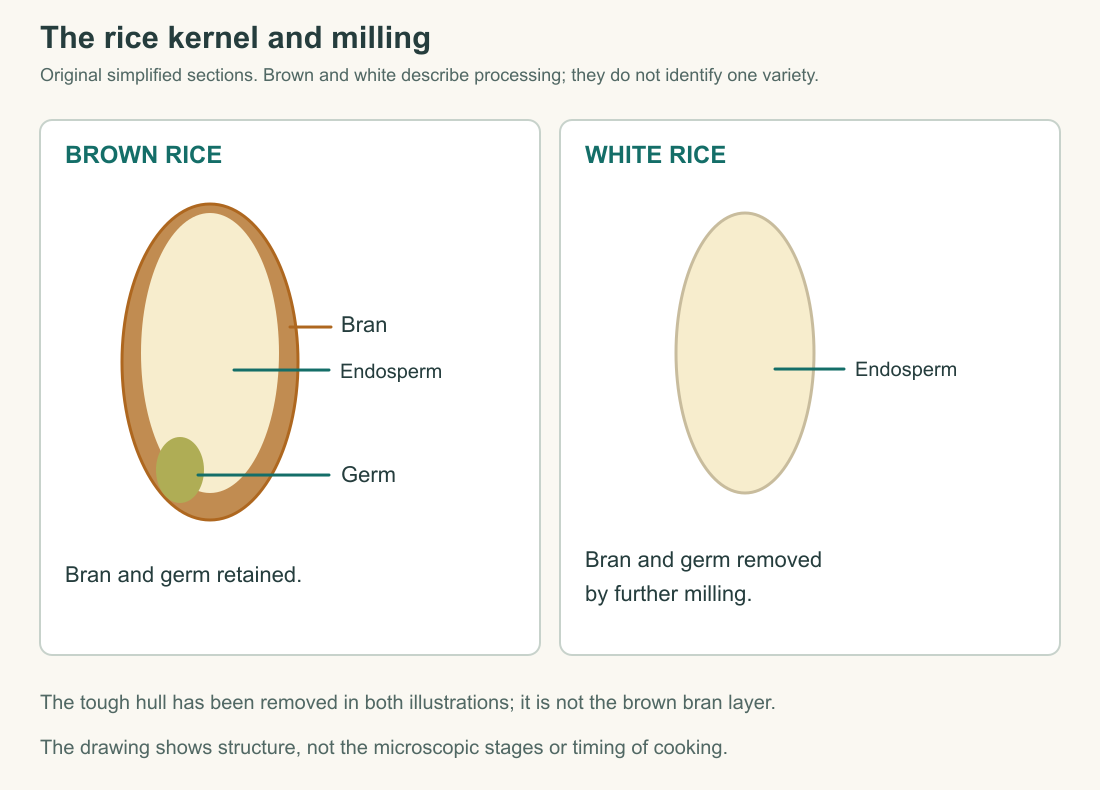
The kernel's structure helps explain one important distinction. A rice hull is the protective covering removed before ordinary culinary use. Brown rice retains bran and germ around and beside its starch-rich interior, the endosperm. Further milling produces white rice by removing bran and germ. USA Rice's cooking playbook illustrates these parts. This anatomy explains a processing distinction; it does not turn every brown rice into the same variety.
Grain shape, processing, and the intended dish are separate pieces of information. A short-grain product may suit a meal where grains cling together. A preparation seeking distinct grains asks for another behavior. Sticky is therefore not an adequate diagnosis on its own. You must first establish whether separation was the intended result for the chosen rice and recipe.
Rinsing and soaking also belong to the particular method. Record whether the instructions require them and follow the product's directions, including any warning about washing enriched rice. A wet, drained grain enters the pot with a different starting condition from a dry grain. You do not need to weigh every drop to understand why switching preparation habits can complicate the interpretation of a familiar ratio.
Water and heat work together
Hydration means taking up water. In grain cooking, hydration accompanies changes in starch under heat. Starch gelatinization describes a loss of ordered structure in starch granules as they interact with sufficient water and heat, with swelling and altered texture. It is not the addition of gelatin, and it does not mean every part of a rice kernel transforms at precisely the same moment.
A microscopy study published in the Japanese Journal of Crop Science examined three rice cultivars during cooking. Its abstract reports faster structural changes in outer regions than at the center, and differences among the cultivars. That is useful evidence against imagining a whole grain as an instantly uniform object. The study's apparatus and timings are not a home recipe. See the 2001 rice-starch microscopy study.
For the cook, this means water present in the pot and water incorporated into the grain are different observations. A grain can remain resistant while surrounded by liquid if the process has not progressed far enough. It can also remain resistant after its available liquid has disappeared. Those cases call for different diagnoses even though the complaint sounds identical.
There is no need to infer an exact microscopic state from one bite. The kitchen observations are coarser: resistance at the center, swelling, free liquid, sticking, and the condition of different parts of the pot. Use the mechanism to organize those observations. Avoid pretending that a fork or spoon supplies the same evidence as the instruments used in a starch study.
The water account
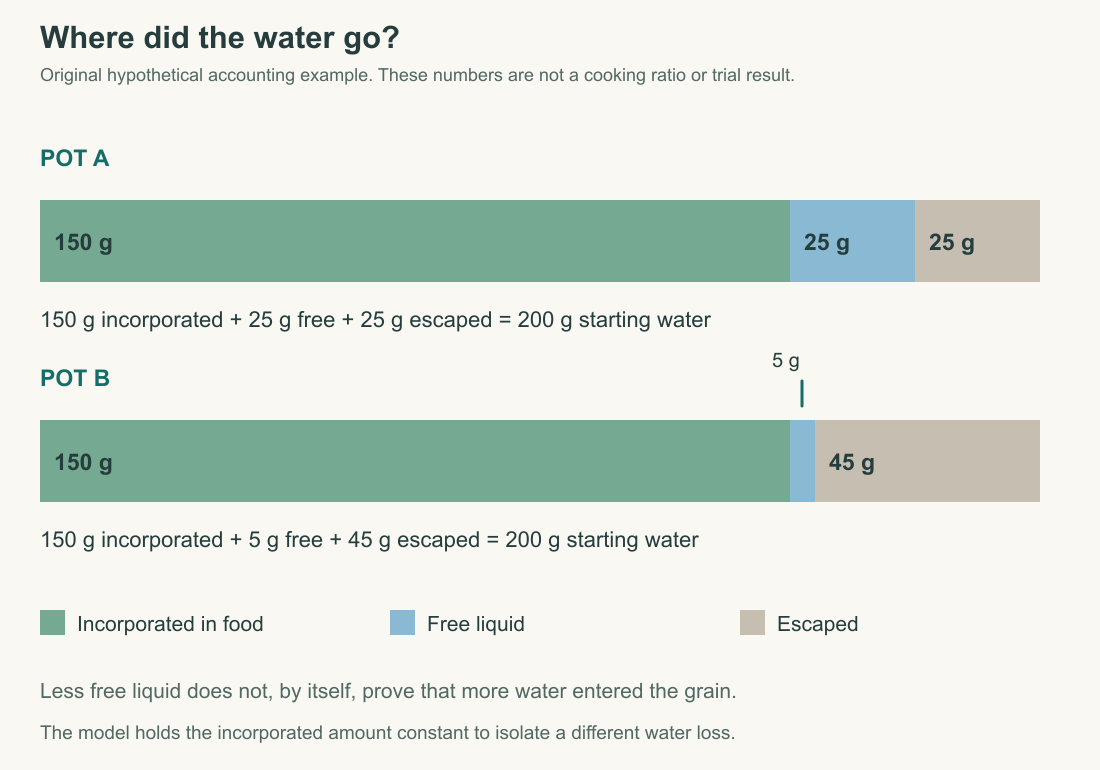
Imagine a simplified accounting model. The starting water, including any retained from a specified preparation, ends in three broad places: incorporated in the cooked food, remaining as free liquid, or lost from the vessel. This is a reasoning model, not a measurement from a trial. It explains why the same starting ratio can behave differently when you change the lid, heating pattern, or batch arrangement.
Consider two identical grain portions with the same measured water. One cooks under the method's fitted lid; the other spends much of its time uncovered. The second arrangement provides a different opportunity for water to leave. If it finishes dry and firm, the original ratio may not be the only issue. The changed cover is part of the method you need to investigate.
Now consider scaling. Water incorporated into twice as much dry grain will generally increase, but water escaping during cooking need not double in the same proportion. A larger pot, a different exposed surface, and a longer heating period can alter that part of the account. Use published batch instructions when available. Do not extrapolate a giant pot from a small one solely by multiplying a remembered ratio and keeping everything else unchanged.
The model also explains why topping up a dry pot and simply cooking a wet pot longer are distinct interventions. In the dry pot, continued heating cannot supply missing water. In the wet pot, adding more liquid may worsen an excess. Begin by identifying which situation you actually have. The word undercooked alone does not tell you.
Put invented numbers into the account to make it concrete. Suppose a model pot begins with 200 grams of water, of which 150 grams end up incorporated into the food, 25 remain free, and 25 escape. The account balances: 150 plus 25 plus 25 equals 200. If a second modeled arrangement loses 45 grams while the incorporated amount stays at 150, only 5 grams remain free. These quantities are illustrative arithmetic, not a recommended grain ratio or observations from cooking.
The example shows why the absence of a large puddle cannot, by itself, tell you how much water the grain absorbed. Water can leave by another route. It also shows what a useful investigation would need to measure if you wanted to separate absorption from evaporation. In an ordinary dinner, you usually do not need those measurements; you need to keep the vessel and method consistent enough that the published starting amount remains a useful guide.
Two concrete rice instructions
Lundberg's published Organic Long Grain White Rice instructions specify, for the one-cup dry-rice amount, 1¾ cups liquid. The stovetop sequence includes bringing the mixture to a boil, a covered low simmer for fifteen minutes, and ten minutes covered off the heat. Consult the full product directions for the listed fat, quantities, and appliance options. These numbers belong to that product and method.
For its Organic Short Grain Brown Rice, the one-cup chart entry gives two cups liquid, and the stovetop directions use a forty-five-minute covered simmer followed by a ten-minute covered rest. Use the current package instructions for the amount you make; the web chart lists different proportions for different batch entries. Do not silently convert one entry into an asserted universal brown-rice ratio.
The comparison contains more than a difference in water. The simmering period changes substantially. If you replace the white product with the brown product but keep the entire white-rice schedule, an unsatisfactory result would not demonstrate that brown rice is inherently impossible to cook. You changed the ingredient while retaining an incompatible set of instructions.
Nor should you infer that this comparison isolates the effect of bran. The products differ in grain category as well as processing. Their instructions are practical product examples, not a controlled experiment on milling. The broader lesson is to preserve the complete ingredient-method pairing when establishing a reliable baseline.
Resting is inside the schedule
The covered off-heat interval in these examples belongs to the method. It is not spare time available to delete because the vegetables are ready. At the moment heat is removed, the pot and grain remain hot and water continues to redistribute within the cooking system. Respecting the specified rest gives you the endpoint against which the recipe should be judged.
This also changes meal planning. Fifteen minutes of simmering does not mean dinner rice is available fifteen minutes after you walk into the kitchen. You must measure, bring the pot to the specified starting condition, complete the simmer, and complete the rest. C1's distinction between active work and elapsed time becomes particularly valuable here.
During the rest you may have attention for another short task, but the rice pot is still occupied. If a meal plan assumes that the same vessel becomes immediately available for beans, it has hidden an equipment conflict. A written timeline should name both the end of burner use and the end of pot use. Those are different moments.
A rice cooker can make this process easier to repeat, provided you use the appropriate product and appliance directions. Its measuring cup, water markings, modes, and minimum amounts may differ from a stovetop recipe. The machine changes the work you perform; it does not make the grain's identity irrelevant. Treat a new appliance as a new method to learn rather than as permission to disregard its instructions.
Diagnose the pot you have
Here are three hypothetical outcomes. Pot A contains firm-centered rice with no free water. Pot B contains firm-centered rice with ample free liquid. Pot C contains very soft rice with surplus liquid. These are supplied descriptions, not results of an experiment. Before suggesting a correction, say which condition you are addressing.
For A, consider whether the method lost too much water, began with too little, or stopped before the grain could finish. Follow the product's troubleshooting directions for a measured addition and further cooking where appropriate. If there is scorching, avoid stirring a burned layer through the whole pot. Missing water and burned flavor are separate problems, and adding liquid does not erase damage already done.
For B, more water is not the obvious need. Check whether the required cooking time and heating condition were actually achieved, and whether the product matches the instructions. For C, additional cooking to force all the liquid into already very soft grains may sacrifice the texture further. A preparation allowing drainage or a different intended use may be more sensible, but no rescue should be represented as guaranteed.
Record what changed for the next attempt. If you alter water, heat, lid, and grain brand together, the next success gives little evidence about which correction mattered. Keep a reliable baseline and change the variable most closely tied to the observed failure. A brief note naming the product, amount, vessel, and actual outcome can save more future effort than memorizing another isolated ratio.
Other grains deserve their own names
Food Hero's whole-grain cooking guide distinguishes hulled barley, rolled and steel-cut oats, quinoa, bulgur, and wheat berries. Its suggested methods and timings differ substantially. For example, its quinoa entry specifies rinsing if not pre-washed and a much shorter suggested cooking period than its hulled-barley entry. Use that guide or the exact product's instructions for a complete preparation, with tenderness checked against the intended dish.
The shopping label matters here too. Pearled barley and hulled barley should not be assumed to share a cooking schedule. An intact wheat berry and a processed bulgur product are different starting structures. An ingredient can occupy the grain component of a meal without being interchangeable in the pot. Even quinoa's familiar culinary grouping with grains is a cooking convenience, not a claim that it is rice.
Choose the staple for its contribution as well as its timetable. A chewy grain may provide the resistance that a soft bean dish lacks. A softer rice may carry a sauce comfortably. A grain salad may need pieces that remain distinct when mixed. These are practical relationships between texture and meal design, not a ranking of ingredients by virtue or sophistication.
If a new grain fails to suit the first dish you try, separate two questions: was it prepared successfully, and was it a good choice for this meal? Well-cooked chewy barley can still be the wrong texture for a dish you imagined as delicate and soft. That is a menu decision to revise, not necessarily a cooking failure.
Plan the leftovers before the pot
Cooked rice requires prompt, appropriate storage; leaving it at room temperature for a later meal is not a drying technique. For this course's exercises, use the Food Standards Agency's conservative rice routine: cool quickly, ideally within an hour, refrigerate promptly, and use refrigerated rice within twenty-four hours. Reheat only once, until steaming hot throughout. Follow the complete FSA student food-safety guidance. These are attributed UK consumer recommendations, not a claim that every jurisdiction publishes identical limits.
For the three-dinner capstone, the simplest approach is to share dry rice across meals and cook the needed portion each time. Reusing an ingredient does not require storing one enormous cooked batch. If you choose batch cooking, a suitable cooling, storage, and reheating plan becomes part of the task rather than something to improvise after dinner.
You now have a method for reading any staple's directions with purpose. Identify the starting material, preserve the preparation and heating sequence, account for the water, include the rest, and judge the result against the intended meal. A reliable grain pot is less a secret ratio than a relationship you can explain and repeat.
Application
Choose one of the two named rice products or use the complete instructions on your own package. No particular brand is required. Write down the exact product, dry amount, water, vessel, starting point for timing, simmer, and rest before cooking. Follow those instructions and the storage routine above. If cooking is unavailable, analyze Pots A–C.
After cooking, record the center's resistance, free liquid, and distribution of texture through the pot. Name one justified adjustment for a subsequent attempt. Do not change multiple variables merely to make the notebook look experimental.
Then select a second grain from a published guide and explain which instructions would have to change. Compare the contribution it would make to a plate of tender vegetables and beans.
Model interpretation: Dry, firm Pot A and wet, firm Pot B need different investigations. A suggests a water-supply or water-loss problem among other possibilities; B already has liquid and calls attention to ingredient identity, time, and heating. Very soft Pot C cannot be made into separate firm grains simply by adding more cooking time. Product-specific directions, complete timing, and the intended texture are the baseline for all three explanations.