A formula you can scale
You make the same cake twice. The ingredients are identical, the oven setting is unchanged and the mixing feels familiar. Yet the second cake is thinner and finishes sooner. The difference is the pan: its diameter increased from eight inches to nine. That extra inch increased the base area by more than a quarter. Baking begins with ingredients, but the formula also enters a physical space, and that space helps determine what happens next.
This course builds on Kitchen Foundations, with Heat, Flavor, and Texture useful for the heating principles. We will learn enough baking mathematics to preserve a formula, enough ingredient science to understand its structure and enough observation to diagnose a result. The destination is a small, repeatable repertoire, not memorizing a list of supposedly infallible baking rules.
A recipe is more than its ingredient list
A complete recipe specifies amounts, ingredient forms, a sequence, equipment, temperatures and cues for readiness. “Butter” is incomplete information if the method relies on it being cold, softened or melted. “One loaf” is incomplete information if the intended pan determines the dough's depth and support. Before scaling anything, identify the conditions the original method expects.
The formula describes the relative quantities. The process describes what we do with them. The two belong together, but they do not scale in the same way. Doubling an ingredient amount is arithmetic. Doubling the mixing time or baking time is a new process assumption, and often a poor one. Two unchanged loaves do not automatically require twice the time of one loaf.
Start by reading through the whole method and recording its yield. Does it make two large biscuits or twelve small ones? Does the stated total time include cooling? Does the pan size refer to a round, square or loaf pan? These questions prevent an avoidable error: making the correct amount of mixture for an arrangement different from the one you actually plan to use.
A first attempt is easier to interpret when it follows an established formula closely. Later, a controlled adjustment can test a hypothesis. Changing the flour, sweetener, pan and oven setting together may produce something delicious, but it will make the cause of any difference difficult to identify. Your notebook should preserve a baseline against which the next attempt can be compared.
Mass gives the comparison a stable reference
A cup measures volume; grams measure mass. Flour can occupy different volumes depending on how it is filled, settled or compressed. Weighing the amount specified by the recipe removes much of that packing ambiguity. It does not make every flour interchangeable or every scale perfect, but it gives the comparison a clearer starting point.
King Arthur's ingredient chart uses 120 grams for a cup of its all-purpose flour. That is the publisher's convention, not a universal law that every author's cup must weigh 120 grams. When a recipe provides both mass and volume, follow its stated mass rather than converting it through a different chart. If it supplies volume only, identify the intended measuring method and keep it consistent. Ingredient weight chart.
Use the scale on a stable surface, check its unit and tare the empty container. Taring subtracts the container from the displayed amount. If you add several ingredients to one bowl, a fresh tare before each addition lets you weigh each separately, but it also makes an overshoot harder to undo once ingredients are mixed. Small or consequential additions are often easier to measure in a separate container.
Precision should match the tool. A scale displaying whole grams cannot reliably distinguish every fraction of a gram. That matters more for a tiny amount of leavener than for a large amount of flour. Use the recipe's specified small-volume measure when your scale is unsuitable, or an appropriate finer scale. Writing extra decimal places does not create measurement capability.
Baker's percentages use flour as the denominator
In baker's percentages, total flour mass is defined as one hundred percent, and each other ingredient is expressed relative to it. The percentages therefore normally add to more than one hundred. They are not each ingredient's share of the complete dough. This convention makes it easier to compare formulas and calculate a different batch size. Martin Philip's explanation of baker's math.
Consider this original arithmetic model. It is a formula for learning the calculations, not a complete tested bread recipe to bake from this page alone. The flour is 400 grams, water 260 grams, salt 8 grams and dry yeast 4 grams. Total mixture mass, before handling losses, is 672 grams.
| Ingredient | Mass | Baker's percentage |
|---|---|---|
| Flour | 400 g | 100% |
| Water | 260 g | 65% |
| Salt | 8 g | 2% |
| Dry yeast | 4 g | 1% |
| Total | 672 g | 168% |
For water, divide 260 by 400 and multiply by one hundred: sixty-five percent. For salt, 8 divided by 400 gives two percent. The total of 168 percent means that each gram of flour corresponds to 1.68 grams of complete mixture under this model. Flour itself is about 59.5 percent of the total mixture, a different percentage with a different denominator.
If a formula uses several flours, combine them for the total-flour denominator. Suppose the 400 grams consist of 300 grams of all-purpose flour and 100 grams of whole-wheat flour. The flour blend is seventy-five percent and twenty-five percent respectively, while the water remains sixty-five percent of total flour. Changing the blend may change behavior; the arithmetic only tells us what changed in the quantities.
Hydration is useful, but define what you counted
For the flour-and-water model, hydration is water mass divided by flour mass. Sixty-five-percent hydration is therefore straightforward. An enriched formula containing milk, eggs or butter is less simple because these ingredients contribute water alongside other substances. Calling the full mass of milk “water” would conceal its solids; calling butter pure fat would conceal its other components.
For everyday recipe comparison, state whether you are reporting the mass of added water, the mass of a named liquid ingredient or an estimate of total water from all ingredients. These are different calculations. You do not need a laboratory analysis before baking, but you should avoid comparing two numbers as though they were defined identically when they are not.
Hydration also does not predict dough consistency by itself. The flour and other ingredients matter, as does the process. Two mixtures with the same water-to-flour ratio can handle differently. The next chapter will explain why. For now, use the number as a precise description of a relationship, not a promise that every sixty-five-percent dough will feel the same.
Scale every ingredient by the same factor
Suppose the arithmetic model's 672 grams would be divided into six equal raw portions. Each would weigh 112 grams. To make nine portions of the same raw size, multiply the batch by nine divided by six, or 1.5. The new amounts are 600 grams flour, 390 grams water, 12 grams salt and 6 grams yeast, totaling 1,008 grams.
The baker's percentages remain unchanged. Water is still sixty-five percent of flour, salt two percent and yeast one percent. If you multiplied the flour by 1.5 but left the salt unchanged, salt would fall to about 1.33 percent of flour. That would be a formula change, whether or not you intended one.
Another route starts with a desired total mixture mass. Suppose you need 1,260 grams under the same model. Divide 1,260 by 1.68 to obtain 750 grams of flour. The other amounts follow: water 487.5 grams, salt 15 grams and yeast 7.5 grams. Together they total 1,260. This method works because the total percentage connects the flour reference to the full batch.
The fractional quantities expose a practical issue. The calculation may be exact while your measuring tool requires rounding. Record any rounding and consider its relative size. Rounding 487.5 grams of water to 488 changes little in this model; rounding 7.5 grams of yeast to an arbitrary spoonful could change much more. The significance of an error depends on the amount and ingredient involved.
A published small-batch formula makes the exercise concrete
Our later biscuit chapter uses King Arthur's Small-Batch Biscuits, a published cream-biscuit formula yielding two large biscuits. Its main quantities include 120 grams flour, 13 grams sugar, 152 grams heavy cream, one and a quarter teaspoons baking powder and half a teaspoon table salt, plus cream for brushing. Keep the full linked method with the formula; the ingredient list alone omits consequential shaping, chilling and baking instructions. Published recipe.
For four biscuits of the same size, the arithmetic factor is two: 240 grams flour, 26 grams sugar, 304 grams cream, two and a half teaspoons baking powder and one teaspoon table salt. Brushing cream is applied as needed to the surfaces rather than represented by a falsely precise original amount. The calculation preserves the listed ingredient relationships.
That does not justify making one biscuit twice as thick and using the same baking time. Four pieces of the original dimensions are a different physical arrangement from two enlarged pieces. Baking them also requires suitable space and an oven arrangement consistent with the method. The numbers solve the batch-quantity problem; they do not solve every consequence of changing size.
Pan area changes depth
For an ideal round pan with straight sides, base area is pi multiplied by radius squared. An eight-inch diameter gives a radius of four and an area of about 50.3 square inches. A nine-inch diameter gives a radius of 4.5 and an area of about 63.6 square inches. The ratio is 81 divided by 64, or about 1.266.
If the same volume of batter is spread evenly in both ideal pans, its depth in the larger pan is 64 divided by 81 of its former depth: about seventy-nine percent. The larger diameter is only twelve and a half percent greater, but the base area is about twenty-six and a half percent greater. This is why scaling by the ratio of diameters alone gives the wrong quantity for preserving depth.
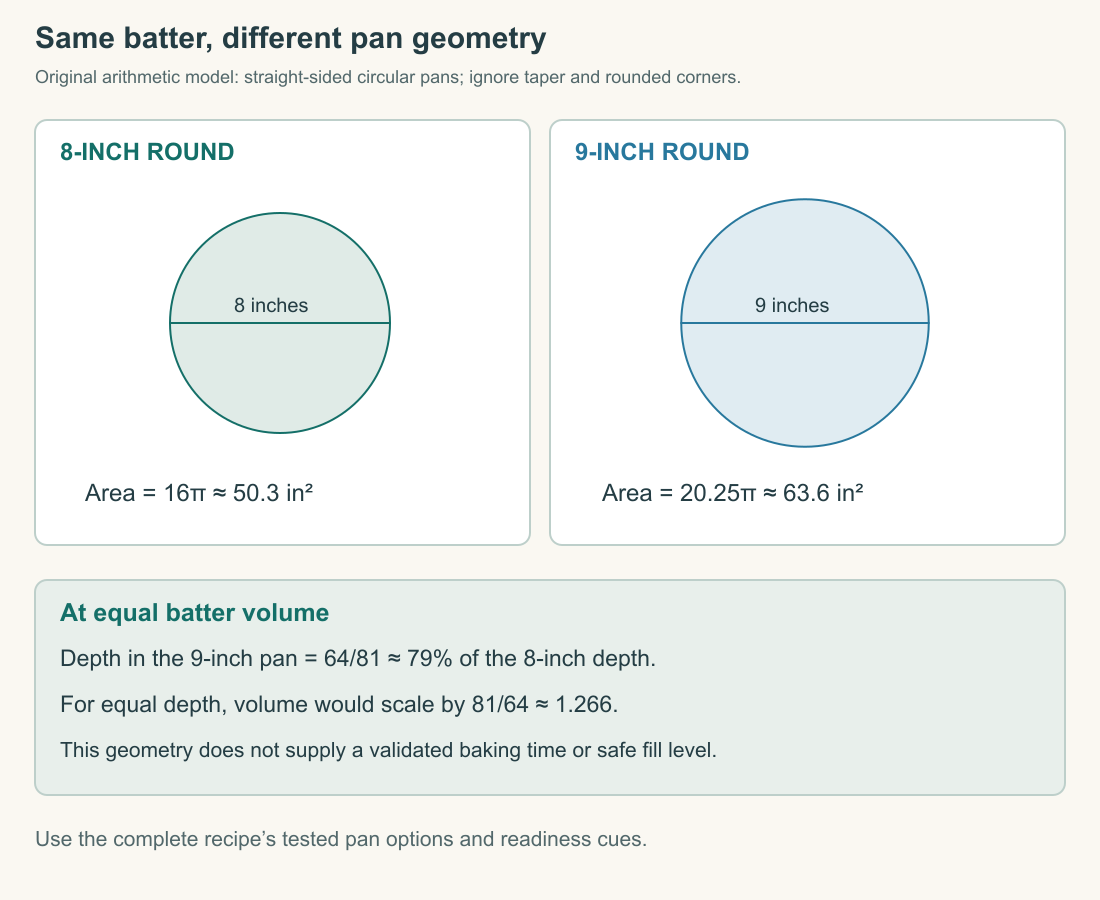
Actual pans may taper, have rounded corners or list dimensions that differ from the useful interior. Their materials and surface finishes can affect heating too. An area calculation is a planning tool, not permission to ignore the recipe's pan instructions. If you need a substitution, prefer a version the recipe developer has checked rather than assuming equal volume guarantees equal baking behavior.
The same issue appears in loaf pans. King Arthur's comparison shows that using a different loaf-pan size changes the shape produced by the same dough amount. A low loaf is therefore not automatically evidence of dead yeast or failed kneading. Before changing the formula, check whether the container matches the intended one. Bread-pan comparison.
Yield changes between mixing and serving
Raw mixture mass is not finished-product mass. Some mixture can remain on utensils, and baking changes mass through losses including water vapor. A formula totaling 672 grams does not promise a 672-gram cooled loaf. If a fictional batch finishes at 600 grams, the difference is 72 grams, about 10.7 percent of its initial mass. This is an invented calculation, not a target baking loss.
A notebook can distinguish mixed mass, divided portion mass and cooled mass. Those observations answer different questions. Unequal raw portions can explain unequal sizes; an unusual cooled mass may prompt questions about baking and moisture, but it does not identify the cause alone. Do not chase a target loss percentage without considering the product and its complete readiness cues.
Record serving yield separately as well. Cutting a loaf into twelve slices rather than ten changes the portion size without changing what was baked. If you compare two recipes' ingredient amounts per serving, first check how each defines a serving. Otherwise, a change in cutting can masquerade as a change in the formula.
Make the first record useful to your future self
Before mixing, write the recipe version, intended yield, ingredient masses, pan dimensions and any deliberate change. During the process, note actual temperatures or times only when you have measured them, and describe the relevant appearance or feel. After cooling, record dimensions, texture and what you would change next. A photograph is most useful when you preserve scale, lighting and the cut surface being compared.
Keep the distinction between observation and explanation. “The loaf is shorter than the reference” is an observation. “The pan was wider” is another observation. “The wider pan explains the height difference” is a hypothesis supported by geometry, but other process differences could still matter. This discipline will become more valuable when the possible causes involve fermentation, mixing and structure.
Finally, do not taste raw dough or batter while making these comparisons. Flour is ordinarily a raw ingredient, and removing eggs does not make an uncooked mixture safe to sample. Follow the complete recipe's cooking directions and the handling practices from Kitchen Foundations. FDA flour guidance. Your first useful baking skill is not guessing what went wrong afterward; it is preserving enough information that the result can teach you something.
Application
Scale the original arithmetic model to 504 grams of total mixture, showing each ingredient and percentage. Then verify the four-biscuit quantities from the published two-biscuit formula. Calculate the ideal area ratio between an eight-inch square pan and a nine-inch round pan, and explain why similar base areas do not establish identical baking times. These are planning exercises; use a complete published method for any actual bake.
Check your understanding: Does sixty-five-percent hydration mean that sixty-five percent of the complete dough is water, and should doubling the number of unchanged-size pieces automatically double their baking time?
Expected answer: No. In the simple model, hydration uses flour mass as the denominator; water is 260/672, about 38.7 percent of total mixture mass. Scaling to 504 grams gives flour 300 grams, water 195 grams, salt 6 grams and yeast 3 grams. Baking time depends on geometry, heating and readiness, not only the number of pieces. An eight-inch square has 64 square inches of base area, close to the nine-inch round's 63.6, but shape, depth, material and oven conditions still matter.