Read the ingredient
There is half a cabbage in the refrigerator, a bag of carrots, and a head of broccoli. You want dinner, and the recipe search produces three kinds of advice: chop everything, heat something, and cook until done. Those instructions conceal the decisions that matter. How finely should you chop? Should the broccoli stalk join its florets? Does a carrot need the same treatment as a cabbage leaf? Before choosing a recipe, you can already make progress by looking closely at the food.
The first question is what you want to eat. A carrot that snaps between your teeth might belong in a slaw. A tender carrot with browned edges might belong beside beans. A carrot soft enough to crush with a spoon might belong in a thick soup. These are different destinations, not three grades on a single scale of correct cooking. Once the destination is clear, an ingredient's structure starts suggesting the route.
This course develops that judgment for vegetables, grains, and pulses. It builds on the organization in Kitchen Foundations and the heat-and-moisture explanations in Heat, Flavor, and Texture. Here the attention shifts to the ingredients themselves: what their parts permit, what their preparation changes, and what contribution they can make to a meal.
Begin with a bite
Imagine serving the cabbage, carrot, and broccoli over rice with a spoonful of sauce. Ask what happens in one mouthful. A huge cabbage wedge may be pleasant on a plate where a knife is available, but awkward in a bowl intended for a spoon. Small broccoli florets can mix with rice; an entire branching crown cannot. A thin carrot ribbon and a thick carrot chunk distribute sweetness and resistance differently. The eating utensil, the neighboring food, and the desired bite all help determine preparation.
This is more precise than declaring a vegetable versatile. Versatility becomes useful when you can name the change. A long strip might provide a chewy strand; a small dice might distribute an ingredient throughout a mixture; a large piece might remain a distinct object. Smaller is not automatically better. Reducing everything to tiny fragments can erase the contrast you wanted, increase preparation work, and expose delicate pieces to excessive cooking while another component catches up.
Set a concrete endpoint before you start: tender enough to cut with the side of a fork, still firm enough to lift without falling apart, or finely cut enough to eat comfortably raw. These descriptions concern texture. They do not establish food safety. A pleasant crunch is an eating preference, not proof that an ingredient has been handled correctly.
A grocery name can contain several structures
Plant anatomy offers useful clues, provided you do not mistake a category for a complete cooking instruction. A potato tuber is a modified stem; an onion bulb combines a short stem with fleshy modified leaves. The edible broccoli shoot includes stem tissue, flower buds, and small leaves. Oregon State University's account of vegetative plant parts explains these distinctions. They immediately complicate the idea that every item in the vegetable drawer is one uniform material.
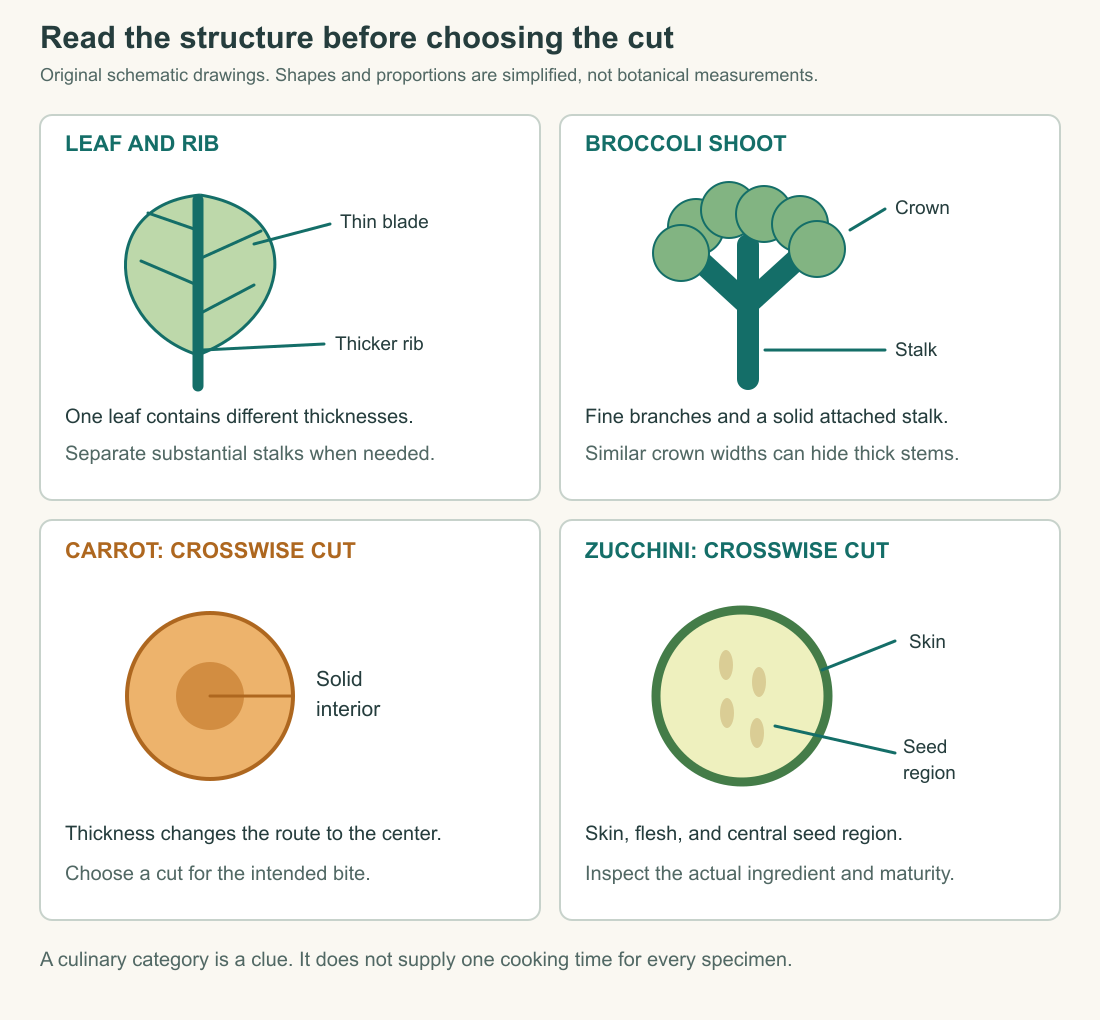
Look at a broccoli floret. The branching top divides into fine structures, but its attached stalk may be thick. If two pieces have crowns of similar width and stalks of very different thickness, their outlines conceal a consequential difference. You can divide a thick stalk lengthwise, separate it for another preparation, or choose a method that gives it time to become tender. Calling both pieces medium florets does not settle the problem.
A cabbage leaf also contains contrasts. Its broad, thin blade surrounds thicker veins and a substantial central rib. When shredded across these structures, it becomes a collection of narrow pieces. Left as a wedge attached to the core, it remains a layered object. Neither form is inherently correct. The wedge can hold together for turning; the shreds can mix throughout a pan. The useful observation is how the chosen cut reorganizes the same material.
Leafy greens offer another example. A chard leaf and its stalk arrive as one purchase but need not enter a pan at the same moment. Maryland Extension's leafy-green guidance distinguishes delicate leaves from thicker leaves and stems. For familiar culinary greens, separating a substantial stalk allows you to address its resistance without making the leaf wait through the whole process. This is not permission to apply one preparation to every edible plant leaf; unfamiliar ingredients can require specific treatment.
Thickness is a decision you can change
Consider an imaginary carrot piece shaped as a cube two centimeters across. Its center lies one centimeter from the nearest face. Split it into slabs one centimeter thick, and the middle of each slab lies half a centimeter from a broad face. You have changed the distance between the surface and the interior without changing the carrot variety or the stove. This simple geometry explains why cutting is part of cooking rather than an ornamental preliminary.
It does not establish an exact time conversion. A half-thickness piece does not necessarily finish in half the time. Shape, contact with the pan, temperature, water, and the texture you call finished also matter. The defensible prediction is directional: a thinner piece generally gives heat a shorter route into its interior. Test the prediction against the actual piece instead of turning it into an invented stopwatch rule.
Now compare a narrow carrot baton with a broad but thin cabbage strip. Their longest dimensions might match, while the distance through their thickness does not. Equal length is a poor substitute for thinking about the path into the food. Even equal thickness cannot guarantee identical behavior across different tissues. Consistent cutting is valuable within a group; compatibility across ingredients requires observation and sometimes a different cut or sequence.
You also change the balance of surface and interior. Many small pieces expose more cut surface than one large piece made from the same amount of food. That affects the opportunities for contact, coating, and surface drying. A finely grated carrot can distribute through cabbage and receive a little dressing in many places. A thick chunk concentrates its interior into fewer bites. Preparation therefore influences both cooking and the way seasoning reaches the eater.
Read a published preparation closely
Food Hero's Sautéed Cabbage pairs shredded cabbage with grated carrots in a large skillet. The published recipe specifies its amounts, fat, seasoning, and procedure, with a tender-but-crisp endpoint. Follow that source for the cooking exercise. Food Hero describes testing and revising its recipes; the example here is a reading of that published preparation, not a report of a kitchen trial performed for this course.
The two preparation words deserve attention. Shredded and grated are doing work that the instruction to add vegetables cannot do on its own. In this pairing, the carrot does not remain a large solid object waiting for its center while thin cabbage strips soften around it. The recipe arranges compatibility before the ingredients reach the pan. If you substitute thick carrot coins, you have changed an important condition even though the ingredient list still says carrots.
Suppose a cook follows the listed quantities but makes that substitution. The cabbage reaches the desired texture while the carrot remains more resistant than the cook wants. Three explanations are possible: the carrot pieces were too thick for the intended shared process, the cook preferred a softer carrot than the recipe's endpoint, or some aspect of the actual heating differed. The observation does not establish that cabbage and carrots cannot cook together. It directs attention to preparation, endpoint, and process.
For a next attempt, the cleanest first correction is to use the published cut. Giving the carrot a separate head start is another possible design, but it would be a changed procedure requiring its own observation. Changing the cut, heat, pan, and order simultaneously might produce dinner, yet it would make the original failure harder to explain. Separate the urgent task of feeding yourself from the later task of learning which change mattered.
Similar resistance does not mean identical ingredients
Cooks often describe one vegetable as dense and another as delicate. Treat these as practical shorthand, not measurements of physical density. A piece may resist a knife because of its thickness, its fibers, or the arrangement of its tissues. Another may contain abundant water and still have a firm skin. The word dense becomes useful only when you translate it into something you can inspect: a thick solid center, a tough outer layer, tightly packed leaves, or a particularly resistant rib.
A zucchini illustrates a different arrangement from a carrot. Cut across it and you can see outer skin, pale flesh, and a central region containing seeds. A mature specimen may present a different balance of these parts from a small one. Do not assume that every disk from every zucchini will act alike because the name is unchanged. Inspect the piece you have, decide whether the center suits the dish, and use a preparation intended for that ingredient and stage.
Likewise, a broccoli stalk need not be discarded simply because florets are more familiar. Examine its cut face and outer layer. A tough exterior may need trimming for the proposed dish; a usable interior can be cut separately. The opposite mistake is insisting that every scrap must appear in dinner. Reducing waste does not require preserving woody material at the expense of the meal, nor does it override rejecting spoiled food. Your task is to distinguish usable structure from material that does not serve the preparation.
These judgments improve through specific notes. Instead of writing broccoli was bad, record that the crowns were tender but the attached stalks remained difficult to cut. Instead of writing carrots took forever, record the approximate thickness, method, and endpoint. Such notes give your next decision somewhere to begin. A verdict about an ingredient gives you much less.
Preparation includes handling
Before cutting, use the established handling sequence from Kitchen Foundations. FDA guidance calls for washing ordinary fresh produce under running water, including produce you will peel, and advises against soap or detergent. Products labeled ready-to-eat or pre-washed can be used without another wash. Keep raw-eaten produce separate from raw animal foods and contaminated utensils, discard rotten produce, and use clean equipment. Washing reduces contamination; it does not sterilize the ingredient. See FDA's produce guidance.
This sequence also helps you observe accurately. Inspecting a washed carrot on a clear board is different from reaching into a crowded sink and guessing what can be cut away. Put the intended pieces in one place and trimmings in another. You can then see how much usable food remains and whether the cuts are reasonably consistent. The point is a workable view of the ingredient, not a photograph-ready arrangement of bowls.
Buying prepared vegetables can remove some of this work, but it does not remove the need to read their condition and instructions. A bag labeled broccoli florets may contain several sizes. A container of shredded cabbage may have thicker rib pieces mixed with thin leaves. Prepared food is a useful option when it suits your time and abilities. Judge the actual product and intended dish, rather than treating labor saved as a loss of culinary seriousness.
Turn an observation into a method choice
Return to the three vegetables and construct two possible dinners on paper. For a bowl with distinct tender pieces, you might choose a published roasting method for appropriately cut carrots and broccoli, keeping their differences visible. Cabbage could supply a separate finely cut element. For a softer skillet mixture, the published cabbage-and-carrot preparation gives you a different starting point, while broccoli can be prepared separately in a method suited to its stalks and crowns.
These are designs, not complete recipes. They deliberately leave quantities and exact cooking procedures to the published preparations examined in subsequent chapters. What they establish is a relationship between the desired bite, the structure you observed, and the method you will investigate. You have narrowed the search from something with vegetables to a preparation that can accomplish a named purpose.
A useful prediction has three parts: the observation, the action, and the expected result. For example: the broccoli stalk is much thicker than its branches; I will divide the stalk portion; I expect the interior to become tender with less waiting for the crown. The expectation might need correction in practice. Its value is that it can be checked. Cook better is a wish; this is a decision you can learn from.
There is room for variation within that decision. Pieces do not need laboratory precision to make a good dinner. Look for the few outliers likely to behave differently: the unusually thick stalk, the enormous carrot chunk, or the nearly transparent shaving. Correcting those is often more useful than spending another ten minutes making every piece look identical.
Application
Choose cabbage and carrots, or work entirely from the published Sautéed Cabbage recipe linked above. If cutting or cooking is impractical, use the supplied situation and write your predictions; that demonstrates understanding without claiming hands-on competence.
- Before preparation, describe the cabbage blade and rib and the solid carrot interior. Name the bite you want in the finished dish.
- Read the complete published recipe, including quantities, equipment, handling, and endpoint. Explain why its two specified cuts are compatible with a shared skillet.
- If cooking, follow that recipe without changing its cuts on the first attempt. Record what you actually observe at the endpoint: resistance, piece size, and distribution through a forkful. Follow its leftover handling instructions.
- Explain the supplied alternative: thick carrot coins remain harder than desired when the shredded cabbage is ready. Propose one change for the next attempt and say what observation would support your explanation.
Model interpretation: The supplied outcome is consistent with an incompatible carrot thickness for the chosen shared process. Using the specified grated carrot is a focused next test. It does not prove thickness was the only difference, and a preference for softer vegetables would require a separate endpoint decision. In an actual attempt, distinguish your observations from these predicted outcomes.